
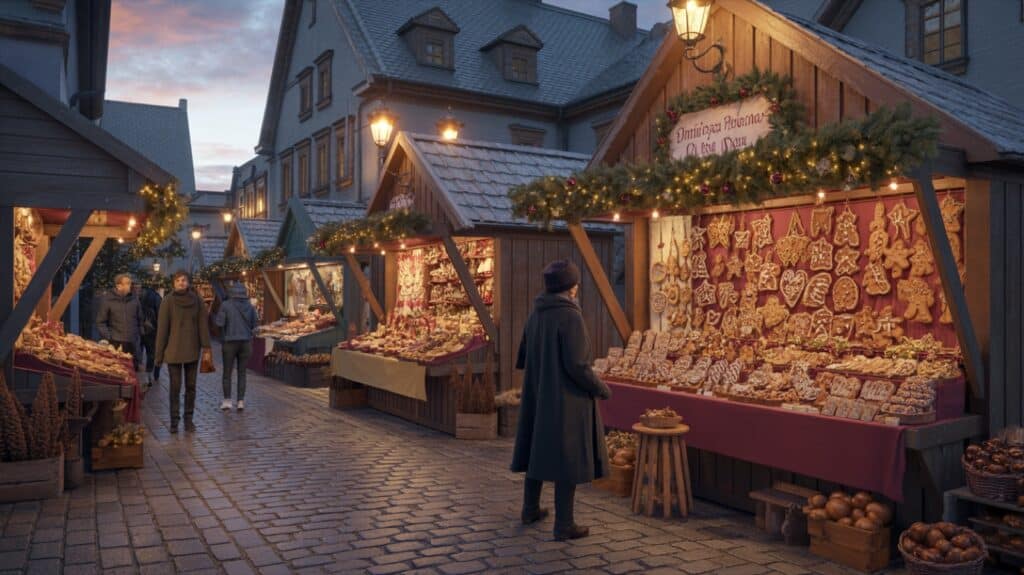
 Illustrative image
 Where Do Christmas Markets Come From? Six Centuries of Tradition
Behind the wooden chalets and the smell of mulled wine lies a long memory. The history of Christmas markets begins well before electric fairy lights, somewhere in the Germanic towns of the Middle Ages, when townsfolk came to stock up for the winter. Six centuries later, the tradition has spread across the whole of Europe and far beyond, without ever cutting the thread that ties it to its origins. Following that thread back is a way of understanding why Strasbourg, Colmar or Ribeauvillé remain the beating hearts of this festival today.
Medieval roots: winter markets before Christmas
At the outset, nothing magical about it. In the towns of the Holy Roman Empire, the late-autumn markets served a concrete need: building up stores before the great cold. Salted meat, spices, dried fruit, carved wood, everything needed to last until spring. These fairs were often held around 6 December, Saint Nicholas' Day, a hugely popular figure in northern Europe and the great giver of gifts to children.
The earliest mention of such a December market goes back to Vienna, in Austria, around 1298, when Duke Albert I authorised the townspeople to hold a winter market. Historians add a caveat, however: this was a general provisioning market, not yet a Christmas market in the modern sense. In Germany, Bautzen stands as the proven elder. In 1384, King Wenceslas granted the town the right to hold a meat fair before Christmas. Its Wenzelsmarkt descends directly from it, which makes it the oldest German Christmas market still in operation.
Dresden 1434: the first Christmas market in the modern sense
The real turning point comes in Saxony. In 1434, the city of Dresden opened its Striezelmarkt, regarded as the first market identifiable as a Christmas market. Its name comes from the Striezel, the ancestor of the famous christstollen, the brioche-like bread with candied fruit that people came to buy for the festivities. On the stalls: sweets, spices, carved wooden toys, items for the Christmas table. People came both to feed themselves and to find something to spoil their loved ones, a double purpose that still defines these markets.
In its early days this market opened for a single day only, before stretching across the whole run-up to Christmas. Dresden thus set the model that would spread throughout the Germanic world: a seasonal gathering, rooted in a town, where you prepare the festival as much as you stock up. The great merchant cities of the Empire followed, each building its reputation around a speciality and a craft. Nuremberg banked on its gingerbread and its figurines, Augsburg on its glass and metalwork. These local identities, forged over generations, explain why each historic market still has its own personality today.
The Protestant Reformation moves the Christ Child
The sixteenth century changed things on a point that seems trivial but explains the very name of these markets. Until then, it was Saint Nicholas who brought the gifts, on 6 December. Martin Luther, hostile to the cult of the saints, wanted to refocus the festival on Christ. He moved the giving of presents to Christmas Eve and told his children that it was the Christkind, the Christ Child, who brought them.
The tradition took root quickly in Lutheran families. In Nuremberg it was already common by the end of the sixteenth century, and the market took the name Christkindlesmarkt, the market of the Christ Child. The Saint Nicholas fairs then slid towards the days before Christmas and changed their names, becoming Christkindlmarkt or Weihnachtsmarkt. The figure of the Christkind, male at first, gradually took on the features of a female angel, inherited from the medieval mystery plays in which an angel announced the birth of Christ. In Nuremberg, a crowned young woman still embodies this Christkind at the opening of the market today. A telling detail: in the Catholic regions of the south, Saint Nicholas never disappeared, so the two traditions still coexist depending on the area.
Strasbourg 1570: the oldest Christmas market in France
Alsace, a German-speaking land won over by the Reformation, adopted this shift. In 1570, Strasbourg saw the birth of its Christkindelsmärik, the market of the Christ Child, on the cathedral square. It is the oldest Christmas market in France, and it was born of a precise religious turn: the Protestant preacher Johannes Flinner spoke out from the pulpit against the habit of giving gifts on Saint Nicholas' Day, which he judged too Catholic. The city then moved the tradition to Christmas and its Christ Child. This often forgotten detail shows how deeply the markets bear the mark of the religious debates of their time.
Since then, the Strasbourg Christmas market has hardly ever stopped, weathering wars and the changes of nationality of a region that has been French and German in turn. Around it, a whole Alsatian constellation has formed over the centuries: the Colmar Christmas market and its half-timbered quarters, the Ribeauvillé Christmas market with its medieval re-enactment, the Obernai Christmas market tucked inside its ramparts, or the Riquewihr Christmas market at the foot of its belfry. These towns have kept a direct link with the crafts and the treats of the early days, as if the medieval thread had never been broken.
Food and drink, the living memory of the origins
What strikes you, going back in time, is the permanence of what people eat. The spices, dried fruit and pastries that filled the stalls of Dresden or Nuremberg have not gone away; they have become the emblems of our markets. These goods came from far away and cost dearly, which kept them for the festive season. Eating spiced and sweet food in December was already a way of treating yourself. Several specialities tell this continuity well.
- Gingerbread descends in a straight line from medieval spiced pastries, when honey and spices from the East were luxury goods reserved for feast days.
- The pretzel, with its crossed arms, has its roots in monastic baking and remains inseparable from the Alsatian markets.
- Bredele, the little Alsatian Christmas biscuits families bake during Advent, carry on the tradition of home-made seasonal sweets.
Impossible to leave out the christstollen of Dresden, or the manala, the little brioche man children enjoy on Saint Nicholas' Day, a sweet reminder of the original festival before Luther moved the gifts. And of course mulled wine, spiced with cinnamon and orange, which has warmed the aisles for generations. If you want to make it at home, you will find ideas over at our mulled wine guide.
The Advent wreath and the symbolism of light
The markets are only one part of a wider set of rituals tied to Advent, the period of waiting that precedes Christmas. The Advent wreath is its most telling symbol. We owe it to a Protestant pastor, Johann Hinrich Wichern, who invented it in 1839 in an orphanage in Hamburg. His first version had twenty-four candles, four large ones for the Sundays and twenty small ones for the weekdays, to help the children count down to Christmas.
The wreath grew simpler over time, keeping its four candles lit one after another, one Sunday after another. The fir foliage only appeared around 1860. The whole symbolism turns on the light growing in the winter night: the endless circle evokes eternity, the green stands for life persisting despite the cold, the flame rising week by week announces the return of longer days. Each candle has been given a meaning, from the forgiveness granted to Adam and Eve to the peace announced by the prophets. This attention to brightness also explains why illuminations hold such a strong place at modern markets. When night falls early and the cold bites, light becomes the real show.
From decline to revival: the French markets of today
The last great chapter of the story plays out in France, at a surprisingly recent date. By the late 1980s, the Strasbourg market was running out of steam and struggling to draw the crowds. The spark came in 1992, when the city proclaimed itself the “Capital of Christmas” and launched a real promotional campaign, backed by Alsatian hoteliers. The success exceeded expectations and gave the rest of the country ideas. What had been a mere regional tradition became an exportable model.
The phenomenon took off in the following decade. From a handful of Alsatian markets, France went to several hundred all over the country. Lyon launched its own in 1997, followed by Lille, Toulouse, Marseille, Nantes. The big cities all wanted their own event, with chalets, entertainment and illuminations. The Christmas market became a product in its own right, with its specialist contractors and its specifications. Today you find that spirit as much at the Reims Christmas market, set against its cathedral, as at the Metz Christmas market, spread across several squares in the centre, or at the Nancy Christmas market, where Saint Nicholas keeps a place of honour inherited directly from the Lorraine origins.
| Date | Milestone |
|---|---|
| c. 1298 | December market in Vienna (winter provisioning) |
| 1384 | Wenzelsmarkt in Bautzen, the proven German elder |
| 1434 | Striezelmarkt in Dresden, first Christmas market in the modern sense |
| 16th century | Luther moves the gifts to Christmas, the Christkindlmarkt appears |
| 1570 | Christkindelsmärik in Strasbourg, the oldest in France |
| 1839 | Wichern invents the Advent wreath in Hamburg |
| 1992 | Strasbourg “Capital of Christmas”, nationwide revival |
What has changed, what has held firm
In almost six centuries, the form has shifted a great deal. Standardised chalets, LED illuminations and entertainment designed as tourist products have little in common with the medieval fair of Dresden. Some regret a growing sameness, as events companies supply turnkey markets from one city to the next, with the same décor and the same stalls. The criticism is not unfounded: a market put up by a contractor looks confusingly like the next one.
The substance, though, holds firm. People still come looking for the same things as in the fifteenth century: spiced treats, a little warmth before winter, the pleasure of preparing the festival together. The Alsatian markets, from Kaysersberg to Eguisheim by way of Turckheim, keep that scent of authenticity because they have never broken with their heritage: the same lanes, the same recipes, often the same families of craftspeople for generations. Understanding the history of Christmas markets gives fresh meaning to what you think you know by heart. Next time you walk up an aisle with a cup of mulled wine in your hand, you will know that the gesture links you to Saxon merchants of the Middle Ages and to a Strasbourg preacher of 1570.
Where to stay near the markets mentioned
Availability with our partners, town by town.
Reviewed and approved by the editorial team
A question, a mistake or a problem on this page? Write to us
Also worth reading
The Largest Christmas Market in France: Which One Really Wins?
Which is the largest Christmas market in France? Strasbourg, Colmar and Amiens compared by chalets and visitor numbers, with verified 2025 figures.
Read the article
Santons de Provence: the Story of a Little Clay People
The santons of Provence, those clay figures of the nativity scene: origin, making, characters and where to buy them in Marseille and Aubagne.
Read the article
The Advent calendar: from devotional pictures to giant façades
The Advent calendar, from the German devotional picture of 1908 to the giant façades of towns in Alsace and the Black Forest. Origins and traditions.
Read the article