
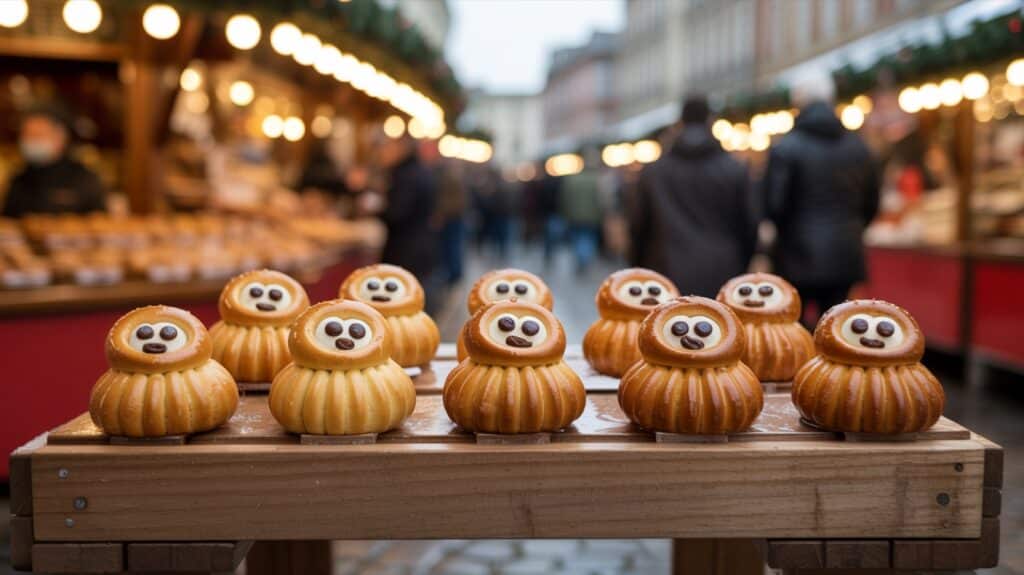
 Illustrative image
 Manala: the little brioche man of Saint Nicholas’ Day
The manala (a little brioche man) is the figure in enriched dough that Alsace brings out every year as December settles in. A plump body, two arms, two legs, a round head, and usually two eyes made of raisins or chocolate chips. You eat it at teatime, dunk it in a hot chocolate, share it at school or along the alleys of a Christmas market. Behind this simple treat lie the story of a saint, a legend of three children saved from a gruesome death, and a small parochial quarrel between the north and south of Alsace that has been running for generations.
A little man tied to Saint Nicholas, not Father Christmas
First thing to set straight: the manala is not strictly a Christmas treat. It belongs to Saint Nicholas’ Day, celebrated on 6 December. In Alsace as in Lorraine, Franche-Comté and part of Germany, this date remains a big family occasion, quite separate from 25 December. Saint Nicholas, bishop of Myra in the 4th century, plays the leading role: he is the one who rewards well-behaved children, long before Father Christmas took his place in the collective imagination.
The pastry represents the saint himself or, depending on the version, the three children he is said to have brought back to life. Since the 15th century, families in Alsace, Lorraine and Germany have shaped these little men to commemorate the miracle during Advent. They are slipped into school bags, handed out after mass, and sold on the stalls as soon as the lights go on.
The legend of the three children in the salting tub
The story is chilling for such a tender treat. Legend has it that three lost children ask a butcher for shelter. He kills them and hides them in his salting tub. Saint Nicholas, passing through, discovers the crime and brings the three little ones back to life with a single gesture. That is the medieval tale the manala acts out: each little man recalls a child restored to life. The human shape of the dough is no decorative accident; it carries the whole meaning of the feast.
This kind of figurative bread goes back further still, to old Saint Nicholas breads shaped like animals or characters, meant to ward off the harshness of winter. The manala belongs to this long line of solstice ritual breads, which over the centuries became the sweet treat we know today.
Manala or mannele: the friendly quarrel between Haut-Rhin and Bas-Rhin
You cannot talk about this little man without settling, or rather refusing to settle, the great Alsatian debate. The name changes depending on where you are. In the Haut-Rhin, around Mulhouse and Colmar, people say manala (also written mannala). In the Bas-Rhin, around Strasbourg and Haguenau, it is mannele (sometimes männele or manele).
The substance does not change one bit. Both words come from Alsatian and mean the same thing: “little man”. The root Männ- refers to a man, and the suffix -le or -ala marks the diminutive. They are linguistic twins, told apart only by dialect. In other words, nobody is right, everybody is right, and the debate is usually settled over a coffee with a laugh. In Germany the cousin is called Weckmann, in Switzerland Grittibänz, and in Lorraine people sometimes speak of Jean Bonhomme.
| Area | Usual name | Reference towns |
|---|---|---|
| Haut-Rhin (68) | Manala / mannala | Mulhouse, Colmar |
| Bas-Rhin (67) | Mannele / männele | Strasbourg, Haguenau |
| Germany | Weckmann | Rhineland, Bavaria |
| German-speaking Switzerland | Grittibänz | Basel, Bern |
A brioche dough, not a simple milk bread
You often read that the manala is “a sort of milk bread shaped like a little man”. It is a good starting image, but it deserves a nuance. The dough is a true brioche dough: rich in butter, enriched with egg, raised with baker’s yeast. Milk bread is plainer, with less butter and less sugar. The manala sits between the two, softer than a classic milk bread, but less rich than a properly opulent Parisian brioche.
This texture explains why it stands up so well to a hot chocolate. The crumb, supple and slightly stringy, soaks up the drink without falling apart straight away. The butter brings the melt, the egg the golden colour, the yeast that little taste of fresh crumb that fills the kitchen. Some add chocolate chips or raisins, others prefer it plain to let the dough speak for itself.
Shaping the little man
The gesture that gives the manala all its charm is the shaping. You take a piece of dough of around 80 grams, roll it into a sausage, then bring the little man to life. A small portion of dough forms the head; the rest becomes the body. Scissors or a knife cut the base to draw the legs, and the sides to mark the arms. Two raisins, two chocolate chips or two pine nuts pressed in at the top, and there are the eyes. Brushed on before baking, the egg wash gives it that glossy tan you would recognise anywhere.
Nothing demanding, really. It is a recipe people happily make with children, each shaping their own little man, more or less successful, always eaten with pride.
The classic manala recipe
A tried and tested recipe, for sixteen manala, in the Alsatian tradition. Allow around three hours including the proving times.
Ingredients
- 700 g wheat flour (T45 or T55, or plain white flour)
- 400 ml warm milk
- 80 g soft butter, diced
- 1 whole egg
- 20 g fresh baker’s yeast
- 30 to 50 g sugar
- 10 g salt
- Raisins, chocolate chips or 32 pine nuts for the eyes
- 1 egg yolk mixed with a little milk for the glaze
Method
- Dissolve the yeast in 4 tablespoons of warm milk with the sugar. Add the egg and whisk.
- Mix the flour and salt in a large bowl, then rub in the diced butter with your fingertips.
- Make a well, pour in the milk mixture and the rest of the warm milk. Knead until you have a supple dough that no longer sticks to your hands.
- Work the dough for 2 minutes on a floured surface, then cover the bowl with a cloth.
- Leave to prove for 1½ to 2 hours at room temperature, until the dough has doubled in size.
- Knock back, flatten slightly and cut the dough into 16 equal portions.
- Shape each little man: a small ball for the head, the rest for the body. Snip the legs and arms with scissors.
- Place the manala on baking trays lined with baking paper and press in the eyes (raisins, chips or pine nuts).
- Cover and leave to prove for another 30 minutes.
- Preheat the oven to 220 °C. Brush the little men with the egg yolk and milk, then bake at 200 °C for about 15 minutes, until nicely golden.
Out of the oven, let them cool a little. A manala is eaten the same day, while still soft. The next day, it gets a new lease of life dunked in a bowl of hot chocolate.
How to eat it
The most Alsatian way is still the simplest: a warm manala and a home-made hot chocolate. The brioche crumb soaks up the drink, the butter melts a little, and the whole thing keeps your hands warm on grey mornings. Some dunk it in coffee, others in vanilla milk for the youngest. Plain, it reveals the taste of butter and yeast; with chocolate chips, it slides towards dessert.
As for size, the little man comes in formats to suit the occasion. A small one of about fifteen centimetres for teatime, a large one of about fifty centimetres to share at breakfast. On the markets you will find both, often warm, out of the oven just before being set on the stall. To extend the festive table, the manala goes very well with bredele, the little Christmas biscuits you nibble all day long, and with a slice of gingerbread for a change of aromatic register.
Where to find a manala on the Christmas markets
As soon as Advent begins, manala take over the bakeries and the stalls. You cannot miss them on any Alsatian market worthy of the name. The best come out still warm, the crumb fragrant, the glaze shining.
In Strasbourg, the self-proclaimed capital of Christmas, the market stalls are full of them, a few steps from the illuminated shop windows. Strasbourg Christmas market remains the logical starting point for a first taste. Further south, Colmar Christmas market and its half-timbered lanes offer the same pleasure, with the Haut-Rhin accent and the name “manala” proudly displayed on the signs. Mulhouse Christmas market, with its printed fabrics and its deep-rooted brioche tradition, proudly claims its Haut-Rhin manala, and in Haguenau, Haguenau Christmas market offers a more intimate version, far from the Strasbourg crowds.
A tip for the greedy: buy it late morning or early afternoon, when the batch is fresh, and eat it on the spot while it is still warm. A cooled manala is still good, but it loses that touch of magic that makes all the difference on a winter stall.
The little man who sums up Alsace in December
The manala fits in one hand, but it carries a great deal. A medieval legend, a religious feast still very much alive, a regional language and its variants, a baker’s craft handed down from one generation to the next. That is probably why it touches people so much. Behind the brioche dough and the raisin eyes lies the whole of Alsace in December, the one of long evenings, school bags that smell of butter and markets that sparkle. Manala or mannele, the debate can go on: what matters is biting the head off first.
Where to stay near the markets mentioned
Availability with our partners, town by town.
Reviewed and approved by the editorial team
A question, a mistake or a problem on this page? Write to us
Also worth reading
Santons de Provence: the Story of a Little Clay People
The santons of Provence, those clay figures of the nativity scene: origin, making, characters and where to buy them in Marseille and Aubagne.
Read the article
Alsace Christmas markets: the guide to planning your trip
Alsace Christmas markets: which ones to visit, when to go and how to combine Strasbourg, Colmar and the villages of the Route des Vins.
Read the article
Saint Nicholas and Père Fouettard: 6 December in eastern France
Saint Nicholas and Père Fouettard, the 6 December tradition in eastern France: the legend of the salting tub, parades from Nancy to Épinal, manala and the link with Father Christmas.
Read the article