
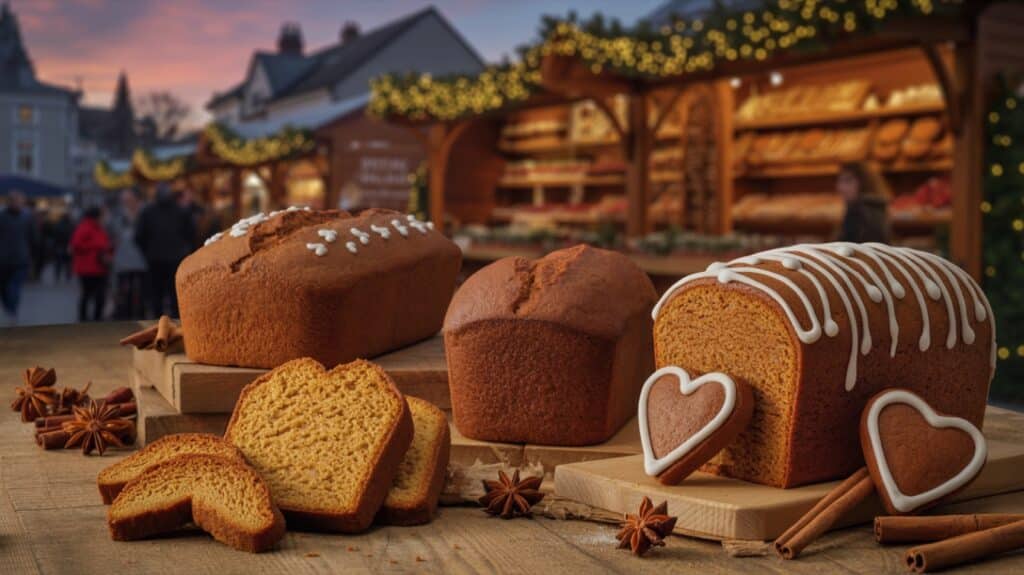
 Illustrative image
 Pain d’épices: the brown gold of the Christmas markets
Pain d’épices, the French spiced honey gingerbread, is one of those scents that announces Christmas before the first tree goes up. On the Christmas markets, its aroma of warm honey, cinnamon and cloves drifts between the chalets and draws the hungry towards the artisans’ stalls. Behind this treat lie a thousand years of history, three rival French traditions and a precise craft that the industrial version under cellophane sums up rather poorly. History, the differences between Reims, Dijon and Alsace, tips for spotting real artisan gingerbread on a stall, a honey recipe and how to store it: the complete tour of a speciality that deserves better than its reputation as a biscuit of last resort.
A history that begins far from the Alsatian chalets
Honey breads have existed since antiquity: the Egyptians and Greeks were already making them. But the direct ancestor of our gingerbread is said to be mi-kong, a Chinese “honey bread” recorded around the 10th century and valued for its energy. In the 13th century it appears among the provisions of Mongol horsemen, who spread it along with their conquests.
The recipe then reached the Arab world, and Europe with the returning crusaders. It settled in the monasteries, which had two assets for working it: beehives and mills. Germany took it up early, with Nuremberg as the stronghold of Lebkuchen from the 13th century. In France, two cities would build their reputation on this blend of flour, honey and spices: Reims first, then Dijon. Alsace developed its own school within the orbit of the Germanic tradition, with mentions in Cistercian monasteries from the first half of the 15th century and a guild of makers from 1476.
One detail shows how seriously the business was taken: in Reims, the makers obtained their own guild in 1571, recognised by letters patent from Henri IV in 1596. The trade of “pain d’épicier”, gingerbread maker, was a profession in its own right, distinct from that of baker.
The spices, the other half of the story
Honey gives the structure and the softness, but it is the spices that sign each house’s identity. The common base comes down to four names: cinnamon, cloves, ginger and aniseed. Around this quartet, every maker writes their own score, with nutmeg, pepper, star anise or orange peel depending on the recipe, often kept secret from one generation to the next.
This blend tells a story of geography. In the Middle Ages, cinnamon and cloves came from Asia along the spice routes, at a king’s ransom: offering them in a cake was a festive gesture, reserved for great occasions. That is one reason why gingerbread found its place in the calendar of winter celebrations, from the Saint Nicholas fairs to the Christmas stalls. The other reason is more down to earth: rich in honey and low in fat, it kept for months and travelled well, a precious quality in an age without refrigeration.
The dosage makes the difference between a good gingerbread and a great one. Overloaded, it turns acrid and masks the honey; too timid, it slips back into being an ordinary sweet cake. The artisans talk of balance: each spice should remain identifiable on the palate, cinnamon on the opening, cloves in the depths, ginger and aniseed on the finish. A useful benchmark when you try a sample on a stall.
Reims, Dijon, Alsace: the three schools of French gingerbread
Three cities, three recipes, three textures. Taste a gingerbread from Reims, one from Dijon and one from Alsace in a row and you quickly realise we are talking about three different products under the same name.
Reims, the rye pioneer
Renowned since the 15th century thanks to the quality of Champagne honeys, Reims gingerbread rests on rye flour, kneaded cold with the honey and spices. The dough then rests for several weeks before baking: this slow maturing develops the aromas and gives a dense, robust bread with a proper chew. The Reims tradition survives today thanks to a handful of houses, including the Fossier biscuit makers, who keep a pure-honey gingerbread going with 50% honey.
Dijon, the soft wheat version
In Dijon, the recipe arrived later and took off in the 19th century. The difference lies in the ingredients: wheat flour, egg yolks and aniseed replace the rye of Reims. The result is a lighter, paler, softer bread, which ended up eclipsing the reputation of its elder from Champagne. The industrial golden age peaked in 1956 with 4,500 tonnes produced in a single year. The house of Mulot & Petitjean, still in business, remains the ambassador of this school, with its famous nonnettes and glazed pavés.
Alsace, the perfumer
The Alsatian school embraces its Germanic influences: eggs, butter and sugar may go into the dough, and the bread comes in cut-out, glazed and decorated shapes, from the little man to the Saint Nicholas heart. Four spices structure the aromatic profile: cinnamon, cloves, ginger and aniseed. The village of Gertwiller, near Barr, is its capital: in 1900 it had nine makers for 800 inhabitants. Two houses keep the craft alive there, Lips and Fortwenger, each with its own museum. The Lips museum brings together more than 10,000 objects, antique moulds and tools of the trade.
| Tradition | Flour | Signature | Texture |
|---|---|---|---|
| Reims | Rye | Dough matured for several weeks, often pure honey | Dense, robust, rustic |
| Dijon | Wheat | Egg yolks, aniseed, glazes (nonnettes, pavés) | Soft, pale, melting |
| Alsace | Wheat or rye | Four spices, cut-out and decorated shapes | Varies, from crunchy to soft |
How to recognise good artisan gingerbread on a market
First reflex in front of a stall: the list of ingredients. Traditional gingerbread makes do with very little: flour (wheat or rye), honey, spices, a little water and bicarbonate of soda for the rise. No egg or butter in the original Reims version, and above all no glucose syrup at the top of the list.
Because the rules leave an enormous margin. The trade’s code of practice (Biscuits & Gâteaux de France) requires wheat or rye flour and spices, but allows “sweetening agents, alone or in combination”: a product sweetened with glucose syrup and a hint of honey can therefore legally call itself pain d’épices. That is the case for many entry-level supermarket versions.
The wording that changes everything: “pur miel”, pure honey. It is reserved for gingerbreads in which honey is the only sweetener. The best houses display it with the percentage: 50% honey at Fossier in Reims, 55 to 57% at some beekeeper-bakers. Since honey is the most expensive ingredient in the recipe, that figure explains the price gap between an artisan gingerbread and its industrial cousin.
On the stall, a few clues round out what the label tells you:
- The colour: a deep, uneven brown, the sign of dark honey and slow baking. A pale, uniform golden shade often betrays sugar and colouring.
- The slice: a tight, supple, slightly moist crumb. A bread that crumbles has dried out or is short on honey.
- The scent: the spices should be distinguishable from one another, not form a vaguely sweet cloud.
- The seller: an artisan can tell you where their honey comes from and which spices they use. Ask the question; the answer says a lot.
- The weight in the hand: for the same volume, a pure honey gingerbread is heavy. Lightness is rarely a good sign here.
Worth knowing too: no PGI protects gingerbread in France today, neither in Dijon nor in Reims. Only the trade’s code of practice governs the names, hence the point of reading labels closely.
Where to enjoy gingerbread on the Christmas markets
The four great gingerbread cities are also four great Christmas destinations, which is convenient.
Strasbourg remains the top address: the Christkindelsmärik lines up stalls of Alsatian gingerbread, from the big houses of Gertwiller to the small producers of the vineyards. Decorated shapes, glazed hearts and little men sit alongside plain slabs for slicing. Half an hour away, Colmar offers a more intimate atmosphere with its six markets spread across the old town, and Gertwiller itself can be visited on the same trip for its two gingerbread museums. If you are in Alsace in early December, keep an eye out for the Saint Nicholas stalls on the 6th: glazed gingerbread men and decorated hearts take centre stage there, alongside the brioche Mannele, a good week before the big rush of the markets.
In Reims, the Christmas market set up near the cathedral lets you reconnect with the city’s rye tradition, that of the old gingerbread makers. And in Dijon, between two chalets, the historic Mulot & Petitjean shop is worth the detour for its filled nonnettes and its pavés de santé.
A tip from the field: buy your gingerbread at the start of your stroll, before the evening crush, and save it for tasting at home. On site, pair a thin slice with a glass of mulled wine instead (for the home-made version, our overview of mulled wine variations tells you which one to pick and where to find the recipe): the pairing has worked for centuries.
The traditional honey gingerbread recipe
The version closest to the origins is the Reims one: no egg, no butter, no milk, with as much honey as flour. It needs little equipment and forgives a great deal. The quantities below follow the traditional recipe published by the Plateforme du miel.
Ingredients for one loaf tin
- 250 g rye flour (T130 for preference)
- 250 g honey, as fragrant as possible (chestnut, fir, forest)
- 17.5 cl water
- 1 teaspoon of bicarbonate of soda
- 10 g mixed spices: cinnamon, ginger, cloves, nutmeg, aniseed
Method
- Heat the water and dissolve the honey in it, without going above 30 °C, to preserve its aromas.
- Sift the flour, bicarbonate and spices together.
- Pour the honey and water mixture over the dry ingredients and work until you have a smooth dough.
- Pour into a buttered loaf tin and bake at 150 °C for about 1 hour. The blade of a knife should come out dry.
- Leave to cool, wrap, and wait until the next day: gingerbread is eaten on day two, never straight from the oven.
Two variations to take it further. Dijon version: replace the rye with wheat flour and add 50 g sugar and 3 egg yolks, for a softer result. Patient version: the traditional houses prepare a mother dough (honey and flour only) which they leave to mature for weeks before baking; at home, 48 hours of resting in the fridge already gives a clear gain in aromatic depth.
Storage: a cake that likes to wait
Gingerbread is a keeping cake, one of the rare ones that improves after baking. The honey draws moisture from the air and keeps the crumb soft, provided you wrap it well: cling film in contact with the surface, then a metal tin, at room temperature and away from any source of heat. Count on several weeks of storage for a pure honey gingerbread, with aromas that round out over the first few days.
Avoid the fridge, which dries it out. It freezes without any trouble, though, whole or in slices, well wrapped. For eating, two registers: the classic sweet one at teatime, plain or toasted with a little butter, and the savoury one, where a thin slice accompanies the festive foie gras or a soft cheese. That too is the legacy of the gingerbread makers: a festive product that runs through the whole meal.
Where to stay near the markets mentioned
Availability with our partners, town by town.
Reviewed and approved by the editorial team
A question, a mistake or a problem on this page? Write to us
Also worth reading

Christmas markets worth the trip
The sixteen Christmas markets worth the trip, in France and just across the border: dates, transport and accommodation to plan your weekend.
Read the article
Where Do Christmas Markets Come From? Six Centuries of Tradition
The history of Christmas markets, from Dresden 1434 to Strasbourg 1570: medieval origins, the Reformation, the Advent wreath and the revival in France.
Read the article
Alsace Christmas markets: the guide to planning your trip
Alsace Christmas markets: which ones to visit, when to go and how to combine Strasbourg, Colmar and the villages of the Route des Vins.
Read the article