
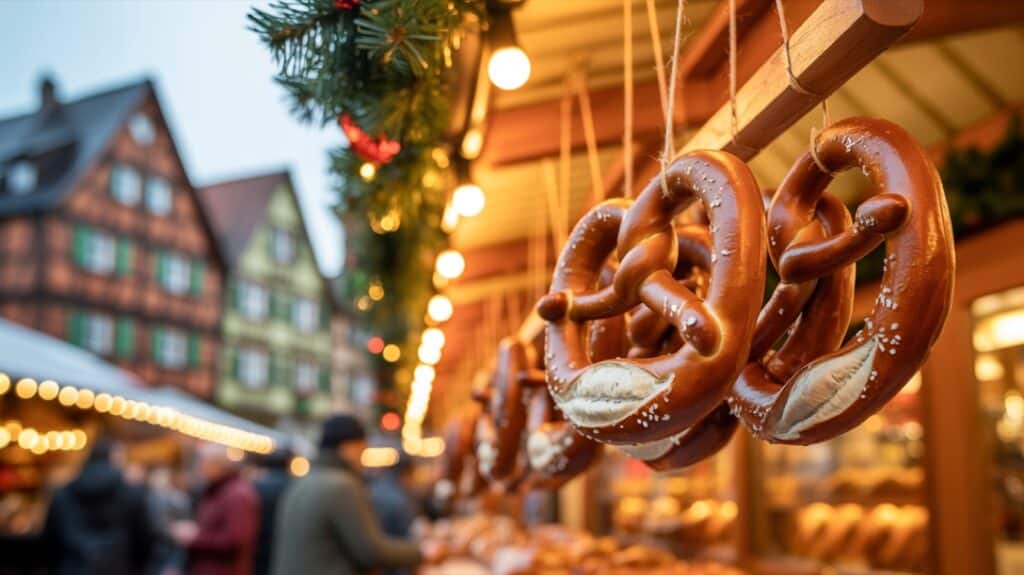
 Illustrative image
 The pretzel, the folded arms that tell the story of Alsace
The bretzel (the Alsatian pretzel) has reigned over the Christmas markets of Alsace since long before anyone invented the wooden chalet. This knot of golden dough, glossy as varnish and studded with coarse salt, is eaten hot at the corner of an alley, hung in garlands across shopfronts, and has served as the bakers’ sign since the Middle Ages. Behind its familiar shape lie legends of monks, a production process that borders on fine chemistry, and variations some of which appear only in December. A complete tour, from the convent on Mont Sainte-Odile to the steaming stall on the cathedral square.
A pretzel history of monks and bakers
The word itself sets the tone. Bretzel comes from the Latin bracchium, the arm, via the diminutive brachitella: literally, little intertwined arms. So the shape is no accident of the baker’s hands; it has been telling a story from the very beginning.
The legend of the monk and the folded arms
The oldest version places the birth of the pretzel around the year 610, in a monastery in northern Italy. A monk is said to have shaped scraps of bread dough into the form of arms folded across the chest, the praying posture of the time, as a reward for children who learned their psalms. No document proves the anecdote, but it fits what we know of the context: the pretzel belongs to medieval monastic culture, where bread readily took on religious meaning.
The baker of Ingwiller and the sun that shines three times
Alsace has its own legend, and a more romantic one. In Ingwiller, a baker named Dorebäck is said to have offended the lord Jacques de Lichtenberg, known as Jacques the Bearded. Condemned to death, he is given one chance to save his neck: invent a bread through which the sun would shine three times. Watching the folded arms of a woman at prayer (his own wife, in some versions), he finds the answer: a knot of dough with three openings. The tale is a fairy story, but it says something true: Alsatians regard the pretzel as their own, not as something borrowed from neighbouring Germany.
A first written record in the 12th century
As for the archives, the pretzel appears in Alsace in the Hortus deliciarum, an illuminated Christian encyclopaedia produced between 1159 and 1173 at the convent on Mont Sainte-Odile, under the direction of the abbess Herrad of Landsberg. In one of the miniatures, a pretzel sits proudly on a banquet table. Eight and a half centuries later, it still sits on Alsatian tables, which makes it one of the oldest documented specialities of the region.
Folded arms turned emblem
The symbolism of arms folded in prayer has travelled down the centuries, and the pretzel ended up outgrowing its status as a simple bread. It became the emblem of bakers across Germanic Europe: in Alsace as in southern Germany, a golden pretzel hanging above a door signals a bakery, the way a caduceus signals a pharmacy. You will also find it as a wrought-iron shop sign, as a Christmas tree decoration, as folk jewellery, and of course as the motif on half the tea towels sold on Rue des Orfèvres in Strasbourg. Few foods can claim to be both a two-euro snack and a regional cultural symbol.
The lye bath, the real secret of the trade
What sets a pretzel apart from any old knotted bread is a step most people know nothing about: the alkaline dip. Before baking, the baker plunges each piece for a few seconds into a bath of food-grade lye, diluted to 3 or 4%. The Germans have a word for this family of products: Laugengebäck, lye-dipped baked goods.
The principle is easy to grasp. The alkaline solution changes the surface of the dough and speeds up the Maillard reaction during baking, the same reaction that browns a bread crust or a grilled steak. The result: a thin, mahogany-brown crust, glossy as varnish, with that distinctive little taste you cannot get any other way. Underneath, the crumb stays white and soft. That contrast between the lacquered skin and the tender heart is the pretzel’s signature.
A bakers’ legend has it that the process was born of an accident: a cat is supposed to have knocked a tray of raw pretzels into a tub of brine, and the baker, in a hurry, put them in the oven anyway. The story cannot be checked, but it has been doing the rounds of Alsatian bakehouses for generations.
At home, the lye (corrosive, and reserved for properly equipped professionals) is replaced with bicarbonate of soda. The crust comes out a little less dark, and the taste comes close to the real thing. We come back to this further down, recipe included.
Alsatian bretzel or German Brezel: the differences
From Strasbourg to Munich, the pretzel changes shape, thickness and even name: Laugenbrezel in standard German, Brezn in Bavaria, Bredschdel in the dialect of the Bas-Rhin. The three main families can be told apart at a glance.
| Style | Shape | Where you will find it |
|---|---|---|
| Alsatian | Thick upper arc, often slashed, with thin, crisp crossed arms | Alsace, Moselle, the Speyer area |
| Bavarian | Thick, plump arms along the whole length, soft crumb throughout | Bavaria, Austria |
| Swabian | Thick slashed belly, very thin, dry arms | Baden-Württemberg |
The Alsatian pretzel therefore plays on both registers: a generous, tender belly and thin arms that crunch. That is the contrast you will find on the region’s Christmas markets, and it is a good yardstick for judging a stall’s skill.
How to spot a good pretzel on a Christmas market
Not all stalls are equal, and a few clues let you sort them out before you reach for your wallet.
- The colour: a good pretzel shows a deep, glossy mahogany brown. A pale or matt piece has most likely skipped the real alkaline bath.
- The contrast in textures: crisp arms that snap cleanly, a soft belly that tears. If everything is soft or everything is dry, walk on.
- The salt: whole grains sitting on the surface, not a shower of fine salt. Some stalls brush it off on request, which is a good sign.
- The heat: a pretzel warmed to order or fresh out of an oven on site has nothing in common with one that has been cooling under cling film since noon.
- The turnover: a stall that sells its pretzels fast replaces them often. The queue is a fairly reliable indicator of freshness.
As for the budget, expect to pay between €2 and €4 for a hot pretzel at Strasbourg Christmas market, plain with coarse salt or topped with melted Munster. That makes it one of the most affordable snacks in the alleys, well ahead of the tartes flambées sold for €7 to €9.
To taste the benchmark, head for Strasbourg Christmas market, where the chalets on the cathedral square also sell giant pretzels for sharing. Colmar’s market plays a more intimate card, with its bakers set up between the half-timbered houses, while Mulhouse remains the locals’ tip, less crowded and every bit as tasty. In all three, the classic pairing is the same: a hot pretzel in one hand, a steaming mug in the other. If you want to recreate that moment at home, the Alsatian mulled wine recipe takes twenty minutes.
The variations to try during the season
The plain pretzel with coarse salt remains the base, but December’s stalls compete with ideas.
First, the mauricette: a small roll made from the same lye-dipped dough, split in two and filled like a sandwich (ham, cheese, salad). It is the markets’ meal option, born in Alsace and now a staple of the region’s delicatessens.
Then the hot versions: pretzel topped with melted Munster or Gruyère, pretzel loaded with bacon and cream in the style of a tarte flambée. Rich, comforting, made for evenings at zero degrees.
Those with a sweet tooth are catered for too: the same dough comes dusted with sugar, coated in chocolate or flavoured with cinnamon. These sweet versions share the stalls with the bredele and the other monument of the Alsatian festive season, gingerbread, whose history deserves a chapter of its own.
That leaves the giant pretzel, an XXL format designed to be shared by two or three as you stroll. More spectacular than refined, but the photo in front of the illuminated cathedral works every time.
Making pretzels at home while you wait for December
Good news: the recipe fits in a normal kitchen, with no professional equipment. The dough is that of a barely enriched bread: flour, water, yeast, a little butter, salt. Knead for 8 to 10 minutes until you have a smooth ball, then leave to rest for an hour under a tea towel, long enough for it to double in size.
The shaping takes two attempts before it feels natural: roll a rope that is thin at the ends and thicker in the middle, form a loop, cross the two branches twice, then fold them back onto the belly of dough. The three openings of the legendary sun must stay visible.
Then comes the step that changes everything: the bicarbonate bath. Bring water to the boil with around 40 g of bicarbonate of soda per litre, then dip each pretzel for 20 to 30 seconds, no more, before lifting it out with a slotted spoon. Any longer and the dough absorbs too much solution and develops an unpleasant taste. Place on a baking tray, scatter with coarse salt, slash the upper arc with a blade and bake at around 200 °C for about fifteen minutes, until mahogany brown.
A final word on safety: the professionals’ lye is not something to improvise at home. It calls for gloves, goggles and experience; bicarbonate gives a very close result with no risk at all. It is the compromise almost every home recipe settles on, and it is enough to bring back the taste of the market.
A knot of dough that sums up a whole way of life
Fourteen centuries of legends, a unique production process, a place of honour on the Christmas stalls: the pretzel condenses the culinary history of Alsace into a single gesture of the baker’s hands. Next time you bite into one between two chalets, look at it for a couple of seconds first: its folded arms have been praying since the Middle Ages, and the sun still shines through it three times.
Where to stay near the markets mentioned
Availability with our partners, town by town.
Reviewed and approved by the editorial team
A question, a mistake or a problem on this page? Write to us
Also worth reading
Speculoos, the little carved biscuit that tells the story of Saint Nicholas
Speculoos, the brown sugar biscuit linked to Saint Nicholas: Flemish origins, wooden moulds, spices and where to taste it at Christmas markets in northern France.
Read the article
Alsatian Christmas Specialities: a Guide to the Treats of the Market
Bredele, gingerbread, manala, pretzel, tarte flambée: the guide to Alsatian Christmas specialities and the markets where you can taste them.
Read the article
Kougelhopf, the Golden Crown That Tells the Story of Alsace
Kougelhopf, the ring-shaped Alsatian brioche: the Ribeauvillé legend, the Soufflenheim mould, sweet and savoury versions, and where to taste it at the markets.
Read the article