
 Illustrative image
 Santons de Provence: the Story of a Little Clay People
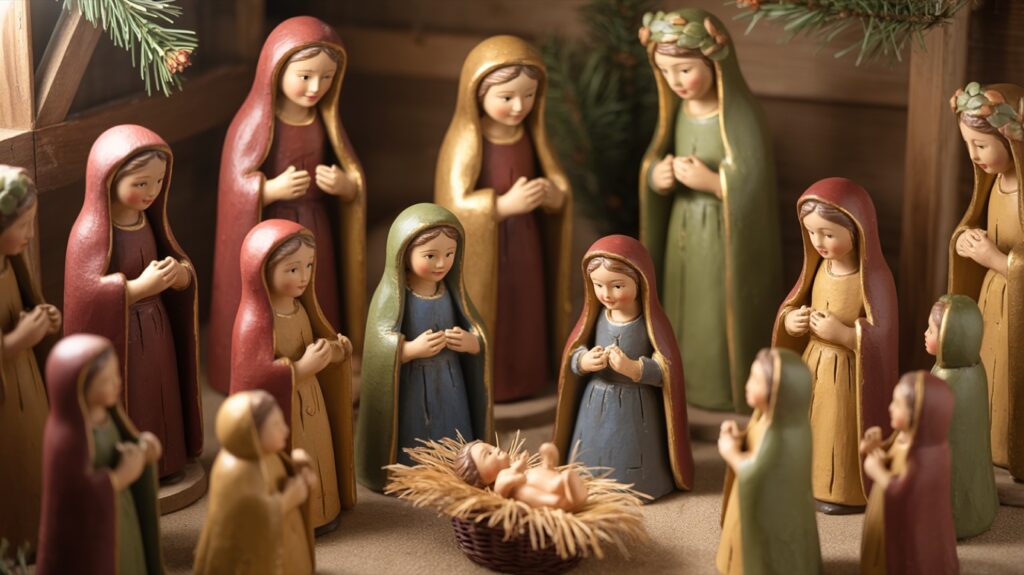
Under the branches of the tree or at the foot of a family nativity scene, the santons of Provence form a small motionless people that tells the story of a whole village. These painted clay figures, a few centimetres high, were born of a precise moment in French history and have never left the Christmas tables of the South since. The word itself comes from the Provençal santoun, “little saint”. Behind that fond diminutive lies a living tradition, carried by santonniers who still mould, fire and paint each character by hand. Here is where they come from, how they are made, who those shepherds and millers are, and where to find them when you head up towards Marseille and Aubagne.
Where the santons of Provence come from
Their birth owes everything to troubled times. With the Revolution, churches became state property, then in 1793 the Assembly decided to close them. The great church nativity scenes, the ones people in Provence came to admire at Christmas, disappeared overnight. Deprived of that appointment, local people rebuilt the Nativity scene at home, in secret, with small figures that were easy to store and to hide.
The first ones were made from whatever was at hand: dried breadcrumb, papier mâché, wax. Fragile, they stood up badly to being handled from one year to the next. It was a santonnier from Marseille, Jean-Louis Lagnel (1764-1822), who turned that domestic makeshift into a genuine craft object. The story goes that as he walked in the countryside around Aubagne, he felt the damp clay sticking to his soles and understood what he could make of that earth. Around 1798 he began modelling his figures in the material, then developed plaster moulds that allowed him to reproduce the same character in series.
That detail changed everything. The mould made the santon affordable for modest families, and the nativity scene stopped being a privilege. In 1803, the first santon fair opened in Marseille, on the Cours Saint-Louis: it still exists, every winter, in the city. If you are planning a visit to Marseille Christmas market, it is the same gesture as Lagnel’s that you find on the stalls, two hundred years later.
Santoun, the little saint turned villager
At the start, the Provençal nativity scene was limited to the holy scene: the Christ child, the Virgin, Saint Joseph, the donkey and the ox, the shepherds and the Wise Men. Very quickly, the santonniers added a crowd of other figures with nothing religious about them: the inhabitants of a Provençal village, with their clothes, their tools and their old trades. The “little saint” of the name became a little villager.
That shift is what gives the nativity scene of the South all its flavour. Where the Neapolitan version stages palaces and characters in heavily worked costumes, the Provençal one sets up a rustic scene, that of the hills, the farmhouses and the streets of a small town. You come across the miller with his sack of flour, the washerwoman bent over her linen, the fisherman, the fishwife, the knife grinder sharpening his blades. A whole world of humble work comes to pay homage to the Nativity, each bringing what they have: a little flour, a fish, a bundle of wood.
That parade of villagers is not just picturesque scenery. It carries a simple, almost tender idea: before the child, everyone is equal, and the humblest brings as much as the Wise Man. Many of these figures come from the Pastorale, the popular theatre in Provençal that replays the shepherds’ walk to the stable every year. The santonniers moved its characters from the stage to the Christmas table, and that is why a santon often has a character, a story, almost a line of its own.
How a santon is made
Lagnel’s method remains, in its broad outline, the one used by today’s santonniers. The santonnier starts by sculpting a model by hand, in clay, down to the smallest fold of the costume. From that mother piece, he casts a plaster mould in two parts, the front and the back of the character.
What follows unfolds in the workshop:
- Moulding: the fresh clay is pressed into the two half-moulds, then the two halves are joined to form the complete body.
- Trimming: once out of the mould, the figure keeps flashes of clay and the mark of the join. The santonnier removes them by hand, retouches the details, corrects a face or a drape.
- Drying: the piece rests for several days in the open air, long enough for the clay to lose its water without cracking.
- Firing: the santon goes into the kiln at around 800 °C, which hardens it and makes it sturdy enough for decades of nativity scenes.
- Painting: the last stage, always done by hand, in gouache or acrylic. Each santonnier has their own palette and touch, so much so that the same character never quite has the same expression from one workshop to the next.
A word on the material: for many santonniers, a true santon of Provence is made of fired clay, full stop. Resin exists and costs less, but it comes out of an industrial mould and loses the hand of the maker. That is also what explains the price gap between a mass-produced figure and a workshop piece.
Clay or fabric: two families of santons
You will come across two great families on the stalls. First the painted clay santon, Lagnel’s, moulded and coloured directly in the earth. It is the most widespread and the oldest. Alongside it, the dressed santon, clothed in real textiles sewn onto a frame, with miniature costumes that are sometimes embroidered. That second form developed in the 20th century: the santonnière Simone Jouglas revived the genre in 1942, and it became a speciality in its own right, often reserved for the larger sizes.
On sizes, the craft distinguishes several formats. The santon puce measures 1 to 3 cm, tiny, perfect for a pocket nativity scene. The so-called traditional santon fits in the palm of the hand, around the size of a thumb. The large santon goes up to 18 to 20 cm, and dressed pieces can go higher still. A single nativity scene happily mixes these sizes to give the setting some depth.
| Type | Material | Markers |
|---|---|---|
| Clay santon | Fired earth painted by hand | The most traditional, from the puce (1-3 cm) to the large format (18-20 cm) |
| Dressed santon | Clay or earth plus a textile costume | Large sizes, appeared in the 20th century |
| Resin santon | Industrial moulding | Cheaper, without the hand of the maker |
Who is who in the Provençal nativity scene
Each santon has a name, often in Provençal, and a role of its own. A few figures turn up in every nativity scene and deserve a closer look:
- Le Ravi (lou ravi): the village innocent, arms raised to the sky, mouth open in wonder. He brings nothing but his joy, and tradition says he brings good luck.
- The tambourine player (lou tambourinaire), nicknamed Guillaume: a galoubet flute in one hand, a tambourine in the other, he leads the farandole and sets the rhythm of the nativity scene.
- The angel Boufarèu: cheeks puffed out over his trumpet, he guides the shepherds to the stable. His name comes from the Provençal verb “to blow”.
- Pistachié: the farmhand, a comic and slightly clumsy figure, inherited from the Pastorale, the popular theatre that stages the Nativity.
- The miller (lou móunié), the washerwoman, the fisherman, the fishwife, the knife grinder, the water carrier: the small trades of a 19th-century Provençal town, each with their tool.
The old man and the old woman (lou viei and la vièio), sitting outside their door, often close the picture. Putting together a nativity scene is a little like piecing a whole village back together, year after year, adding one santon each Christmas.
Aubagne and Marseille, the heart of the clay
If the santon was born in Marseille with Lagnel, it is a little further off, at Aubagne, that it found its earth. The clay beds of the area have fed a ceramic industry for centuries, and the town presents itself today as the capital of the santon. Its santon and ceramic market, every winter, brings together dozens of workshops and ranks among the great events of the season. A visit to Aubagne during Advent takes you behind the scenes of the craft as much as into a Christmas market.
Marseille keeps its fair, heir to the one of 1803, while Aix-en-Provence also holds its santon fair on the Cours Mirabeau. Further north, the markets of Avignon and Arles offer their santonniers’ stands among the other exhibitors. From one town to the next, you find the same characters, but each workshop signs its figures with a recognisable colour and line.
Choosing and hunting for santons at a market
Buying a santon on the spot is a pleasure that calls for a little preparation. A few pointers so you do not get it wrong:
- Look at the material: fired clay painted by hand has weight, a slightly uneven surface, and the underside is not as smooth as a piece moulded in resin.
- Look closely at the painting: real workshop santons show brush strokes, sometimes tiny variations from one example to the next. That is the signature of the hand.
- Ask the santonnier: most are happy to talk about their work, the size of their pieces and how to add to an existing nativity scene.
- Think about consistency of size: better to stay within the same scale so the miller does not stand a head taller than the Holy Family.
A quality charter in fact governs the craft, with criteria on the clay, on making by hand and on the size of the pieces, between 2 and 40 cm for a nativity santon. It is a good thread for telling craftwork from souvenir trinkets.
At these markets in the South, the walk between two santon stands carries on around a steaming cup of mulled wine, another treat of the season, to which the magazine devotes an article on mulled wine and its variations. To place the santons back in the atmosphere of the southern markets, read our article on Christmas markets in Provence, which carries this one further on the towns and the entertainment.
A tradition that is handed down
What strikes you about santons is their continuity. Lagnel’s gesture, the plaster mould, the firing at 800 °C, the painting by brush: all of it has passed from workshop to workshop without setting solid. Each family of santonniers keeps its models, creates new ones, and brings figures of today into the nativity scene alongside the Ravi and the tambourine player.
Bringing a santon home from a market around Aubagne or Marseille means leaving with a small piece of that thread. You place the figure in your nativity scene, it joins the previous ones, and next year you will add another. Two centuries after the first fair, the little clay people goes on growing, one Christmas at a time.
Where to stay near the markets mentioned
Availability with our partners, town by town.
Reviewed and approved by the editorial team
A question, a mistake or a problem on this page? Write to us
Also worth reading
The Advent calendar: from devotional pictures to giant façades
The Advent calendar, from the German devotional picture of 1908 to the giant façades of towns in Alsace and the Black Forest. Origins and traditions.
Read the article
Manala: the little brioche man of Saint Nicholas’ Day
The manala (a little brioche man) is the figure in enriched dough that Alsace brings out every year as December settles in. A plump body,…
Read the article
Christmas markets worth the trip
The sixteen Christmas markets worth the trip, in France and just across the border: dates, transport and accommodation to plan your weekend.
Read the article