
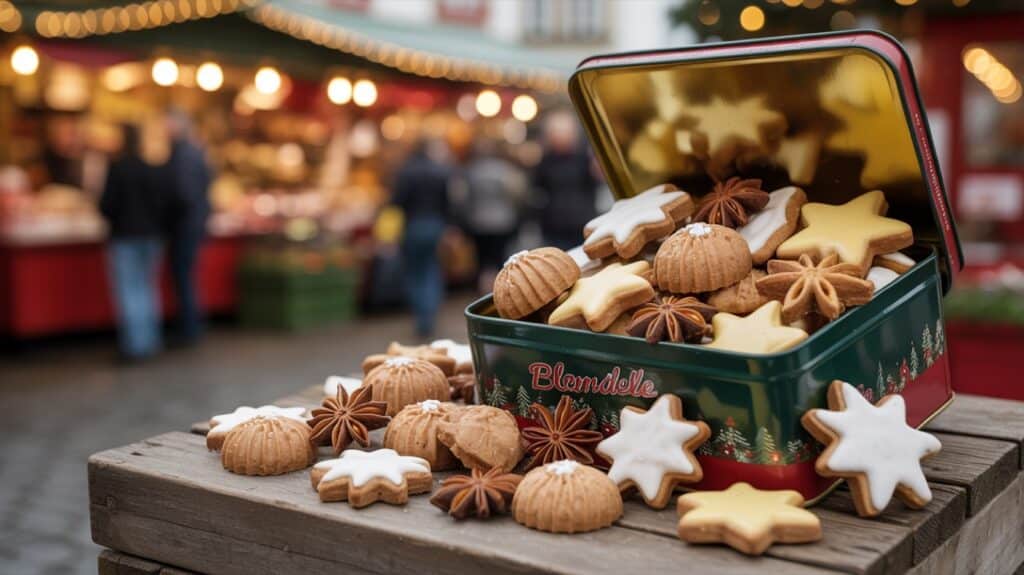
 Illustrative image
 Bredele, the little biscuits that make an Alsatian Christmas
Bredele are to an Alsatian Christmas what the tree is to the living room: a given. From late November onwards, kitchens across Alsace smell of butter, cinnamon and aniseed, and the tins fill up with little biscuits shaped like stars, hearts and moons. On the markets you buy them by weight or in assortments, and every family guards its recipe like a small treasure. History, varieties, where to buy them and two classic recipes: a tour of a tradition that is very much alive.
Bredele, a story that begins in the 14th century
The word comes from the dialect: an Alemannic diminutive of the word for bread, in other words “the little loaf”, which came to mean the little Christmas biscuit. Depending on the valley and the local way of speaking, you will also come across the spellings bredle, bredala or winachtsbredele, the “Christmas bredele”. The same logic applies to the Strasbourg mannele, which becomes mannala around Mulhouse: in Alsace the language changes with the landscape, and the biscuit tastes the same.
The tradition is an old one. Carved wooden biscuit moulds dating from the 14th century have been found in the Rhine valley: they were used to press patterns into firm doughs before baking. Metal cutters arrived in the early 19th century, with their festive silhouettes: stars, fir trees, bells, hearts. They are what gave bredele the look they have today.
The season starts early. In many homes, the first batches come out of the oven in November, in large quantities, then wait in tins until the festivities. Four Sundays of Advent, four occasions to lift the lid: the rhythm has been honed over generations, and the recipe notebooks are passed from hand to hand along with the moulds.
Even today, baking them remains a family affair. It happens during Advent, often over several weekends, with grandmother’s scribbled recipes and quantities worthy of a biscuit factory. Custom has it that you give them away: one tin for the neighbours, another for colleagues, a third you keep jealously for yourself. And on 6 December, Saint Nicholas’ Day brings its own treat to the table: the manala, a little brioche man who deserves a story of his own.
The main families of bredele
There are dozens of varieties, and every household has its own. A few, though, turn up on every table and every stall. The names change from one village to the next, and so do the proportions: the table below gives the most common reference points, not a law carved into Vosges sandstone.
| Variety | Dominant flavour | Texture |
|---|---|---|
| Butterbredele | Butter and vanilla | Crisp shortbread that melts in the mouth |
| Anisbredele | Green aniseed | Smooth, crunchy cap on a softer, puffed base |
| Spritzbredele | Butter, vanilla or almond | Crumbly shortbread, piped or pushed through a mincer |
| Schwowebredele | Orange and cinnamon | Fragrant, golden shortbread |
| Zimtsterne | Cinnamon and almond | Soft star under a white glaze |
| Läckerli | Honey, spices, candied citrus peel | Small, dense, firm square |
The butterbredele (butter biscuit) is the ideal way in: it is the most widespread in Alsace, the one children cut out with cutters on a Wednesday afternoon. The anisbredele (aniseed biscuit) plays in another register, with its pale dome sitting on a small puffed foot, the signature of a successful drying. The spritzbredele takes its name from the gesture: a butter-rich dough pushed through a nozzle or a mincer, hence its S shapes, sticks and rings. The schwowebredele, the “little Swabian biscuit”, pairs orange and cinnamon in a shortbread that smells of winter, while the zimtsterne goes for softness with its cinnamon and almond duo under a white glaze. As for the leckerli, dense and honey-scented, it flirts with the world of gingerbread, another pillar of the Alsatian Christmas table.
One tip for putting your tin together: mix the registers. Two butter shortbreads, one spiced biscuit, one crunchy aniseed and one cinnamon star, and you have an assortment that holds its own against the biscuit makers’.
On the Christmas markets, from chalet to biscuit shop
You cannot wander between the Alsatian chalets without running into mountains of clear bags and illustrated tins. At Strasbourg Christmas market, whose Christkindelsmärik has been running since 1570, the bredele stalls sit alongside the decorations and the pretzels. In Colmar, the markets of the old town give the same place of honour to Advent biscuits, between the half-timbered façades.
The wine route is worth the detour for this too. Kaysersberg and Eguisheim focus on local crafts, and the producers sell their biscuits directly. In Ribeauvillé, the market’s medieval atmosphere gives the biscuit stalls a charm from another age.
How to buy well? Go for the stalls that sell by weight: you put together your own mix and get to taste everything. Check the ingredients when they are displayed, as butter makes all the difference in a shortbread. And if you want to give them as a gift, the matching tins from the artisan biscuit makers travel well and keep for weeks. A bag bought on a side street gets nibbled as you walk; an illustrated tin ends up under the tree. All of it goes down best with a steaming mug in hand: to make your own at home, start with our guide to mulled wine and its variations, which points you to the recipe.
Two classic recipes to get you started
No pastry chef’s skills required: the two great classics can be made with an ordinary oven, a rolling pin and a little patience. The proportions below come from published Alsatian recipes.
The equipment list is short: scales, a rolling pin, biscuit cutters for the first recipe, a piping bag for the second, and baking trays. Allow yourself some space too: one batch of bredele quickly takes over three trays and an entire worktop, especially when the whole household joins in.
Butterbredele, the butter shortbread
For a generous batch:
- 500 g flour
- 250 g softened butter
- 250 g sugar and 1 sachet of vanilla sugar
- 2 egg yolks and 1 whole egg
- 1 pinch of baking powder
- 2 tablespoons of crème fraîche
- Beat the softened butter with the sugar and vanilla sugar until you have a smooth cream.
- Add the yolks and the whole egg, then the flour and baking powder. Knead, work in the crème fraîche and shape into a ball.
- Rest the dough in the fridge for at least an hour: it rolls out better and the biscuits keep their shape.
- Roll out to 6 mm thick, cut out with the cutters and place on a baking tray.
- Bake for 10 minutes at 180 °C. The edges should barely turn golden. Cool on a wire rack before storing in a tin.
The dough takes re-rolling well: gather up the offcuts, roll out again, and keep going until the last star.
Anisbredele, the crunchy aniseed biscuit
For around sixty biscuits:
- 3 whole eggs (about 150 g)
- 250 g sugar
- 280 g flour
- 1 to 2 teaspoons of green aniseed
- Whisk the whole eggs with the sugar for 20 minutes, until the mixture doubles in volume and falls in a ribbon. This is the step that makes everything: the foam must be firm and airy.
- Fold in the aniseed, then the sifted flour, with a spatula and without overworking, to keep the foam.
- Pipe small domes onto a baking tray.
- Leave to dry for 10 to 12 hours somewhere dry, a full night at the very least. It is this drying that forms the crust on top.
- Bake for 10 minutes at 180 °C, one tray at a time. The cap should stay smooth and pale, and a small puffed foot forms at the base: that is the mark of a successful anisbredele.
The aniseed flavour improves with time: wait a few days before tasting them, they will only be better for it.
The art of the tin
Bredele are made in advance, and that is the whole point: the Advent batches have to last until Christmas. The golden rule is an airtight metal tin, stored away from light and damp. Under those conditions, most varieties keep for three to four weeks.
Two precautions make the difference. First, one tin per family of textures: soft biscuits give off moisture and turn the crunchy ones soft if they share a lid. Second, wait until they have cooled completely before putting them away, otherwise condensation does the same damage. Anisbredele, for their part, benefit from waiting: their flavour develops over the days in the tin.
A well-filled tin remains the Advent gift par excellence: in Alsace, offering your bredele to neighbours and loved ones is as much part of the ritual as eating them. Choose a container that opens without a struggle, slip a sheet of baking paper between the layers, and your assortment will arrive intact.
All that is left is to pick your side: a home-made batch on a December Sunday, or a filled tin brought back from a chalet somewhere between Strasbourg and Colmar. Alsatian families settled the question long ago: both.
Where to stay near the markets mentioned
Availability with our partners, town by town.
Reviewed and approved by the editorial team
A question, a mistake or a problem on this page? Write to us
Also worth reading
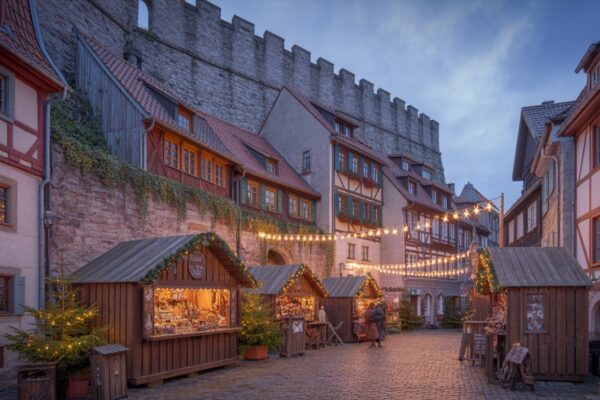
The Most Beautiful Medieval Christmas Markets in France
Our pick of the most beautiful medieval Christmas markets in France: Provins, Carcassonne, Ribeauvillé, Sarlat and the fortified towns of Alsace.
Read the article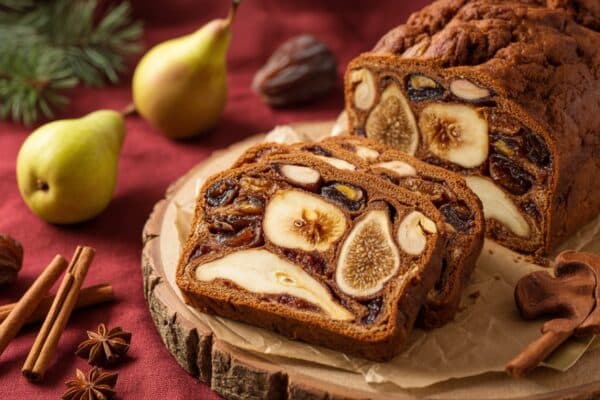
Berawecka: the Dried-Fruit Christmas Bread of Alsace
Berawecka, a bread of dried fruit and pears steeped in kirsch, is an Alsatian Christmas speciality. Its origins, what goes into it and where to find it.
Read the article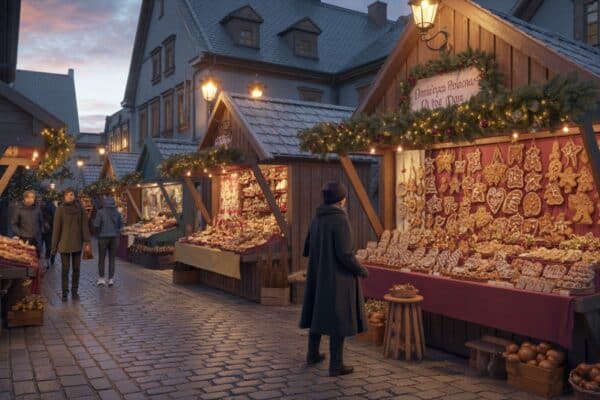
Where Do Christmas Markets Come From? Six Centuries of Tradition
The history of Christmas markets, from Dresden 1434 to Strasbourg 1570: medieval origins, the Reformation, the Advent wreath and the revival in France.
Read the article