
 Illustrative image
 The Advent calendar: from devotional pictures to giant façades
Every December morning, you open a little door to help pass the time until Christmas: the Advent calendar is so much part of the festive scenery that we forget where it comes from. Behind the cardboard, the chocolate and the beauty versions filling the shelves lies a German story more than a century old, a specific religious root, and a spectacular variation you’ll come across in the Christmas squares of Alsace and the Black Forest: entire façades turned into life-size calendars. A short trip back in time, from the 1908 cardboard to the 24 illuminated windows of a town hall.
Advent, before the calendar
The word comes from the Latin adventus, meaning “arrival” or “coming”. In the Christian calendar, Advent refers to the four weeks leading up to Christmas, a time of preparation and waiting. It begins on the fourth Sunday before 25 December and also marks the start of the liturgical year. Its colour is purple, the shade of penance, except on the third Sunday, known as Gaudete (“rejoice”), when pink takes over to announce the joy to come.
You may know its cousin better, the Advent wreath: a ring of fir branches holding four candles lit one after another, one Sunday at a time, until Christmas. This growing light says the same thing as the calendar: counting the days, making the wait tangible. The Advent calendar itself was born to keep children occupied through this long wait. If the wreath interests you, we’ve written a separate article about it.
One detail often causes confusion: the number of days. The liturgical season of Advent doesn’t always last twenty-four days, since its length depends on the date of the fourth Sunday before Christmas. The commercial Advent calendar, on the other hand, settled on a fixed format of twenty-four doors, from the start of December to the 24th. The two don’t always match, but the object has kept the name and the spirit of the religious season it came from.
A 19th-century German invention
The calendar’s ancestor was a household custom, not a product. In the 19th century, Protestant families in Germany got into the habit of giving children a small devotional picture every morning during the twenty-four or twenty-five days before Christmas. Others drew twenty-four chalk lines on a door or a wall and rubbed one out each day. The countdown was homemade, different in every household.
The story goes that in Maulbronn, a pastor’s wife came up with a tastier version: twenty-four squares drawn on a piece of card, with a small biscuit attached to each one. The child who enjoyed this system was called Gerhard Lang, and he would not forget the idea.
These family inventions say something about the Protestant culture of the time, deeply attached to reading and devotion at home. The countdown wasn’t just a game: it often came with a verse to read each morning, a prayer or a hymn. The picture given to the child was as much about teaching as about waiting. It’s this mix of reward and daily ritual that made the custom stick, and it explains why it ended up being printed and sold.
1908: Gerhard Lang prints the first calendar
Having become a publisher in Munich, Gerhard Lang brought out the first printed Advent calendar in 1908, called the Weihnachtskalender. The idea drew on his childhood memory: two cardboard sheets, one with twenty-four small coloured pictures to cut out, the other with twenty-four numbered squares to stick them on, one a day. It was an instant success.
Lang didn’t stop there. He developed his idea year after year: new illustrations, house-shaped formats, and even a Braille version. Around 1920, he came up with the famous little pre-cut windows that you lift to reveal a picture. That gesture, opening a cardboard flap, is still the heart of the object today.
From cardboard to chocolate
Treats took their time to find their way behind the windows. It wasn’t until 1958 that the first chocolate surprises appeared in the doors. The real industrial turning point came in 1971, when the British brand Cadbury launched its chocolate Advent calendar in England. The consumer habits of the 1970s did the rest: the format became a mass-market product, found in almost every home each winter.
Since then, the object has spilled far beyond its religious and childhood roots. There are now calendars of beer, tea, cosmetics, toys and cheese. The original idea (counting down the days) has become a universal commercial template. Some purists roll their eyes, but the mechanism is the same as the 1908 cardboard: one door, one small pleasure, one day less to wait.
A word on the chocolate hiding behind the windows, because the question comes up often. The figures in supermarket calendars are moulded very thin, with cocoa of varying quality: this isn’t where to look for fine chocolate. The pleasure lies in the gesture and the morning appointment more than in the square itself. Chocolatiers and Christmas markets offer more refined versions, filled with pralines or small handmade figures, which give the object back its prestige. On December stalls, you’ll also come across wooden calendars to fill yourself, made to last from one year to the next.
| Stage | Date | What changes |
|---|---|---|
| Daily devotional pictures | 19th century | A family custom, with no commercial product |
| First printed calendar (Lang) | 1908 | Pictures to cut out and stick on a numbered card |
| Pre-cut windows | around 1920 | The gesture of opening a flap appears |
| Chocolate surprises | 1958 | Treats replace the picture |
| Mass production (Cadbury) | 1971 | The calendar becomes a mainstream product |
Giant town calendars
The most spectacular version doesn’t fit in your hand: it covers an entire façade. The principle is simple and lovely. An old building, often the town hall, happens to have twenty-four windows. Each one gets a decoration or an artwork, and a new one is lit every evening until 24 December. The wall becomes a life-size calendar, and the daily opening takes place in public, with a little ritual.
The benchmark is in the Black Forest, in Gengenbach, about forty-five minutes from Strasbourg. Its 18th-century town hall lines up twenty-four windows on its façade, turned every winter into a calendar billed as the largest in the world. Every day at 6pm, a window opens in front of the crowd, with a theme and a guest that vary from year to year. The tradition has been going for more than twenty years and sets the rhythm of the whole Christmas market in this small wine town.
What makes these town calendars so touching is that they are shared. A cardboard calendar, you open alone in your kitchen. A façade, you watch light up together, on a square, in the cold, often with a children’s choir or a small brass band. Waiting becomes a shared moment again, as it probably was in the villages of old. Every evening the crowd comes back, curious to see which window will open and what scene lies behind it.
Where to see a giant calendar in Alsace
On the French side, Alsace has adopted and reinvented the idea. In Strasbourg, the station district hosts a giant Advent calendar on the façade of a Haussmann-style building at 18 rue Kuhn: twenty-four contemporary artists decorate the windows, revealed one by one each evening. A good addition to a visit to the Strasbourg Christmas market, the historic capital of Christmas.
About fifty kilometres away, the Sélestat Christmas market sets up its giant calendar opposite the town hall. There, it’s the night watchman who opens the window of the day: at 6pm from Sunday to Friday, at 11am on Saturday. A piece of staging that revives the old figures of medieval towns. To follow the trail of Advent in Alsace a little further, a few towns are worth a look:
- Colmar Christmas market, whose illuminated districts form an open-air fairy-tale setting.
- Obernai Christmas market, at the foot of Mont Sainte-Odile, true to Advent traditions.
- Riquewihr Christmas market, a fortified village that puts up its garlands as soon as Advent begins.
- Kaysersberg Christmas market, regularly named among the most beautiful villages of the season.
- Mulhouse Christmas market, known for its Christmas fabric, redesigned every year.
Making your own, the old-fashioned way
Nothing says you have to buy a ready-made calendar. The original gesture, the one 19th-century families knew, is easy to recreate at home, and it has the advantage of being personal. A few ideas, depending on your mood and the time you have:
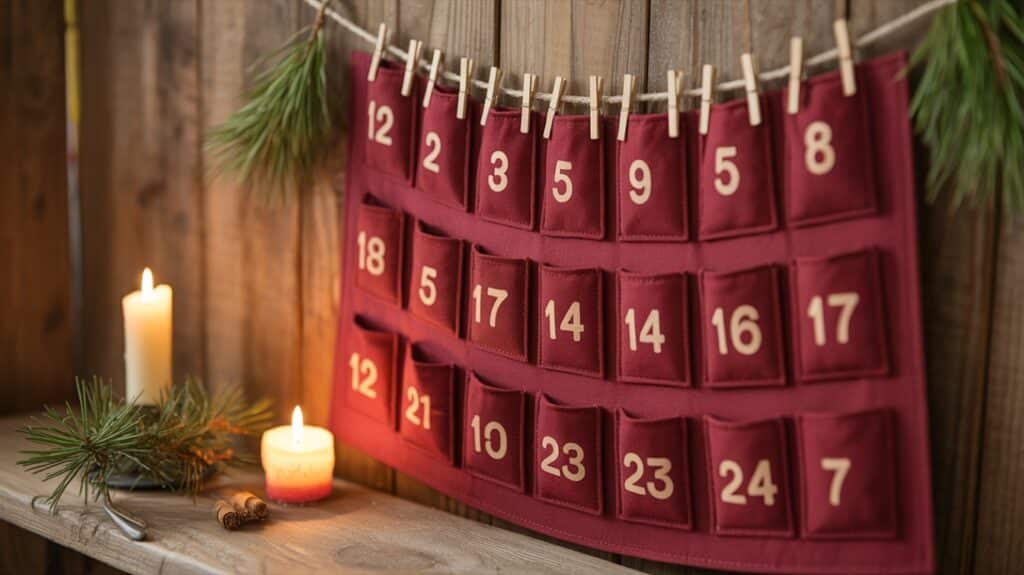
- Twenty-four small numbered pouches in fabric or kraft paper, hung on a string, filled with sweet notes or little treats.
- A wooden board drilled with twenty-four holes, like a pigeonhole rack, each one closed with a cork.
- Matchboxes covered in paper and stacked in a pyramid, each one hiding a surprise.
The hardest part isn’t making the structure, but finding twenty-four little things to slip inside without breaking the bank. For a child’s calendar, you can mix treats and messages: a voucher for a bedtime story, another for a sledging trip, a picture to colour in. For an adult, a few squares of chocolate, a tea bag, a quote. The idea isn’t to fill every door with a present, but to create a small morning or evening ritual for the whole month.
A homemade calendar like this goes well with a winter evening by the fire, a slice of gingerbread and a steaming mug. On that last point, if you want the drink that best suits these first window openings, mulled wine remains the ideal Advent companion, and we devote an article to its variations. For treats, our article on the history of gingerbread will give you ideas for filling a few doors with something homemade.
An object that has travelled far
From a chalk line on a door to the illuminated façade of a town hall, the Advent calendar has come a long way in just over a century. It has kept the essentials: the simple pleasure of counting the days, of having a daily appointment during the most eagerly awaited month of the year. Whether you open a chocolate door, hang hand-sewn pouches or go and watch the night watchman open his window in Sélestat, you’re carrying on the same old German idea. And perhaps that’s the calendar’s finest gift: turning the wait itself into a celebration.
Where to stay near the markets mentioned
Availability with our partners, town by town.
Reviewed and approved by the editorial team
A question, a mistake or a problem on this page? Write to us
Also worth reading
The pretzel, the folded arms that tell the story of Alsace
The bretzel (the Alsatian pretzel) has reigned over the Christmas markets of Alsace since long before anyone invented the wooden chalet. This knot of golden…
Read the article
Santons de Provence: the Story of a Little Clay People
The santons of Provence, those clay figures of the nativity scene: origin, making, characters and where to buy them in Marseille and Aubagne.
Read the article
Christmas foie gras, from the marché au gras to your table
Christmas foie gras from south-west France: duck or goose, IGP, raw or preserved, where to buy it at the marchés au gras and how to choose a good one.
Read the article