
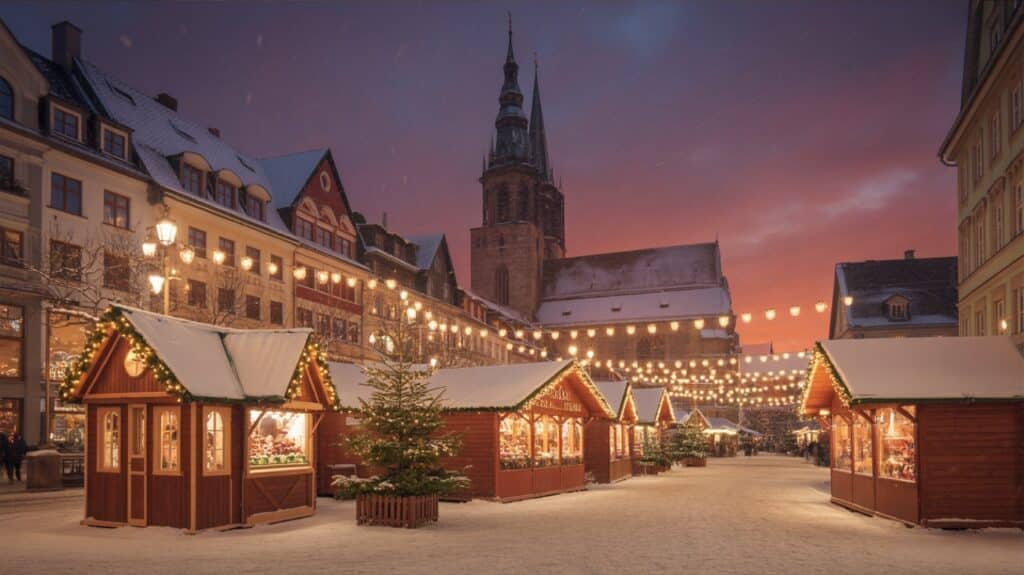
 Illustrative image
 Christmas markets worth the trip
Out of more than 250 listings on the site, only a handful carry the “Worth the trip” badge: these are the Christmas markets worth the trip, the ones you block out a whole weekend for, sometimes at the other end of France or Europe. Ten are in France, six across a border. The ranking is not based on gut feeling: it combines visitor numbers and search data, and is shown openly on the site’s Worth the trip page. This article goes through all sixteen, with everything you need to plan the journey.
How do you spot the Christmas markets worth the trip?
The ranking is based on visitor numbers published by the towns and on the search volume linked to each market, two measures that match up most of the time. A market followed by hundreds of thousands of visitors, and by a public coming from far beyond its own region, naturally falls into the “Worth the trip” category; a market loved locally, but which remains mainly a local affair, is ranked elsewhere, without that saying anything about its quality.
The site ranks its markets on four levels: “Worth the trip”, “Worth the weekend”, “Day out” and “Local favourite”. The first level brings together the markets that, on their own, justify crossing the country or a border for a full weekend. Size is not everything: Kaysersberg fits into a handful of lanes, while La Défense has hundreds of chalets without making it into this top tier. What counts is a reputation built over decades, the crowds it draws and the way the whole town transforms for the occasion.
Six of the sixteen markets below are outside France: the selection works on the principle that a weekend in Bruges or Nuremberg is planned just like a weekend in Strasbourg or Reims, with a train to book and a currency to check. The full, up-to-date list can be found on the Worth the trip page.
The Alsace heartland: six markets worth the trip in their own right
Six of the ten markets on the French list are concentrated in the Alsace wine country, between Strasbourg and Colmar. The Strasbourg Christmas market leads the way, running since 1570, one of the oldest recorded dates for a market of this kind in Europe; the city decorates square after square around the cathedral and Petite France. The Colmar Christmas market is spread over several squares in the historic centre, each with its own atmosphere, from the half-timbered houses of Little Venice to the covered aisles of Place des Dominicains.
Nearby, four villages in the wine country each host a market on their own scale. The Kaysersberg Christmas market takes up a handful of lanes, but the view from the ruined castle and the 15th-century setting are enough to justify the trip for many visitors. A few kilometres away, the Riquewihr Christmas market sets up its stalls within intact ramparts, and the Eguisheim market winds around the village’s circular square, known for its colourful houses. The Ribeauvillé Christmas market completes the picture with an unashamedly medieval touch, with musicians in costume and craft stalls.
Food is as much a part of the scenery as the chalets. Bredele, the small Alsatian Christmas biscuits, turn up at almost all of these markets, in shapes that vary from one pastry shop to the next (for their history and variations, see our article on bredele). Gingerbread holds a similar place, particularly in Strasbourg and Colmar, where dozens of stalls sell it.
All six can be reached by train from Strasbourg or Colmar, with frequent TER regional connections in December: enough to take in two or three markets in a single weekend without getting back on the road.
Metz, Reims, Arras and Montbéliard: the rest of the French podium
Four other markets complete the list, further from the Alsace cluster but just as capable of filling a weekend. The Metz Christmas market appears every year among the busiest markets in the country, spread over several squares around Saint-Étienne cathedral and its stained glass. The Reims Christmas market has the same asset, a Gothic cathedral at the centre of the scene, plus a location that is easy to reach by direct train from Paris.
Further north, the Arras Christmas market spreads across the listed Grand-Place, lined with Flemish Baroque façades that make for a remarkably uniform setting. Finally, the Montbéliard Christmas market owes its place to a choice that may come as a surprise: the town, smaller than the other three, is named every year among Europe’s great markets for its trail of lights, which runs through much of the historic centre.
Nuremberg, the benchmark for Christkindlesmarkt
The Nuremberg Christmas market is the name most German markets cite as their benchmark. The Christkindlesmarkt is recorded there since 1678, but its roots go back to the 16th century, when the Protestant Reformation led several towns to rename their Saint Nicholas fairs as Christ Child markets, to steer people away from the cult of saints. The tradition has lasted through the centuries: every year, a young woman from the city is chosen to play the Christkind, the golden angel who opens the market from the balcony of the Frauenkirche.
The historic centre, ringed by medieval ramparts, lends itself well to this kind of spectacle. From France, the journey usually involves a change in Germany rather than a direct line: enough to turn the trip into a proper stay of two or three days rather than a day return.
Cologne, Aachen, Bruges and Brussels: crossing the border
Four markets complete the selection on the German and Belgian side. The Cologne Christmas market draws around four million visitors a year, one of the highest figures in the country; the city does not stop at one market but spreads several across the centre, including the one at the foot of the Gothic cathedral. The Aachen Christmas market is also held next to a cathedral, a World Heritage Site, and makes the most of a local speciality, Printen gingerbread, sold by the city’s bakeries throughout the season.
In Belgium, the Bruges Christmas market enjoys a setting the city did not need to invent: canals, gabled façades and medieval cobbles around the Markt and the belfry, where an ice rink welcomes skaters every winter. The Brussels Christmas market plays a different card, that of scale: Winter Wonders (Plaisirs d’Hiver) takes over several squares in the centre, from the Bourse to the Grand-Place, with a sound and light show projected onto the listed façades.
These four cities can be reached by direct train from several major French stations, which makes all the difference compared with a return drive on the motorway on a December weekend.
Montreux, the Swiss market on the shores of Lake Geneva
The only Swiss entry on the list, the Montreux Christmas market runs along the quays of Lake Geneva, two hundred metres from the station according to information published by the market’s organisers. The 2026 edition is announced from 20 November to 24 December, with more than 150 chalets and a Ferris wheel set up on the market square. The currency changes: Switzerland pays in Swiss francs, not euros, a detail to sort out before you go.
The local curiosity has a name: the Flying Father Christmas, who crosses the sky between the landing stage and the market square at set times. A new addition for 2026 is a cruise on a Belle Époque steamer, to watch the scene from the water. From France, Geneva or Lausanne are the gateways, with a short rail connection to Montreux.
Planning the weekend: dates, transport and budget
The markets on this list traditionally open in late November and close around Christmas or New Year depending on the city; the exact dates of the 2026 edition are on each market’s page, to be checked before you book a train or hotel. A few pointers help you plan the trip without nasty surprises:
- Book your accommodation early: hotels in the Alsace towns and in Nuremberg are fully booked several weeks ahead for December weekends.
- Check the currency before heading to Switzerland: Montreux is paid in Swiss francs, the other markets on the list in euros.
- Pack warm clothes and closed shoes: the markets are outdoors, often visited late, in temperatures that drop below zero as soon as dusk falls.
- Look at direct trains first: Reims, Strasbourg, Brussels and Cologne can be reached without a change from several French stations, which makes the weekend simpler.
At most of these markets, mulled wine remains the drink of choice for staying warm under the garlands; to tell Glühwein, white mulled wine and glögg apart, head to our guide to mulled wine and its variations.
The budget depends mainly on accommodation and transport, and on how early you book. A train booked several weeks ahead costs less than a last-minute ticket, and nights in Strasbourg, Colmar or Nuremberg quickly get expensive on a December weekend. Once there, on the other hand, a Christmas market is an affordable outing: most of these sixteen markets charge no entry fee, and you can happily make do with a mulled wine and a treat from a stall rather than a sit-down meal.
The table below lists the sixteen markets, with the reason each one is worth the journey.
| Market | Country | Why it is worth the trip |
|---|---|---|
| Strasbourg | France | France’s oldest Christmas market, since 1570 |
| Colmar | France | Several decorated squares in a well-preserved historic centre |
| Kaysersberg | France | A whole village transformed, with a view from the ruined castle |
| Riquewihr | France | Stalls set up within intact ramparts |
| Eguisheim | France | Circular square and colourful half-timbered houses |
| Ribeauvillé | France | Medieval atmosphere, musicians and craftspeople in costume |
| Metz | France | Several squares around Saint-Étienne cathedral |
| Reims | France | Gothic cathedral at the centre of the scene, direct train from Paris |
| Arras | France | Listed Grand-Place, Flemish Baroque façades |
| Montbéliard | France | Trail of lights named every year among Europe’s great markets |
| Nuremberg | Germany | Christkindlesmarkt recorded since 1678, Christkind tradition |
| Cologne | Germany | Several markets in the city, around four million visitors a year |
| Aachen | Germany | World Heritage cathedral, Printen gingerbread |
| Bruges | Belgium | Canals, gabled façades, ice rink near the belfry |
| Brussels | Belgium | Winter Wonders across several squares, sound and light show |
| Montreux | Switzerland | Lake Geneva quays, Flying Father Christmas, more than 150 chalets |
This list is not set in stone: the ranking is updated as new listings join the site, and the “Worth the weekend” markets, one level down, already include familiar names such as Lyon, Bordeaux and Toulouse. For now, these sixteen remain the ones worth taking time off work and getting the suitcase out for.
Where to stay near the markets mentioned
Availability with our partners, town by town.
Reviewed and approved by the editorial team
A question, a mistake or a problem on this page? Write to us
Also worth reading
The Advent calendar: from devotional pictures to giant façades
The Advent calendar, from the German devotional picture of 1908 to the giant façades of towns in Alsace and the Black Forest. Origins and traditions.
Read the article
Manala: the little brioche man of Saint Nicholas’ Day
The manala (a little brioche man) is the figure in enriched dough that Alsace brings out every year as December settles in. A plump body,…
Read the article
A family Christmas near Lille: Bellewaerde, Plopsaland, Pairi Daiza
Bellewaerde, Plopsaland or Pairi Daiza for a family Christmas near Lille: 2026-2027 dates, journeys, prices checked and budget to pick the right park.
Read the article