
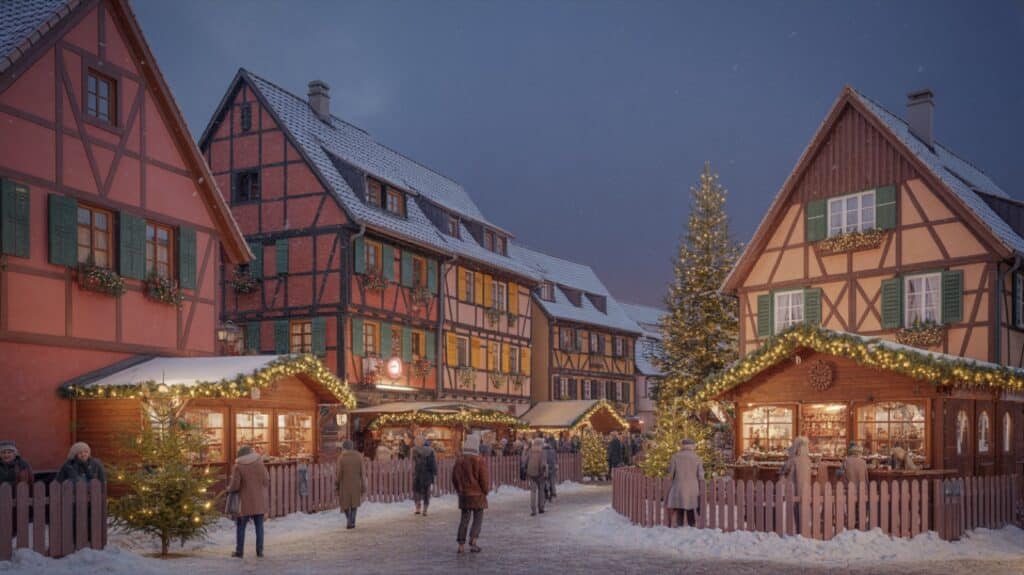
 Illustrative image
 Alsace Christmas markets: the guide to planning your trip
If one region shaped the tradition in France, it is this one. Alsace Christmas markets are nothing new: Strasbourg’s Christkindelsmärik goes back to 1570, when the Protestant Reformation replaced the Saint Nicholas fair with a market tied to the Nativity. More than four centuries later, around a hundred towns and villages light up every winter, from the two festive capitals to the small wine villages of the Route des Vins. This guide helps you choose which ones to visit, understand what sets each atmosphere apart, and string several markets together without losing your nerve.
Why Alsace is the benchmark
Age explains a lot. Strasbourg holds the oldest Christmas market in the country, and the city declared itself the capital of Christmas in 1992 before turning that into a proper tourist brand. Around it, a craft has been handed down from one generation to the next: wooden chalets, half-timbered houses decked in garlands, local crafts, seasonal food. The whole thing holds together because the tradition is lived by the residents, not laid on for passing visitors.
In practice, you have two complementary scales. The big cities offer abundance: hundreds of chalets, entertainment, an organisation honed over decades. The villages play the card of a medieval setting and a more hushed atmosphere, with fewer stalls but often more charm. The good news is that everything fits into a tight area. From Strasbourg to Colmar, count about thirty minutes by train, and the Route des Vins links the two while pinning a dozen villages along the way. This compactness changes everything when planning a stay, because it lets you mix registers over two or three days without spending your life on the road.
Strasbourg, the cradle of the Christkindelsmärik
Strasbourg Christmas market remains the logical way in. The old town, a UNESCO World Heritage site, turns into eight separate markets spread across around ten squares, with the great fir tree on Place Kléber as the rallying point. People come for the scale, the quality of the crafts and the atmosphere of the Grande Île, that island ringed by the Ill where the cathedral watches over the chalets.
The flip side of that reputation is the crowds: around two million visitors over the period. To breathe, time your visit for the morning before eleven, or late evening after eight, once the coaches have left and the shop windows take on a different look. On Saturday afternoons, bring patience and a plan B. Strasbourg lends itself well to a first approach to the region, before heading on to more intimate places once you have taken the measure of the setting. A tip for getting your bearings: Place de la Cathédrale and the Christkindelsmärik on Place Broglie give a good idea of the scale before you pick your favourite corners.
Colmar and Little Venice
Half an hour to the south, Colmar Christmas market spreads six themed markets across the old town and the Little Venice quarter. The canals, the colourful façades and the carefully judged decorations make up a setting that has been round the world on postcards, and for good reason. The density is high within a compact area, which makes the stroll pleasant on foot: you move from one market to the next in a few minutes, without ever really losing the thread.
Colmar has another asset Strasbourg does not offer to the same degree: its railway station acts as a hub for the wine villages. You can base your stay here, see the town one morning, then fan out in the afternoon thanks to the Christmas shuttles. This central position often makes it the best base camp for anyone wanting to see several sides of Alsace without changing hotels. We come back to the shuttle logic a little further down.
A word about the evening atmosphere: Colmar takes on a particular look once the street lamps come on and the reflections of the façades fall into the canals of Little Venice. Many visitors come for the day and leave, so a late weekday evening offers a setting that feels almost private. Plan a hot chocolate stop along Quai de la Poissonnerie, one of the most photogenic corners of the town.
The villages of the Route des Vins
This is where Alsace takes on another dimension. Every wine village has its market, often set up at the foot of a church or in a half-timbered courtyard, with a small number of chalets but a carefully staged setting. Distances are short: less than twenty minutes separate most of these villages from Colmar. A few addresses worth the trip:
- Riquewihr Christmas market: a fortified medieval town listed among the most beautiful villages in France, with its intact ramparts and cobbled lanes dressed in lights.
- Eguisheim Christmas market: concentric circular layout around its old castle, tightly packed half-timbering, a fairy-tale atmosphere from dusk.
- Kaysersberg Christmas market: medieval lanes, ornate ironwork and old shop signs, a setting often cited among the prettiest in Alsace.
- Turckheim Christmas market: more low-key, it runs until 30 December some years, handy if you are visiting just after Christmas.
You can also push on to Bergheim and its well-preserved medieval ramparts, or Guebwiller in the south of the vineyards, two stops that thin out the crowds without giving up anything on the setting. The trick with the Route des Vins is pacing: one or two villages per half-day is enough, otherwise the half-timbered houses all start to look the same and the wonder wears off.
The quieter alternatives
If you prefer markets where you can move around easily, several medium-sized towns offer a good density for manageable crowds. Obernai combines a well-preserved medieval centre with a market on a village scale, complete with Renaissance wells and a belfry. Sélestat claims a history tied to the Christmas tree as far back as 1521, the oldest known written mention, and its market stays peaceful despite such a heritage. Haguenau, north of Strasbourg, offers a relaxed, family-friendly version, far from the pressure of the star sites.
Ribeauvillé medieval Christmas market deserves a mention of its own. It runs over two weekends, with troubadours, artisans in costume, encampments and period entertainment. Hugely popular, it is worth a look if you are after that theatricality, provided you accept the crowds that come with it. Other peaceful and charming options: Barr, at the foot of Mont Sainte-Odile and its terraced vines, and Munster, on the Vosges valley side, for those who like to breathe mountain air once they have left the market. Those three sum up the Alsatian range nicely: from spectacular re-enactment to the quiet local market.
One last point about these alternatives: their appeal is not limited to easy movement. You often find local artisans there who are less swamped by the tourist flow and more available to explain their work, whether it is Soufflenheim pottery, Alsatian textiles or wood carving. That is sometimes where you will pick up the most genuine souvenirs, far from the mass-produced runs found on the big sites.
When to go and how to string the markets together
The calendar runs from late November to 24 December, sometimes until the 30th for a few villages. Be warned: the villages are not all open continuously. Some, like Kaysersberg or Obernai, only come alive on specific weekends, so check the dates of each stop before building your route. The golden rule for avoiding the crush: favour weekdays, or Sunday morning on the markets that open daily. The busiest slots remain Saturday afternoons and early evenings. In the small villages, arriving at opening time in the morning makes all the difference, before the coaches unload their groups.
For transport, two solutions combine well:
- The regional TER trains link Strasbourg, Sélestat, Obernai, Colmar and Mulhouse quickly, with no worries about traffic jams or parking, which is saturated almost everywhere in December. This is the backbone of a car-free stay.
- The Christmas shuttles leave Colmar station for Kaysersberg, Riquewihr, Ribeauvillé, Eguisheim, Turckheim and Munster. A day ticket lets you hop on and off as you please to sample several wine-village markets in an afternoon.
For a long three-day weekend, you can spread things out: a full day in Strasbourg and its surroundings (Obernai, Sélestat by TER), a day in Colmar with Little Venice, and a last one devoted to the villages by shuttle. This format avoids rushing and leaves time to taste, chat with the artisans, and linger in front of a street choir.
A tighter itinerary works well over two days: Strasbourg on the first day for the historic scale, then down to Colmar by train, and out by shuttle to two or three wine villages the next day. For somewhere to sleep, base yourself in Colmar or Strasbourg, which have the best connections, and book early because accommodation goes fast in December. If you are driving, park on the outskirts and reach the centres on foot or by shuttle: hunting for a space in the heart of a packed village will cost you more time than the journey itself.
The specialities to try on the spot
An Alsatian market is also experienced on the plate, and that is a part of the trip not to be rushed. Mulled wine remains the drink that sets the pace of the stroll between two chalets, served well spiced in a deposit mug that people sometimes keep as a souvenir. On the sweet side, you will come across honey-laden gingerbread and above all bredele, the little biscuits that come in some forty recipes depending on the family: cinnamon, aniseed, orange, walnut, chocolate. Christstollen, a dense brioche with candied fruit dusted with icing sugar, and the manala shaped like a little man round off the range of seasonal sweets.
On the savoury side, it is hard to pass up a warm pretzel, golden crust and soft heart, sometimes finished with coarse salt or seeds. A flammekueche shared standing up, a piece of farmhouse Munster with cumin, and you have a proper market meal. Every village has its producers and its home recipes, so taste as you go from stop to stop rather than loading up at the first stall. This roaming feast is as much part of the folklore as the lights, and it varies from one village to the next.
Planning your visit in practice
Three reflexes for a successful stay. First, what to wear: an Alsatian December is damp and cold, so bring waterproof shoes and several layers, because the cobbles are slippery and queuing at a mulled wine stall chills you fast. Next, the deposit budget: most markets charge for the mug, refunded when you return it, so keep some change to speed up your purchases. Finally, train and shuttle times thin out in the evening, so check the last departures before lingering over the final batch of mannele.
If you were to remember just one sequence for a first visit, it would be Strasbourg for the historic scale, Colmar for the Little Venice setting, and a village on the Route des Vins such as Kaysersberg or Eguisheim for intimacy. Three atmospheres, one region, and enough to understand why Alsace remains the benchmark for Christmas markets in France, as much for its history as for the density of its stops. The rest is a matter of taste and pace: it is up to you to put together the route that suits you.
Where to stay near the markets mentioned
Availability with our partners, town by town.
Reviewed and approved by the editorial team
A question, a mistake or a problem on this page? Write to us
Also worth reading
The Origins of the Christmas Market, from Bautzen to Strasbourg
Bautzen 1384, Dresden 1434, Strasbourg 1570: the verified origins of the Christmas market, from the Protestant Reformation to its spread in France.
Read the article
The Advent calendar: from devotional pictures to giant façades
The Advent calendar, from the German devotional picture of 1908 to the giant façades of towns in Alsace and the Black Forest. Origins and traditions.
Read the article
Bredele, the little biscuits that make an Alsatian Christmas
Bredele are to an Alsatian Christmas what the tree is to the living room: a given. From late November onwards, kitchens across Alsace smell of…
Read the article