
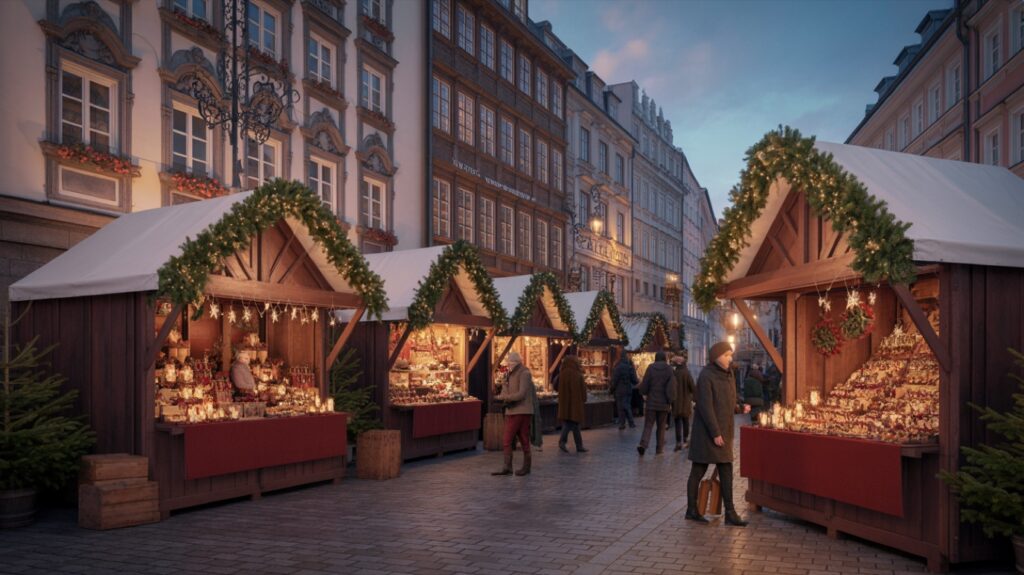
 Illustrative image
 The Origins of the Christmas Market, from Bautzen to Strasbourg
The Christmas market as we know it today, with wooden chalets, fairy lights and the smell of gingerbread and mulled wine, descends from a line of winter fairs born in German lands more than six hundred years ago. Tracing the origins of the Christmas market means following a thread that starts with a trading privilege granted to Bautzen in 1384, runs through Dresden and then Strasbourg, crosses the Protestant Reformation, and only reaches France as a whole in the 20th century, before a boom shared by all of Europe in the 1990s. The thread is long, but each stage has left a written trace that lets you follow it almost without a break.
Bautzen, 1384: the oldest trace in the origins of the Christmas market
The earliest marker dates back to 1384. That year, King Wenceslas granted the town of Bautzen, in Upper Lusatia, the right to hold a duty-free meat market every Saturday between Michaelmas (29 September) and Christmas. At the time, the fair was above all about food: it supplied residents ahead of winter and the festive season, with simple street stalls rather than decorated chalets. Yet the principle was already the one that would shape the following centuries: a recurring trading event, set at the same time every year, anchored in the calendar leading up to Christmas. Bautzen was not an isolated case: other German-speaking towns held comparable fairs at the same period. Vienna obtained the right to a “December market” as early as 1296 to supply its population, and Munich has held its own St Nicholas market since 1310, proof that the idea of winter trade timed to Advent was already circulating across much of the German-speaking world before the word “Christmas” even entered its name. Historians nevertheless regard Bautzen as the earliest documented ancestor of the tradition, the one that gave Advent a market dimension before it even had a festive one.
Dresden, 1434: the Striezelmarkt enters the archives
Half a century later, it was Dresden’s turn to appear in the records. On 19 October 1434, Elector Frederick II of Saxony and his brother Duke Sigismund granted the town council a privilege “for the common good and the betterment of our town”. This document authorised a one-day meat market where residents came to buy their Christmas roast at the end of the Advent fast. The name “Striezelmarkt” comes from Striezel, a sweet leavened bread considered the ancestor of Stollen: around 1500, the term “Striezelmontag”, Striezel Monday, became firmly established in the town’s calendar. Over the 16th century, the success of this event drew merchants from the Erzgebirge, Upper Lusatia and Bohemia, so much so that the town council constantly had to arbitrate between local traders and visiting sellers. The market then gradually became more formal between 1706 and 1721, and from 1787 pitches became positions that could be bought for life. In 1853, the artist Ludwig Richter even made an engraving devoted to the market’s small traders, proof that the festival already held an established place in the popular imagination. Moved several times between 1945 and 1976, after the war and then during the GDR years, it returned to its historic site on the Altmarkt in 1977 and is still presented today as the oldest documented Christmas market in Germany.
From the St Nicholas fair to the Christ Child market
Before the Reformation, most presents given to children were handed out on 6 December, St Nicholas’ Day. Protestant preachers then attacked this practice, which they considered too close to the cult of saints they rejected. The shift happened town by town, but it profoundly changed the German festive calendar, year after year:
- 6 December lost its status as the great gift-giving festival in towns won over to the Reformation.
- Preachers steered gift-giving towards Christmas Eve rather than the feast of a Catholic saint.
- Presents were now brought by the Christkindel, the Christ Child, a figure seen as more in keeping with Reformed theology.
- The market itself changed its name, from “St Nicholas market” to “Christkindlmarkt”, without losing its commercial purpose: toys, sweets and gingerbread remained at the heart of the stalls.
- The two traditions continued to exist side by side depending on the town, some keeping St Nicholas as the main figure, others adopting the Christ Child.
This religious shift, specific to the regions won over by the Reformation, explains why the two figures, St Nicholas on one side and the Christkindel on the other, still coexist today depending on the towns and regions of German-speaking Europe.
Strasbourg, 1570: the birth of the Christkindelsmärik
It was in this context that Strasbourg made its own switch. In 1570, the pastor Flinner spoke out from the pulpit against the custom of the St Nicholas market, which he considered too Catholic for a town won over to the Reformation. The town council then authorised its replacement with a market dedicated to the Christkindel: the Christkindelsmärik, literally the “Christ Child market” in Alsatian dialect. The market first took place near the cathedral, before moving to Place Kléber between 1830 and 1870, then to Place Broglie after 1871, where it still opens every year. A second turning point came in 1992: the city proclaimed itself “Capital of Christmas”, extended its market to eleven sites across the historic centre and saw its visitor numbers change scale. Walking around Strasbourg Christmas market today, you still come across, often without realising it, four hundred and fifty years of intertwined religious and commercial history.
Nuremberg and the Christkindlesmarkt, a Bavarian tradition
In Bavaria, the same religious shift produced another market that became world-famous. The first documented mention of the Nuremberg market dates from 1678, under the name “Kindles-Marck”. Its exact origins remain unknown: historians reckon it took shape gradually, up to 1639, out of the sales of the weekly market. It draws on the practice introduced by Luther, who had his children’s presents brought on Christmas Eve by the Christkind, the Christ Child, rather than by St Nicholas on his feast day. Carried by this long continuity, Nuremberg Christmas market is today among the busiest events in Germany and one of the best-known markets in the world. As in Dresden and Strasbourg, the name changed several times before settling, but the substance has stayed the same since the 17th century: an open-air market, open for a few weeks before Christmas, organised around wooden stalls and local specialities.
A later spread in France, up to the 20th century
For centuries, Strasbourg kept the unbroken tradition going on the French side almost single-handedly. Alsace switched several times between French and German sovereignty, a shifting status that kept the market in the German cultural orbit while rooting it, year after year, in France. The rest of the country took much longer to adopt the custom: it was only during the 20th century that the formula crossed the borders of Alsace, carried by Strasbourg’s tourist appeal and by exchanges with neighbouring Germany and Switzerland. This spread long remained discreet, market by market, town by town, with no text setting a switchover date common to the whole country, unlike the royal privileges which, in Saxony, had brought Bautzen and then Dresden into the official records as early as the 14th and 15th centuries.
Other Alsatian towns developed their own end-of-year events in turn, such as Colmar Christmas market, which today organises its historic centre around several distinct squares, each with its own atmosphere. The rest of France then followed, town by town, with no shared calendar: some cities took inspiration from the Strasbourg model, central square and big Christmas tree included, while others invented a more modest format, a square or shopping street dressed up for a few weeks. The common ground is the same everywhere: wooden chalets, local crafts and an opening timed to the four weeks of Advent. This shared foundation, inherited without saying so from the founding markets of Saxony and Alsace, can be found today on the main square of a préfecture town as much as in a village of a few thousand inhabitants.
The 1990s boom: a rise shared by all of Europe
The real change of scale came in the mid-1990s. Many towns, in France and across the rest of Europe, then set up their own Christmas market, often inspired by the Alsatian or German model. Strasbourg had led the way as early as 1992 by rebuilding its offer around several sites and a “Capital of Christmas” identity; other French, German and Belgian towns followed suit over the following decade, each at its own pace. The Christmas market then stopped being a regional curiosity and became a tourist event recognised across the continent, with shared codes that cross borders: wooden chalets, local crafts, seasonal food and illuminations.
Several factors combined to explain this boom. The growth of short-break tourism pushed medium-sized towns to create a winter highlight capable of attracting visitors outside the summer. Rail links between France, Germany, Belgium and Switzerland also made it easier to travel from one market to another over a weekend. This recent phase explains why so many French towns today have a market born in the 1990s or 2000s, even though the principle itself is nearly six centuries old. The two histories overlap without merging: the old one, of a handful of founding towns, and the more recent one, of a model copied and adapted by hundreds of others.
Key dates
These four dates remain the best documented in this shared history, each marking a distinct milestone: first fair, first document, first religious shift, first mention in Nuremberg.
| Town | Recorded date | Key fact |
|---|---|---|
| Bautzen | 1384 | Royal privilege for a duty-free meat market, from 29 September to Christmas |
| Dresden | 19 October 1434 | First document mentioning the Striezelmarkt, a one-day meat market before Christmas |
| Strasbourg | 1570 | The St Nicholas market becomes the Christkindelsmärik, the Christ Child market |
| Nuremberg | 1678 | First mention of the Christkindlesmarkt, under the name Kindles-Marck |
This chronology is anything but linear. Each town developed its market at its own pace, sometimes as a food fair, sometimes as a religious market, and, much later, as a tourist event. What stands out as you go through it is how constant the substance is behind the changes of form. For six centuries, winter has remained a time when people go out to buy, to give and to get together, well before Christmas Eve closes the calendar of the year. If you pass through Dresden, Strasbourg or Nuremberg this winter, you are walking on six centuries of chalets, under a name that has changed but for the same gathering.
Where to stay near the markets mentioned
Availability with our partners, town by town.
Reviewed and approved by the editorial team
A question, a mistake or a problem on this page? Write to us
Also worth reading
Speculoos, the little carved biscuit that tells the story of Saint Nicholas
Speculoos, the brown sugar biscuit linked to Saint Nicholas: Flemish origins, wooden moulds, spices and where to taste it at Christmas markets in northern France.
Read the article
The Most Beautiful Medieval Christmas Markets in France
Our pick of the most beautiful medieval Christmas markets in France: Provins, Carcassonne, Ribeauvillé, Sarlat and the fortified towns of Alsace.
Read the article
Saint Nicholas and Père Fouettard: 6 December in eastern France
Saint Nicholas and Père Fouettard, the 6 December tradition in eastern France: the legend of the salting tub, parades from Nancy to Épinal, manala and the link with Father Christmas.
Read the article