
The Advent Wreath: Origin, Candles and Tradition
On Sunday 29 November 2026, a first candle is lit on the Advent wreath, then one more every Sunday until 20 December. Four candles on a circle of fir: the custom is widespread above all in German-speaking countries, in Alsace and in North America. Yet the wreath started out in another form: a wooden cart wheel, hung in 1839 from the ceiling of a children’s home in Hamburg, with one candle for each day of Advent. Between that wheel and the four candles placed on the table lie almost two centuries of simplifications, added colours and meanings with no documented basis, right up to the giant wreaths that some Christmas markets put up on their squares.
Where does the Advent wreath come from? A cart wheel in Hamburg
The Advent wreath was born during Advent 1839 at the Rauhes Haus, in Horn, then on the outskirts of Hamburg. Johann Hinrich Wichern, a Protestant theologian and founder of the German Diakonie, had opened a home there in 1833, in an old farmhouse, for children and young people in distress. He wanted to make the wait for Christmas easier and more tangible for the children of the house, who kept asking how many days were left before the feast.
His answer took the form of an object: a wooden cart wheel, hung from the ceiling of the prayer room. Each day, from the first Sunday of Advent to 24 December, one more candle is lit on the wheel, and the children watch Christmas draw nearer without having to count. That first wreath carried some twenty candles, 24 if the house rule is applied to the calendar of 1839, though the exact number has not been established with certainty.
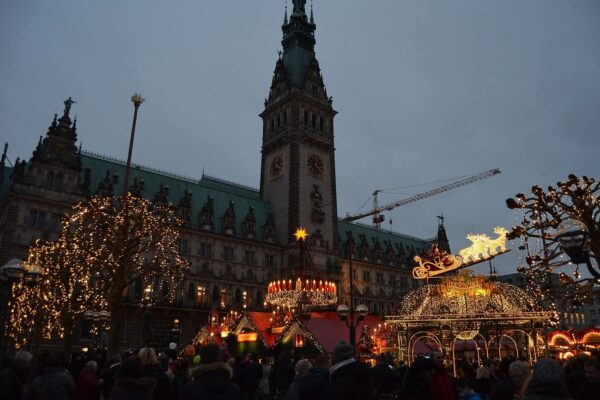
This rule has a consequence that is often forgotten: the number of candles changes every year, since the first Sunday of Advent falls between 27 November and 3 December. A Wichern wreath has between 22 and 28. In 2026, the first Sunday of Advent is 29 November, so 26 candles are needed, 4 large ones for the Sundays and 22 small ones for the weekdays, the last being lit on Thursday 24 December. The Rauhes Haus still lights a wreath of this kind every year and presents one to Hamburg’s city hall, while the Diakonie offers one to the Bundestag before the first Sunday of Advent. The Hamburg Christmas market is a chance to see Wichern’s city in December.
Large white candles, small red ones: what is actually documented
Wichern’s wreath is shown today with large white candles for the Sundays and small red candles for the weekdays. This is the form that the Rauhes Haus and the Protestant Church in Germany present and maintain today.
Nothing proves, however, that this distinction dates from 1839. The only known old image, a black and white engraving kept at the Rauhes Haus, shows candles all of the same size, and the available clues point to identical colours at the start. The difference between Sundays and weekdays therefore seems to be a later tradition, which became the house’s trademark, rather than a decision by the founder.
Fir branches and four candles: how the wreath became simpler
The fir greenery arrived around 1860: the bare wheel was covered with branches, and the wreath took on the look it still has. The move to four candles dates from the early 20th century, when the wreath entered middle-class living rooms. A cart wheel fits poorly in a city room, and tightly packed candles melt into one another. Most often, only the four Sunday candles remained.
It spread first through cities with a Protestant majority, where the wreath ended up in almost every Protestant home. Catholics adopted it next: a first church in Cologne in 1925, a first mention in Munich in 1930. Rome recognised it in December 2001, when the Directory on Popular Piety and the Liturgy described the arrangement of four candles on a wreath of evergreen branches as the symbol of Advent in Christian homes, in use above all in German-speaking countries and in North America.
The Advent wreath in Alsace and in France
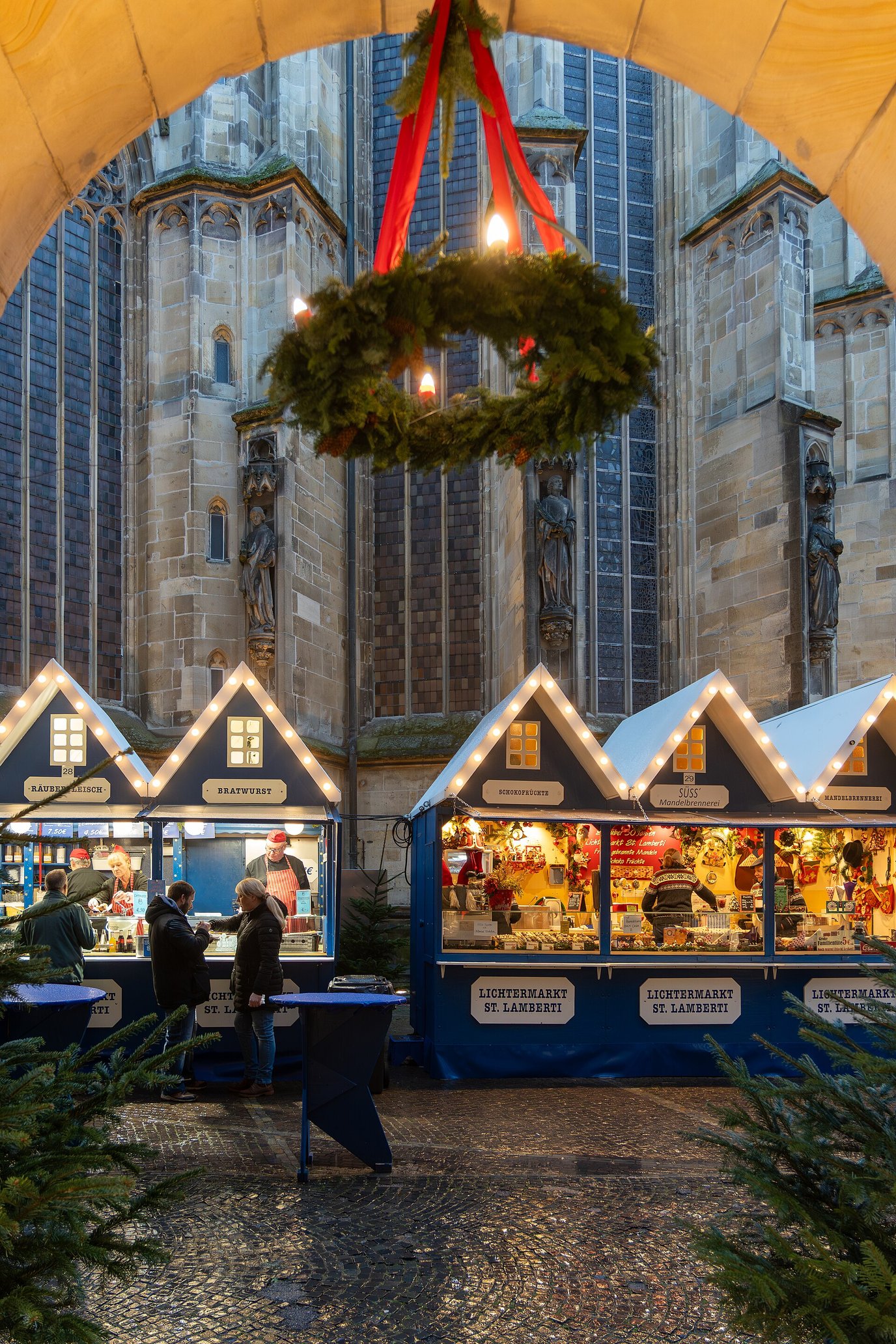
In Alsatian, the wreath is called the Àdvantskrànz. A first mention in Alsace dates from 1894, and the custom spread above all between the two world wars. The Alsatian wreath is made of fir, spruce, holly or laurel branches, with four candles lit one by one each Sunday before Christmas. The rest of France adopted it later, though no precise date can be given. The Christmas tree followed a similar path, from Alsace to the rest of the country.
At the Christmas markets of Alsace, the wreath is one of the seasonal purchases: ready-made wreaths, candles and branches to assemble yourself can be found on the stalls, among the other Christmas market traditions.
Purple, pink, red, white: the meaning of the candles on the Advent wreath
The liturgical colours: purple and the pink Gaudete candle
Purple is the liturgical colour of Advent for Catholics, a time of preparation and waiting. On the third Sunday, known as Gaudete (“rejoice”, the first word of the entrance chant of the Mass), pink is allowed where it is customary, as on the fourth Sunday of Lent. In 2026, this Sunday falls on 13 December. From this comes a widespread Catholic custom: three purple candles and one pink candle, lit on that day. No official text, however, imposes a colour on the candles of the wreath, and the 2001 Directory says nothing about it.
Red and white: the colours of common usage
In Germany and in Alsace, red candles are common, with no liturgical value: they echo the small weekday candles of Wichern’s wreath as it is shown today. White is the colour of the large Sunday candles on the same wreath. Some Catholic families add a fifth white candle in the centre, lit on Christmas Day, a family custom more than a rule.
The names of the candles: a tradition that is not one
Candle of the prophets, of Bethlehem, of the shepherds, of the angels, or of Abraham, David and John the Baptist: several sets of candle names are in circulation, and they do not match from one parish to the next. None is liturgical or linked to a documented historical tradition. The same goes for the pagan or Roman roots sometimes attributed to the wreath: nothing documents them. For the Church, the wreath symbolises the growing light from one Sunday to the next until Christmas. The endless circle and the evergreen foliage are added to it in everyday catechesis.
The four Sundays of Advent 2026, with the candle to light on a classic wreath and the count on a Wichern wreath the same evening:
| Advent Sunday 2026 | Four-candle wreath | Wichern wreath (26 candles) |
|---|---|---|
| 1st Sunday, 29 November | 1 candle lit | 1 candle |
| 2nd Sunday, 6 December, Saint Nicholas Day | 2 candles | 8 candles |
| 3rd Sunday, 13 December (Gaudete) | 3 candles, the pink one in Catholic usage | 15 candles |
| 4th Sunday, 20 December | 4 candles | 22 candles |
| Thursday 24 December | All 4 candles | 26 candles |
Giant wreaths: where to see an extraordinary Advent wreath
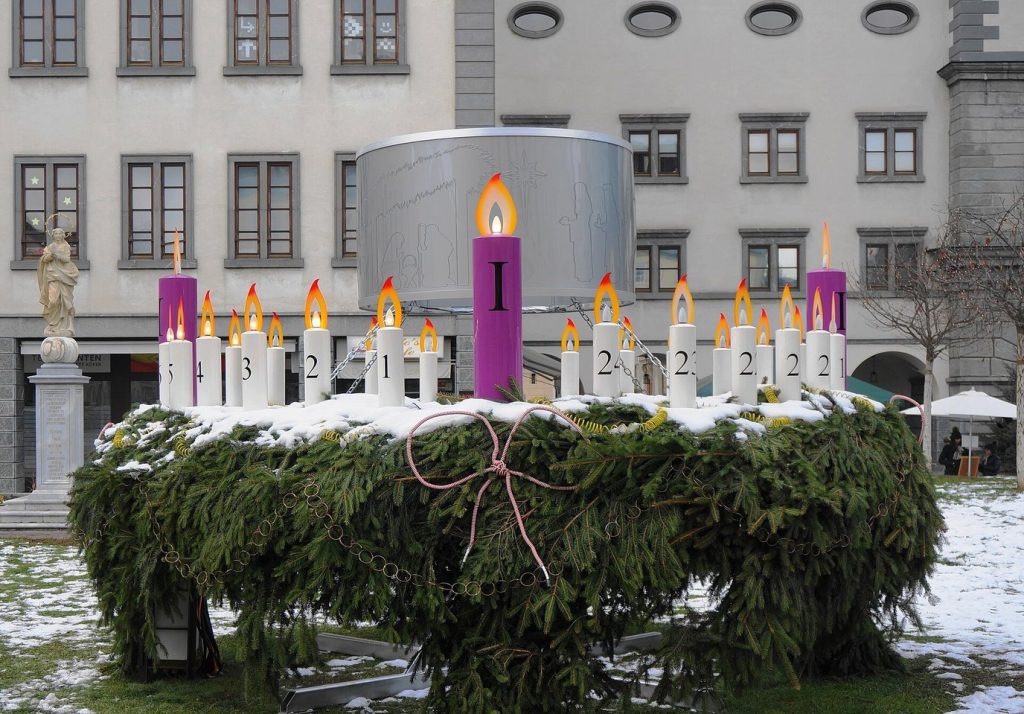
In Klagenfurt, in Carinthia, the cathedral square carries a large Advent wreath with 24 numbered candles, used to count the days like Wichern’s wheel: large purple candles numbered in Roman numerals for the Sundays, small white ones for the weekdays.
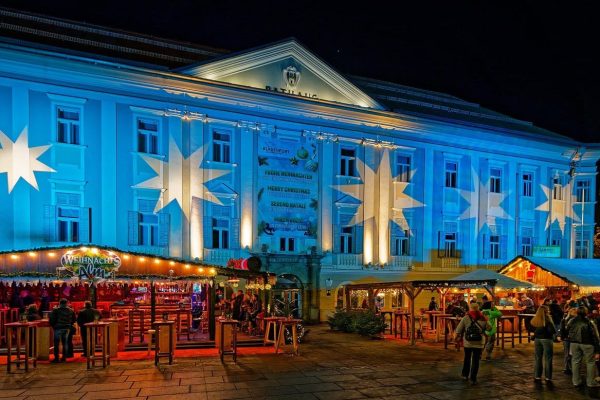
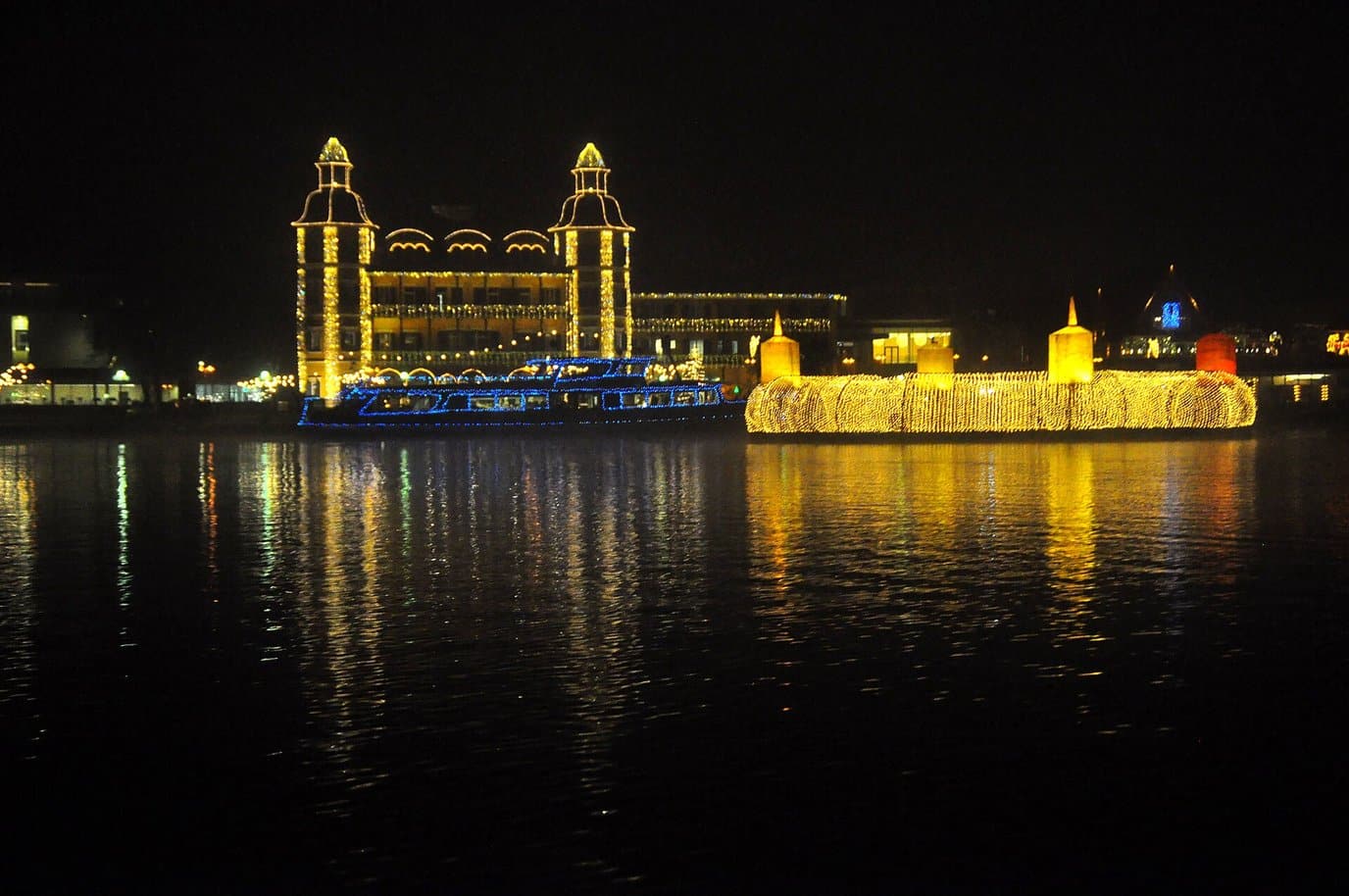
In Velden am Wörthersee, in the same region, the wreath floats on the bay, lit by 80,000 lights, and serves as the emblem of the Veldener Advent. The market runs from 20 November to 20 December 2026, on Fridays from 3pm to 8pm, on Saturdays and Sundays from 11am to 8pm, with two extra openings on Monday 7 December (3pm to 8pm) and Tuesday 8 December (11am to 8pm).
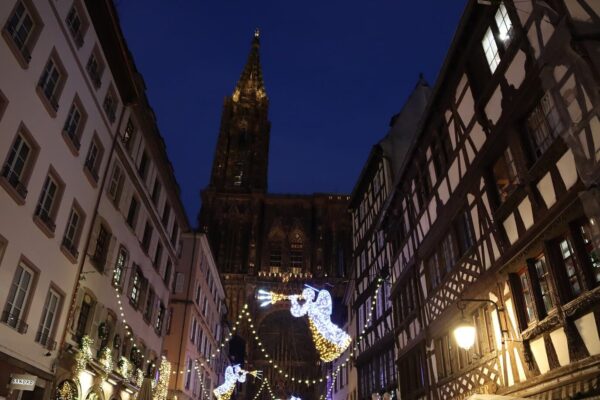
In Strasbourg, the 2025 edition had taken the wreath as its theme: a giant wreath lit up the main courtyard of the Hôtel de Ville, with one more candle lit each week. The 2026 programme of the Strasbourg Christmas market has something else planned for that courtyard.
The largest Advent wreath ever made was set up in 2017 in a field at Mosnang, in the canton of St. Gallen, Switzerland: 120 m in diameter, 400 m in circumference and four electric candles 5.8 m tall. It was blessed on 1 December 2017. The previous record, held in Slovenia, was for a circumference of 100 m.
Advent wreath or door wreath?
The door wreath is not an Advent wreath. Hung outside, without candles, it decorates the entrance and often stays up until after Christmas, a custom found above all in English-speaking countries. The Advent wreath, for its part, is placed or hung indoors, carries candles and serves to count the Sundays. To count the days one by one rather than the Sundays, there is still the Advent calendar.
Reviewed and approved by the editorial team
A question, a mistake or a problem on this page? Write to us
Also worth reading
5 traditions to know before you visit
From medieval origins to today's markets Christmas markets date back to the 14th century, in the German-speaking towns of central Europe. In France, it is…
Read the article
Mulled Wine and Its Variations, from Alsace to Scandinavia
Glühwein, Alsatian mulled wine, glögg, Austrian Punsch: a tour of Europe's mulled wine variations served at Christmas markets, with no recipe.
Read the article
Christmas in Provence: santons, thirteen desserts and lit-up lanes
Our pick of Christmas markets in Provence: santon fairs, thirteen desserts and villages of the south, from Marseille to Nice, town by town.
Read the article