
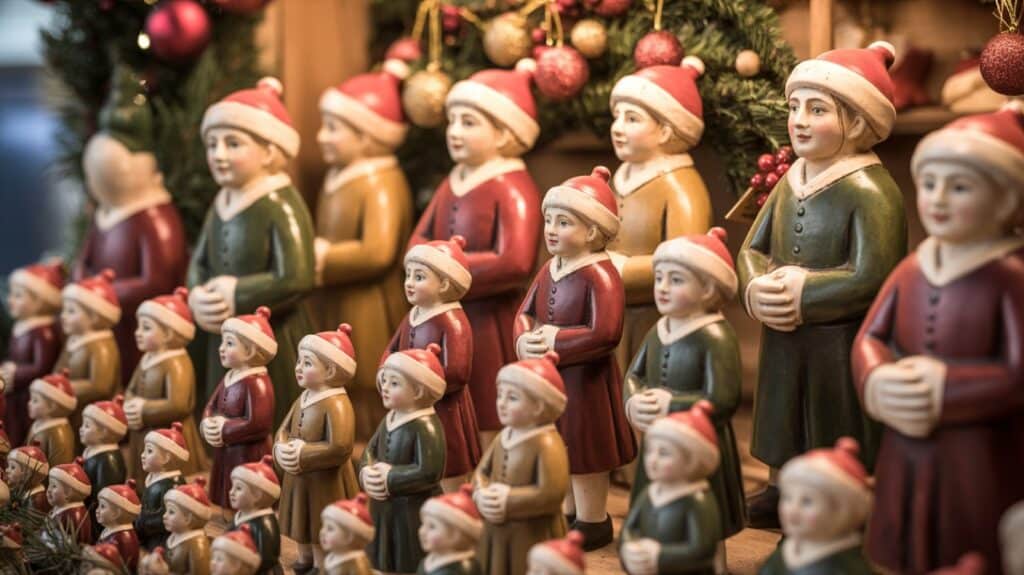
 Illustrative image
 Christmas in Provence: santons, thirteen desserts and lit-up lanes
A Christmas market in Provence is like no other. Here winter keeps the light of the south, the stalls smell of olive oil and orange blossom, and the little clay people of the nativity scenes keep families company until the end of January. This selection follows one particular thread: the Provençal culture of Christmas, the culture of santons, of the thirteen desserts and of the cobbled lanes known as calades. Every town adds its own character, between santon fairs a century old and villages by the sea.
The santon, soul of a Provençal Christmas
Before talking about the markets, you have to understand what sets them apart. The clay santon was born in Marseille under the hand of Jean-Louis Lagnel (1764-1822), who had the idea of modelling small nativity figures that any family could afford. The first subjects were shaped from breadcrumbs, then the red clay from the local quarries took over. The first santon fair dates from 1803, on the Vieux-Port, and launched a tradition that has never stopped since.
The principle of the Provençal nativity scene lies in that miniature crowd: shepherds, the ravi, the miller, the fishwife, the knife grinder. The whole village of the old days gathers around the Nativity, and each santon maker adds figures of his own, sometimes people from the neighbourhood or forgotten trades. At a market in the south you will therefore come across santon makers' stalls where elsewhere you would mostly find food chalets. That signature makes the experience different, and explains why so many fairs are called a “santon fair” rather than a Christmas market.
Understanding that root changes the way you visit. You are no longer looking only for mulled wine and bredele, you are also watching the maker's hand, the painstaking painting on a figure four centimetres tall, the cork and moss setting that recreates a village clinging to its hill. It is a living craft, passed from workshop to workshop, and the markets of Provence are its annual showcase.
Marseille and its santon fair on the Vieux-Port
The starting point is the Vieux-Port. The santon fair of Christmas in Marseille has returned to the Vieux-Port every year for more than two centuries, which makes it one of the oldest events of its kind in France. Dozens of santon makers show their work there, from the classic figure to recent ones that sometimes slip present-day characters into the nativity scene.
Around it, the city takes on its Mediterranean mood: low light on the water, ochre façades, the scent of navettes flavoured with orange blossom that you nibble as you walk. The fair occupies the top of the Vieux-Port, facing the boats and the hill of Notre-Dame-de-la-Garde. If you want to grasp where the Provençal Christmas comes from, this is the central landmark. The rest of the selection almost follows from it, each town taking up the santon theme in its own colours.
Aix-en-Provence and Aubagne, two capitals of clay
A few kilometres away, two towns share the title of santon reference. The santon fair in Aix-en-Provence is held on the esplanade in the heart of the town, in the elegant setting of the fountains and the private mansions of the Cours Mirabeau. The contrast between the pale stone and the strings of lights gives this market a very composed, almost museum-like feel.
In Aubagne, you reach the source. The town is recognised as the capital of the santon and of ceramics: it is here, in the red clay of the local quarries, that the tradition took root. Its santon and ceramics market brings together workshops and makers in the atmosphere of a studio rather than a shop window. For anyone interested in the gesture, the firing, the modelling, the visit is worth the trip.
| Town | Signature | Setting |
|---|---|---|
| Marseille | Historic santon fair (since 1803) | Vieux-Port |
| Aix-en-Provence | Elegant fair, heritage setting | Esplanade, old centre |
| Aubagne | Birthplace of clay and ceramics | Avenues and workshops |
Avignon, Arles and the cities of the Rhône
Along the Rhône, the Provençal Christmas takes on notes of stone and history. In Avignon, the chalets stretch out at the foot of the ramparts and the Palais des Papes, in a medieval setting that changes everything: the light of the decorations catches the Gothic façades and keeps the walk going late into the evening.
In Arles, home of the living nativity and of Camargue traditions, the spirit stays very local. You find regional produce, crafts, and that very Arlesian way of mixing Christian feast with Provençal culture, between Roman arenas and traditional costume. The two towns make a fine pair for a weekend centred on heritage as much as on food, with listed monuments at every corner and markets on a reasonable scale that you can walk without hurrying.
Salon, Martigues and Istres, the Provence of the lagoons
Between the Rhône and the Étang de Berre, three towns offer a more intimate version of Christmas in the south. Salon-de-Provence, Nostradamus's town, brings its old centre to life around the Château de l'Empéri, with family entertainment and a compact market that is easy to cover.
In Martigues, nicknamed the Venice of Provence for its canals, the water reflects the lights and creates a singular atmosphere. The Île quarter, with its colourful fishermen's houses and its bridges, inspired generations of painters; in December, the lights mirrored in the canals add a layer of quiet magic. A little further north, Istres banks on a village feel and on local producers, with friendly events where Provençal crafts take the lead role.
These three stops suit anyone who wants a taste of the Provence of the lagoons, with the same base of santons and specialities as on the coast, but in a more family atmosphere. You take the time to talk with the makers, to leave with a santon chosen at the stall, to try a fresh pompe à l'huile. It is a less photographed side of the south, and yet very true to the Provençal spirit of Christmas.
- Salon-de-Provence: historic centre, Château de l'Empéri, family atmosphere.
- Martigues: lit-up canals, reflections on the water, harbour character.
- Istres: village spirit, producers and makers from the area.
The coast in festive mood: Nice, Cannes, Antibes, Toulon and Hyères
Off to the Mediterranean, where Christmas is lived facing the sea. The Christmas village in Nice spreads its chalets across Place Masséna and the Jardin Albert 1er, with a fine density of entertainment, craft stalls and food. The light on the Italianate façades and the blue of the Nice sky give the season a particular flavour. It is one of the liveliest atmospheres in the south, carried by a city that lives outdoors even in winter.
In Cannes, the Christmas village settles on the Vieux-Port and along the Croisette, between lights, concerts and parades that turn the town into a winter tale. A little further on, Antibes adds the card of old-world charm: its old town with its cobbled calades, its covered Provençal market and its ramparts facing the open sea make up a more intimate setting, where you move from lit-up palm trees to santon stalls without leaving the seafront.
Further west, the Var completes the picture. Toulon brings its centre to life around Place d'Armes and the naval port, with a market generous in regional produce and crafts, a couple of steps from the harbour. Hyères, the town of palm trees, plays the Mediterranean card to the full: medieval lanes in the old hilltop town, palms dressed in lights, mild weather even in December. These five stops are a reminder that Christmas in Provence is not limited to the Bouches-du-Rhône, and that a Christmas with your feet almost in the sand has a charm of its own.
Thirteen desserts and gros souper: the Provençal Christmas table
At the markets you will find many of the ingredients of the great table tradition of the south. On the evening of 24 December, Provence keeps up the gros souper, a meatless meal served before midnight mass, once laid on three white tablecloths one over the other with three candlesticks and sprouted Saint Barbara wheat. The rules have loosened over time, but the idea is the same: sharing a proper family meal before the feast begins.
The meal closes with the famous thirteen desserts, a symbol of Christ and the twelve apostles. The base brings together the four beggars (fig, almond, walnut, raisin), whose colours recall the mendicant religious orders, the two nougats (white and black) and the pompe à l'huile, the olive oil brioche that you break by hand rather than cut, or so they say, on pain of ruining yourself for the year. To these are added fresh fruit, dates, calissons from Aix and candied fruit depending on the family.
Custom says the desserts stay on the table for three days and that everyone tastes all of them, in equal measure, to be sure of a good year. One notable fact: although the tradition goes back to the 17th century, the figure of thirteen does not appear in writing until 1925, which leaves every family free to put together its own list. On the stalls of Provençal markets, calissons, nougats and candied fruit are sold in abundance from mid-November, so you can lay the table without rushing.
- The four beggars: fig, almond, walnut, raisin.
- White nougat and black nougat.
- The pompe à l'huile, to break rather than cut.
- Dates, candied fruit, calissons and seasonal fruit.
On many stalls, spiced mulled wine goes with that winter wandering. To make it at home and keep the market mood going, take a look at our mulled wine guide, which gathers everything you need to warm up December evenings.
Putting together your Christmas route in Provence
All that is left is to link it all up. A Marseille-Aix-Aubagne axis can be covered in a day and concentrates the heart of santon culture: the historic fair on the Vieux-Port in the morning, the Aix esplanade in the afternoon, the Aubagne workshops to finish. It is the best way in if you want to understand where all the rest comes from.
The Avignon-Arles pairing works for a heritage weekend, between ramparts and arenas. The Côte d'Azur (Nice, Cannes, Antibes) and the Var (Toulon, Hyères) lend themselves to a coastal road trip, the sea on one side, the chalets on the other. And the lagoon towns (Salon-de-Provence, Martigues, Istres) offer a breather between two major stops, with more family-scale markets.
One practical tip: most of these markets open in mid-November and run until early January, far longer than in the rest of France, thanks to the santon tradition. So you have room to combine several towns in a single trip. Each town page on the site gives the dates, the hours and the access details to build your programme without any nasty surprises, and to help you choose between a historic santon fair, a seaside village and a stone city on the banks of the Rhône.
Where to stay near the markets mentioned
Availability with our partners, town by town.
Reviewed and approved by the editorial team
A question, a mistake or a problem on this page? Write to us
Also worth reading
5 traditions to know before you visit
From medieval origins to today's markets Christmas markets date back to the 14th century, in the German-speaking towns of central Europe. In France, it is…
Read the article
Alsatian Christmas Specialities: a Guide to the Treats of the Market
Bredele, gingerbread, manala, pretzel, tarte flambée: the guide to Alsatian Christmas specialities and the markets where you can taste them.
Read the article
The Christmas Markets That Come Into Their Own After Dark
A Christmas market by night, from dusk onwards: the great tree in Strasbourg, the projection shows in Reims and Amiens, the reflections of Colmar. Our pick, town by town.
Read the article