
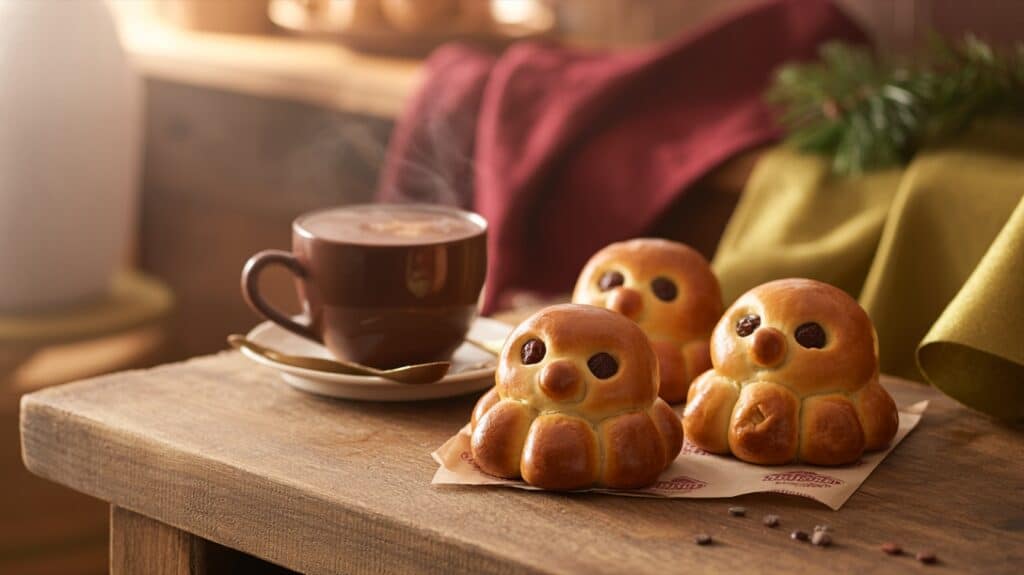
 Illustrative image
 Saint Nicholas Day, a foretaste of Christmas in eastern and northern France
Three weeks before Christmas Eve, another celebration has already got the party started. On 6 December, Saint Nicholas Day works as a foretaste of Christmas in eastern and northern France: the first parades, the first lights, the first treat slipped into a school bag. In homes across Lorraine, Alsace, the Nord and on into Belgium, this date matters almost as much as 25 December itself, and sometimes more. This page brings together what the day involves, from still-warm manalas to cards swapped between schoolchildren, not forgetting a pronunciation quarrel that has divided Alsace for generations, without going back over in detail what another cornerstone page of the site already tells about the legend and Père Fouettard.
6 December, a dress rehearsal for Christmas
The comparison is no exaggeration. In the Grand Est region, bakers’ windows fill up, the first markets open their chalets, and children learn the song that tells the origin of the celebration at school. A good part of what will come back on a bigger scale at Christmas plays out here for the first time, on a more modest scale: lights on the façades, the smell of gingerbread in the shopping streets, the first whiffs of mulled wine around the chalets, the processions that bring young and old together on the pavements. Some towns even switch on their street lights for the occasion, several weeks before the official date of the big Christmas weekend.
On the evening of 5 December, children in Lorraine and Alsace put their little shoe in front of the fireplace or the front door, just as they will again for Christmas three weeks later. In the morning, clementines, chocolates and sometimes a manala are waiting for them there, before they set off for school. This head start on the calendar does not stop at the borders of Lorraine or Alsace: the Nord and Pas-de-Calais also celebrate the day in their own way, as does neighbouring Belgium, where Saint Nicholas remains a central figure in early December. The celebration also exists in Luxembourg, carried by the same Germanic roots as its neighbours. 6 December thus traces a coherent geographical band, from the heart of Lorraine to the plains of the Nord and Belgium, where growing up without knowing Saint Nicholas is almost unheard of.
A gruesome legend, in brief
The founding story does not do things by halves. Three children lost in the night knock at a butcher’s door; he kills them, cuts them up and puts them in his salting tub. Nicholas passes by years later, asks for the salted meat, uncovers the crime and brings the children back to life with a simple gesture over the barrel. The gruesome core is no accident of transmission: it is what has allowed the story to cross the centuries without fading from children’s memories, unlike smoother tales that are quickly forgotten once Advent is over. A butcher, a salting tub, a resurrection: the story runs on three powerful images, easy to remember and to pass on in turn, from one generation to the next.
The moral, for its part, stays crystal clear despite the dark setting: evil is punished, innocence is protected, and kindness always wins in the end. That is probably why the story is still handed down as a song, at school and in the family, rather than as a fixed text in a book. The lyrics even scroll across the screen in this filmed version (in French).
To read the legend in full, with its regional variations, the French Wikipedia page on Saint Nicholas Day tells the story well beyond the chorus. Nicholas of Myra, his relic that reached Bari and then Saint-Nicolas-de-Port, and his dark shadow Père Fouettard, born during the siege of Metz in 1552: the cornerstone page on the legend of Saint Nicholas and Père Fouettard covers all of this in detail, including the big parades in Lorraine.
The manala, the brioche that kicks off the festivities
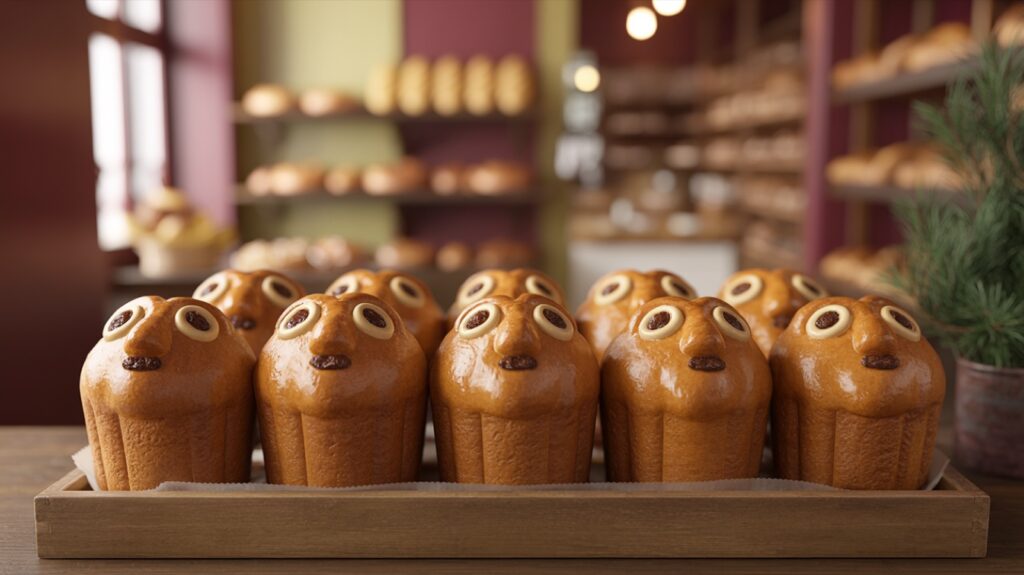
You cannot talk about 6 December without this little brioche man. With eyes made of raisins or chocolate chips, the manala is eaten at breakfast with a hot chocolate that warms you up before school. Bakeries in Alsace fill their windows with them from the last days of November, and the plain brioche now sits alongside all-chocolate versions, sweeter and very popular with children. The shape itself is far from arbitrary: arms folded or by its sides, a clearly marked round head, the little man is recognisable at a glance on the counter, between the wreaths and the bredele. Under the golden crust, the crumb stays soft and slightly sweet, made to be eaten warm, fresh from the oven or reheated for a few minutes before leaving for school.
Nursery and primary schools often hand one out on the morning of 6 December, with no particular fuss, just a seasonal ritual shared by the whole class. Many families also prefer to knead their own, letting the children put the eyes in place before baking: the dough is easy to shape into a little man, and the result matters more than a perfect shape. The cornerstone page on the manala gives its full recipe and the best places to find one at the markets. Children happily slip one into a pocket alongside a few bredele, the little biscuits that go with the whole of Advent in Alsace.
Mannele or manala? The quarrel that gets Alsace going
That leaves one question on which people in Alsace disagree, and not just a little: what exactly is this little man called? In the Bas-Rhin, around Strasbourg, people say mannele, or männele with the umlaut. In the Haut-Rhin, around Mulhouse, people say manala. Each side remains convinced it is right, and the discussion can get heated at the table between guests from the two departments, each defending their version without giving an inch.
In reality, it is the same brioche under two dialect pronunciations, inherited from two local traditions of Alsatian: mannele in the north, manala in the south, with neither version more legitimate than the other. The two words also share the same root, “Mann”, the Alsatian for man, simply softened by a different diminutive depending on the area. The custom goes back to the 15th century, and the symbolism is also debated. For some, the figure represents Bishop Nicholas; for others, it recalls the three children from the salting tub brought back to life. Either way, biting into a manala means re-enacting the legend in your own way, whatever name you give it when sharing it with the family. Outside Alsace, most people do not even know such a debate exists: the brioche is simply called “the little Saint Nicholas man”, and nobody wonders about the Bas-Rhin or Haut-Rhin version of the name.
In the Nord, Saint Nicholas cards between boys
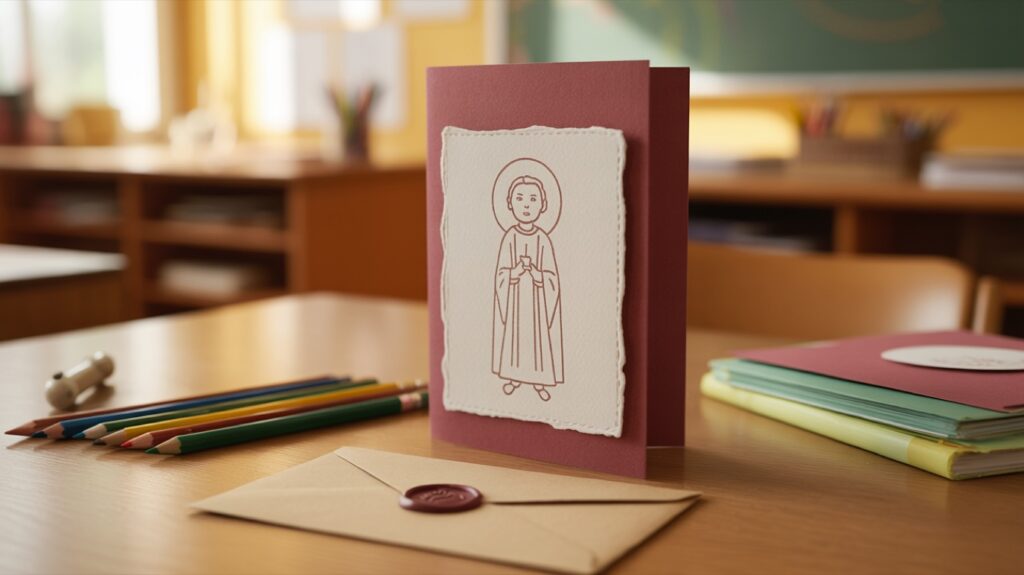
The Nord and Pas-de-Calais have their own version of the celebration, less spectacular than the big parades in Lorraine but just as rooted in local habits. There, as in nearby Belgium, 6 December is also the day when boys swap Saint Nicholas cards with each other, at school or in the family. The idea is simple: a drawing, a few words, a card handed from one friend to another, without any great ceremony or staging. Some schools make it a small group moment, others leave it to the children themselves, following the friendships in the class.
This custom mirrors that of St Catherine’s Day, celebrated on 25 November, when girls, the famous Catherinettes, used to swap their own cards. The two celebrations echo each other a few days apart: St Catherine’s Day for the girls in late November, Saint Nicholas Day for the boys in early December, each with its ritual of cards slipped into school bags in the Nord. Here too, 6 December arrives ahead of time, in a quieter way than the big processions in Lorraine, but with the same idea of an occasion that comes before Christmas and heralds it. The card itself stays modest: a drawing coloured in class, a scribbled note, sometimes slipped into a classmate’s school bag without even waiting for one in return.
What you will find at the Christmas markets that day
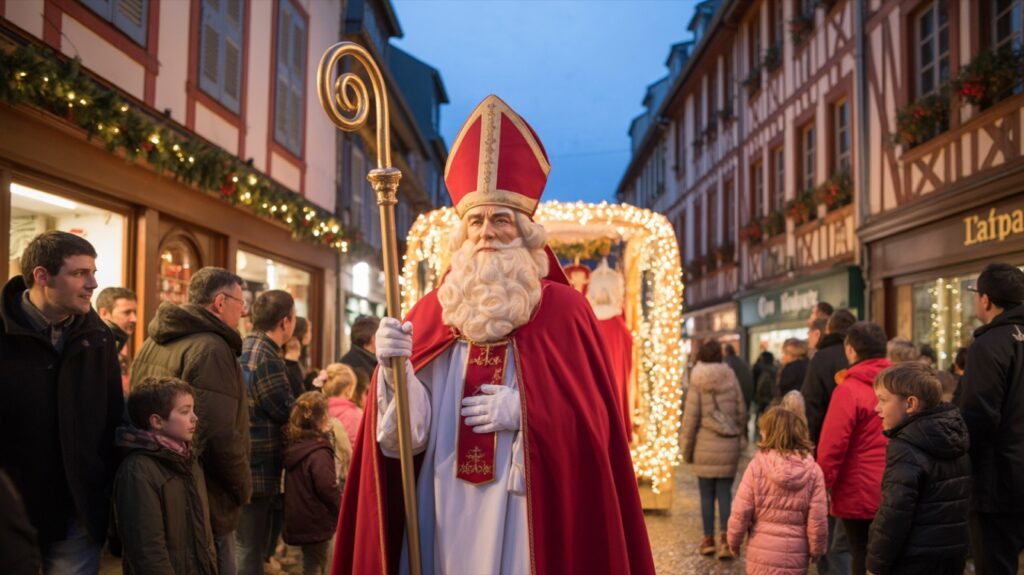
On the first weekend of December, the markets in the east often take on the feel of a celebration in their own right. Saint Nicholas processions parade to music through several towns, led by illuminated floats, and Père Fouettard slips in as a dark silhouette, whip in hand, to play the villain opposite the saint. Nancy Christmas market celebrates these days on the grandest scale, with illuminated floats and brass bands, while Strasbourg Christmas market and Épinal Christmas market each carry on the festivities on their own squares, at their own scale. Further north, Lille Christmas market has an atmosphere close to that of neighbouring Flanders, where Saint Nicholas cards are already doing the rounds between the stalls and the school playgrounds.
The atmosphere of these days comes as much from the smells as from the decorations: burnt wood from the chalets, hot sugar, spices rising from the stalls as the cold sets in. On these stalls, a few classics come back from one market to the next, with a local flavour specific to each town:
- Manalas and mannele, sold warm from opening time, sometimes offered with a cup of hot chocolate to take away.
- Gingerbread, often decorated with a picture from the Épinal print tradition, sliced or heart-shaped.
- Bredele and little Advent biscuits, sold in bags or individually on the stalls.
- Clementines and papillotes, a direct legacy of the little shoe left out the night before.
There is nothing to stop you planning a visit for that first weekend of December, when the processions are on and the chalets are still fresh for the season, before the crush of the last weeks before Christmas sets in.
A foretaste, not a replacement
Saint Nicholas Day is not trying to compete with Christmas: it comes first and paves the way. A child in Lorraine or Alsace thus lives through two separate celebrations three weeks apart: one carried by a 4th-century bishop and his gruesome legend, the other by a grandfatherly figure in a sleigh from a completely different folklore. The two coexist without treading on each other’s toes, each with its own setting, treats and songs, and nobody seems to complain.
That may be why 6 December still keeps its special place in the winter calendar today: neither a copy of Christmas nor a mere commercial excuse, but an occasion in its own right, between a repentant butcher, a little brioche man and cards slipped into a school bag. Enough to keep you smiling while you wait for the big night itself.
Where to stay near the markets mentioned
Availability with our partners, town by town.
Reviewed and approved by the editorial team
A question, a mistake or a problem on this page? Write to us
Also worth reading
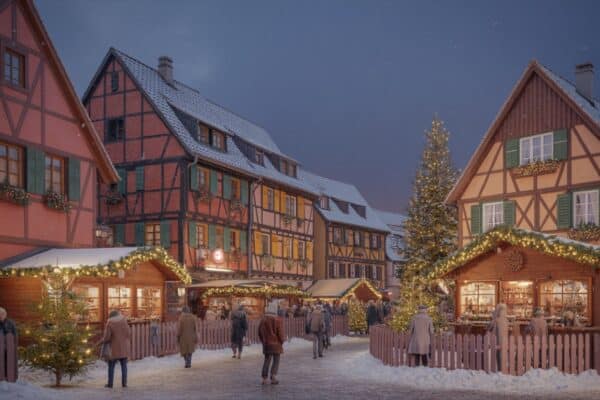
Alsace Christmas markets: the guide to planning your trip
Alsace Christmas markets: which ones to visit, when to go and how to combine Strasbourg, Colmar and the villages of the Route des Vins.
Read the article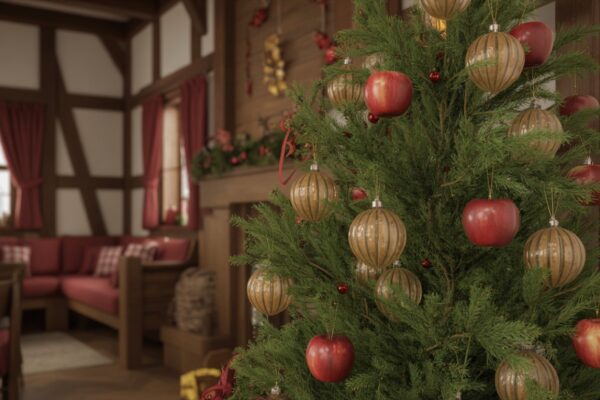
The Christmas tree, a story born in Alsace
The history of the Christmas tree, from the medieval tree of paradise to Sélestat in 1521, then the glass baubles and its spread across France.
Read the article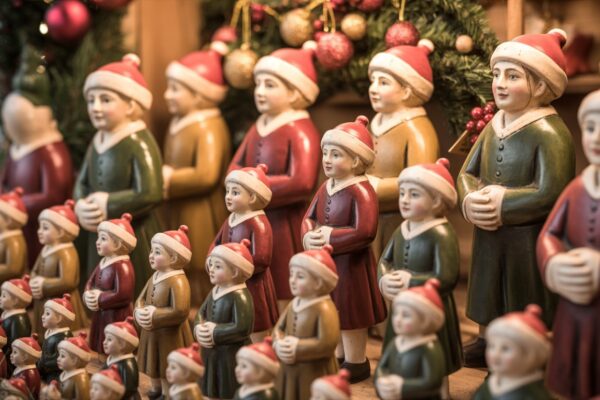
Christmas in Provence: santons, thirteen desserts and lit-up lanes
Our pick of Christmas markets in Provence: santon fairs, thirteen desserts and villages of the south, from Marseille to Nice, town by town.
Read the article