
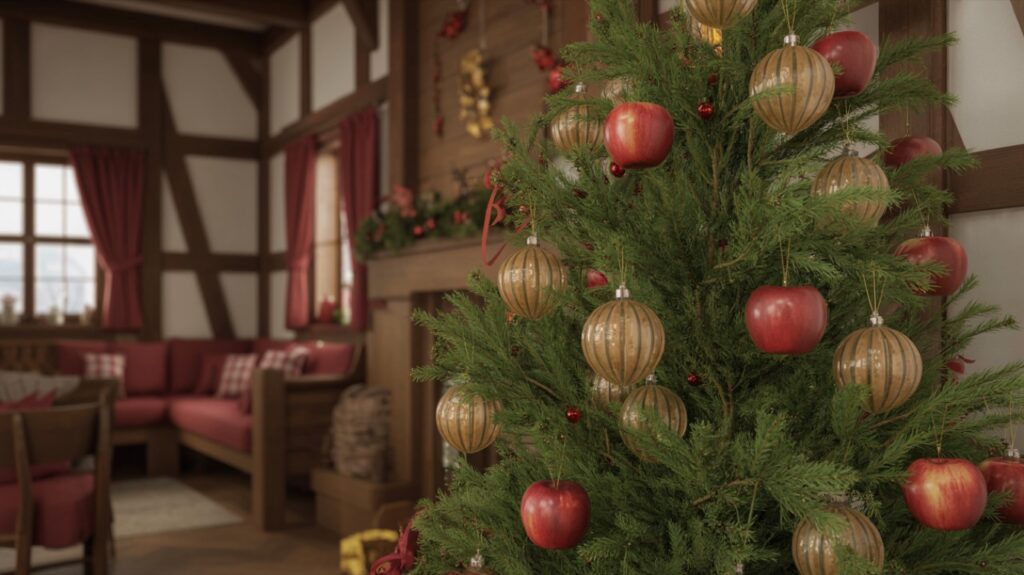
 Illustrative image
 The Christmas tree, a story born in Alsace
Every winter you put up a Christmas tree in the living room, hang the baubles, string the lights. The gesture feels as old as Christmas itself. Yet the decorated tree as we know it has a fairly precise birth date, a clear geographical cradle and a chain of transmission that runs through Alsace, then the French court, then the whole world. Tracing that story means understanding why a conifer ended up at the centre of the feast, and why the markets of Alsace still make it their emblem.
Before the decorated tree: greenery in the heart of winter
The idea of keeping something green when everything else is bare did not come with Christianity. In several cultures of northern Europe, conifer branches were already used to mark the winter solstice. Green that survives the frost carried a simple message: life goes on even when the days shorten and the forest strips bare. The Romans already decorated their houses with green branches for the Saturnalia at the end of December. Further north, Germanic and Scandinavian peoples credited the conifer with a protective role against the evil spirits of the longest night of the year.
The fir tree combines two qualities that explain its career. It stays green all year, and its conical shape points to the sky. Those symbols were reread later through a Christian lens, but the fascination with the evergreen tree came long before. When the custom of the Christmas tree took hold, it built on ground already prepared by centuries of seasonal habit. Christianity did not invent the gesture: it gave new meaning to an object that winter had already loaded with promise.
The tree of paradise, and Adam and Eve
The real direct ancestor of the decorated tree appears on the forecourts of medieval churches. In the 13th and 14th centuries, short plays telling the story of Genesis were performed on the evening of 24 December. On stage, Adam and Eve bit into the forbidden fruit and were driven out of the garden of Eden. To represent the tree of the knowledge of good and evil, the actors planted a conifer, the only tree still in leaf in the middle of December.
That “tree of paradise” carried red apples, a direct echo of Adam's fall. The date of 24 December is no accident: the Christian calendar celebrated Adam and Eve on that day, the eve of Christ's birth. When these performances were gradually set aside, the apple-laden tree left the church forecourt and came into people's houses. Decorating a tree at home descends in a straight line from that piece of religious stage scenery.
The symbolism grew richer along the way. The green of the foliage suggested hope and life carrying through winter. The triangular shape of the fir was reread as a sign of the Trinity. The tip, for its part, called for the star that would crown it, echoing the star of the Magi. Every item hung on the tree carried a meaning, well before the glass bauble and the electric garland took over in a vocabulary that has become mostly decorative.
Sélestat 1521: the earliest written trace
It is in Alsace that the oldest written mention of a Christmas tree is found. In Sélestat, the town's account book records in 1521 a payment of four schillings to the forest wardens tasked with watching over the fir trees of the communal forest. The register is kept at the town's Bibliothèque Humaniste, which has made it a local treasure.
That accounting detail says a great deal. If the town paid wardens and threatened a fine for anyone cutting a tree on the sly, demand must already have been strong as Christmas approached. So many young firs were being felled that the communal forest had to be protected. The custom was therefore not new in 1521: it was established enough to create a forest management problem. The register in fact speaks of a practice followed “from time immemorial”, a sign that the Christmas tree was already part of the scenery before any accountant thought to note it down. Some researchers point to an even earlier trace in Strasbourg, slipped into a register from 1492, but Sélestat remains the quiet, documented reference in this story. If you want to see the cradle of the tradition, the Sélestat Christmas market puts that seniority at the centre of its atmosphere every year.
From red apples to glass baubles
For a long time the tree was decorated with whatever nature and the house had to offer. In the 16th century it was mostly hung with red apples and communion wafers: the apple recalled the fall, the wafer announced redemption through Christ. Over time came small gingerbread pieces, paper flowers, fabric ribbons and sweets. The tree then told a complete story, from the fall to the promise.
The decorative turning point happens in Lorraine, very close to Alsace. In 1858, a poor harvest left households without apples to dress the tree. A glassmaker in Goetzenbruck, a village next to Meisenthal, had the idea of blowing glass baubles to replace the missing fruit. The object caught on, production industrialised quickly, and the glass bauble became the leading Christmas tree decoration. The Goetzenbruck glassworks would blow up to several hundred thousand a year, exported well beyond the region. Meisenthal remains associated with that know-how, revived by the Centre International d'Art Verrier at the end of the 1990s. The baubles still made there follow the original gestures: glass blown by mouth, then silvered on the inside to catch the light.
| Decoration | Period | What it said |
|---|---|---|
| Red apples | 16th century | The fall of Adam and Eve |
| Communion wafers, then paper flowers | 16th-17th century | Redemption through Christ |
| Gingerbread, ribbons, sweets | 17th-18th century | Treats and celebration |
| Blown glass baubles | From 1858 | The failed apple harvest, replaced |
That gingerbread story is not just an image: the Alsatian speciality really did serve as an edible ornament. To understand why it fits Christmas so well, our article on gingerbread retraces its journey, and the one on bredele tells the other great sweet tradition of the Alsatian holidays.
From Alsace to the French court
For a long time the decorated tree remained a regional and Protestant affair, confined to Alsace, the Basel area and the German lands. The Reformation had favoured this pious family tree, kept at a distance from very Catholic nativity scenes. It needed a relay to cross those borders.
That relay arrives in 1837. Hélène de Mecklembourg, a Lutheran princess of German origin and daughter-in-law of King Louis-Philippe, had a fir tree put up at the Tuileries Palace. The court looked on the object with curiosity, and a bourgeois fashion took hold in the 1840s, centred on family and piety. The momentum stayed limited, though: the tree won over Parisian drawing rooms without winning the country. The custom struggled to leave the royal residence and the circles close to power.
Real nationwide spread came from a more painful episode. After the Franco-Prussian war of 1870, many people from Alsace and Lorraine left their annexed region and settled all over France. They took their customs with them, the tree among them. In a single generation, the Christmas tree went from regional curiosity to shared family ritual. What had not worked from the top, from the court, happened from below, carried by ordinary families attached to a piece of home. The tradition we believe to be universal is therefore, in part, a legacy of Alsatian exile.
Alsace, keeper of the tradition
Alsace still claims that founding link today, and its towns bring it to life every December. In Strasbourg, the great tree on Place Kléber has become a fixture known well beyond the region, raised in the middle of a market that is among the oldest in Europe. In Colmar, the trees punctuate an old town of colourful façades that seems made for the season.
The tradition is not limited to the big towns. In the wine villages, the tree keeps a more intimate side. The Riquewihr Christmas market and the one in Eguisheim show trees in conversation with half-timbering and ramparts. In Kaysersberg as in Obernai, the tree stands at the centre of the square, surrounded by chalets. And over towards Munster, in the valley, the fir almost returns to its original setting, the Vosges forest where people went to cut it. The markets of Turckheim and Ribeauvillé extend that geography of the fir tree, between the vineyard plain and the first foothills of the Vosges.
The link between Alsace and the Christmas tree is nothing like a tourist reconstruction. It rests on a real continuity: the forest that supplies the conifer, the Lorraine glassmakers close by who invented the bauble, the families who carried the custom as far as Paris and beyond. When you come across a tall fir on an Alsatian square in December, you are looking at the end of a chain that runs back, unbroken, to the register of 1521.
- Sélestat: the documented cradle, with its 1521 register kept at the Bibliothèque Humaniste.
- Strasbourg: the great tree on Place Kléber, emblem of the market.
- Colmar and Riquewihr: trees set among old stone and painted façades.
- Munster: the Vosges valley, natural home of the conifer.
Real or artificial: today's debate
The big modern question is no longer about the symbol but about the choice: a living tree or a fake one? The real fir still dominates French homes, and two species account for most sales. The Nordmann wins out for its soft needles, which hold well and do not drop too fast, making it the favourite for living rooms. The spruce, more classic, appeals with its frank scent of resin but loses its needles quickly once cut. The Nordmann also goes by the name of Nordmann fir or Caucasian fir, after the botanist who described it in the 19th century. Most trees sold in France are grown for that purpose, chiefly in the Morvan, rather than taken from wild forests.
The artificial tree makes its case: reusable from one year to the next, clean, no watering. The environmental debate stays open and depends above all on how long it is used. A plastic tree has to serve many years to compete with a locally grown fir, often cultivated for that very purpose and compostable at the end of its life. There is no single answer: your choice depends on what you want from the object, between the living gesture and convenience.
Whichever camp you are in, the tree keeps its first function: gathering people around it. Once the tree is up and the baubles hung, all that is missing is a mulled wine for the evening to take on its true face. That is where, between the green branches and the lights, a five-hundred-year-old story is played out again each year, starting from an Alsatian account book and ending in your living room.
Where to stay near the markets mentioned
Availability with our partners, town by town.
Reviewed and approved by the editorial team
A question, a mistake or a problem on this page? Write to us
Also worth reading
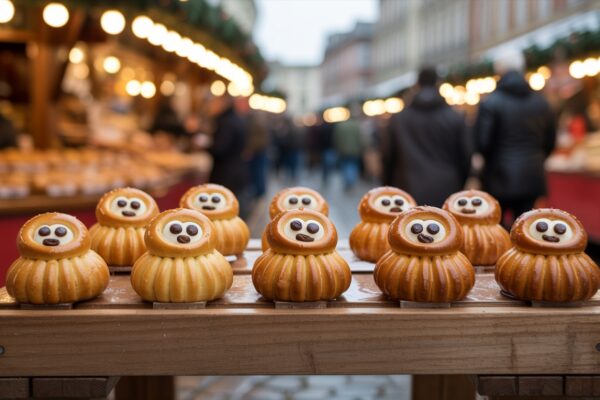
Manala: the little brioche man of Saint Nicholas’ Day
The manala (a little brioche man) is the figure in enriched dough that Alsace brings out every year as December settles in. A plump body,…
Read the article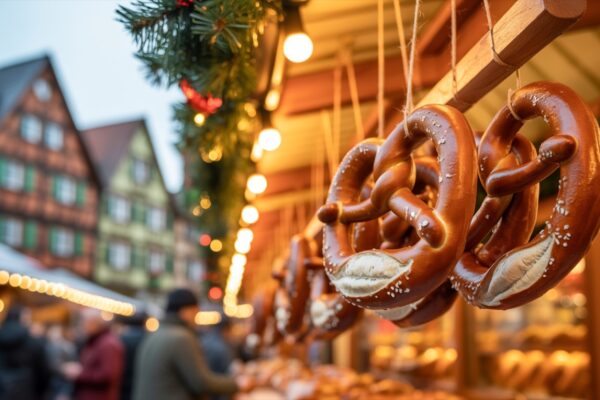
The pretzel, the folded arms that tell the story of Alsace
The bretzel (the Alsatian pretzel) has reigned over the Christmas markets of Alsace since long before anyone invented the wooden chalet. This knot of golden…
Read the article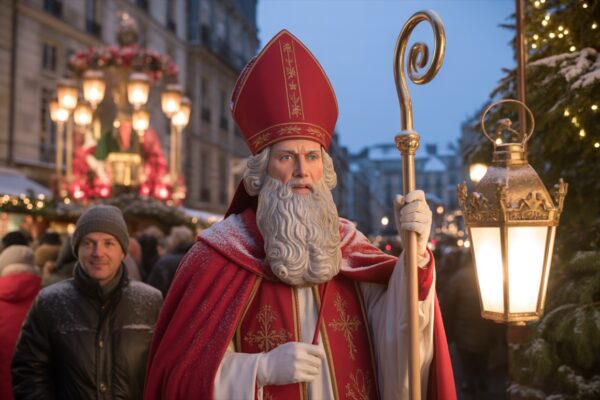
Saint Nicholas and Père Fouettard: 6 December in eastern France
Saint Nicholas and Père Fouettard, the 6 December tradition in eastern France: the legend of the salting tub, parades from Nancy to Épinal, manala and the link with Father Christmas.
Read the article