
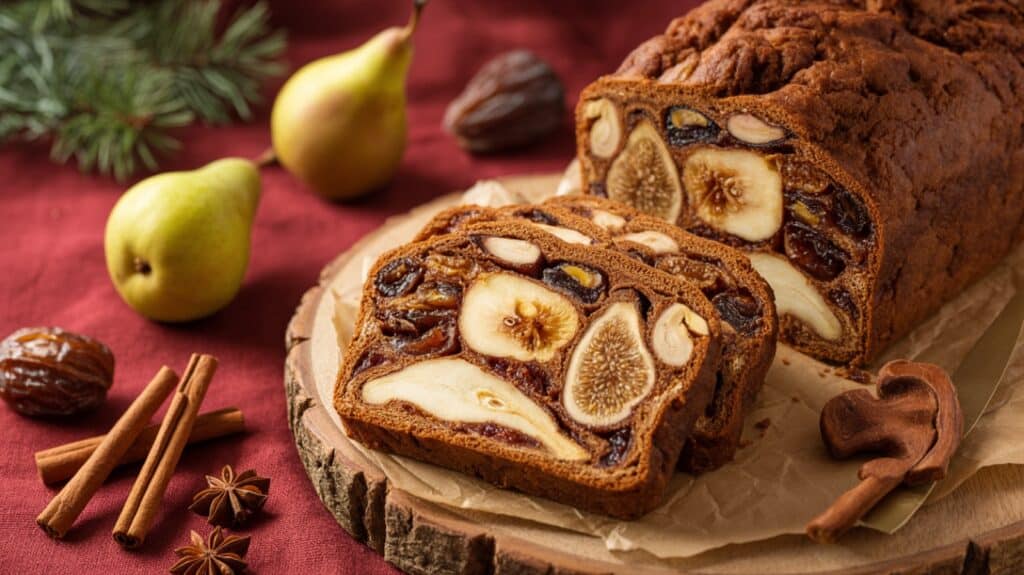
 Illustrative image
 Berawecka: the Dried-Fruit Christmas Bread of Alsace
On the food stalls of Alsatian markets, a dark, compact loaf catches the eye between the bredele and the kougelhopf. This is berawecka, the Alsatian dried-fruit bread, dense and scented with kirsch, that families prepare long before Christmas Eve. Nothing like a soft brioche or a sugary pastry. Berawecka is a concentrate of dried pears, figs, dates and walnuts, held together by a layer of dough kept to the bare minimum. You slice it thin, very thin, and one mouthful is enough to understand why this treat has lasted for centuries in Alsace.
Berawecka, a fruit bread whose name is in its shape
The word itself describes the object. In Alsatian, beera means pear and wecka a small bread roll. Berawecka therefore translates as “pear bread”, which fits exactly what you hold in your hand: a small elongated block, shaped like a log, made to fit into a palm. Dried pear remains the signature ingredient, the one that gives it its dark colour and its tight texture.
The origin of the cake is more nuanced than its name suggests. Several sources link berawecka to the Jewish community of Alsace, which served a dried-fruit bread at its spring festivals before the rest of the population gradually adopted it for Christmas. One theory even traces the name to the Yiddish word connected with Passover rather than to the pear. Both readings coexist in Alsatian accounts, and neither cancels out the place of the fruit in the recipe.
This drift from one festival to another says a lot about Alsatian cooking, built on borrowings and exchanges between communities. Berawecka crossed the confessional divide to become a marker of the regional Advent, handed down from generation to generation with its small variations. Every household keeps its own recipe, adjusts its proportions, chooses its eau-de-vie. This oral transmission explains why no official version holds sway: berawecka belongs first and foremost to families.
What really goes into it
The composition varies from one house to another, but the principle stays the same: lots of fruit, very little dough. You start with a base of dried fruit left to steep for several days in a local eau-de-vie. That spirit is no minor detail: it roots the cake in the Alsatian terroir, the world of village distilleries and orchards at the bottom of the valleys. Depending on what has cropped well that year, one household will favour Williams pear, another cherry or quetsche plum.
- The dried fruit: pears first, then figs, dates, prunes, sometimes dried apricots and apples.
- The nuts: walnuts, hazelnuts and almonds, chopped or whole.
- Raisins and candied fruit: orange and lemon peel for the tangy note.
- The spices: cinnamon, clove, star anise, nutmeg, in generous measure.
- The dough: a thin casing that acts as a binder, never as the main filling.
This thrift with the dough is the trait that defines berawecka. Where other Christmas cakes drown their fruit in crumb, this one puts it centre stage. The dough often amounts to a little flour, some of the steeping liquid and a pinch of yeast, just enough to bind the filling in the oven. The result is heavy for its size: a small loaf of a few hundred grams packs the equivalent of a large bowl of dried fruit.
The kirsch, meanwhile, does more than add flavour: it also helps the bread keep for a long time, which mattered when it had to last from Advent until Twelfth Night. The spices play the same double role: they give the cake its warm character and contribute to its preservation. Cinnamon, clove, star anise and nutmeg are measured to each cook's taste, some adding a hint of pepper or coriander to lift the whole.
Why it is made well in advance
Berawecka is not a last-minute cake. Steeping the fruit often takes several days, sometimes a week, so that the eau-de-vie soaks into every pear and every fig. Once baked, the bread gains again from resting two or three days before the first slice. The aromas settle, the texture firms up, and the result is all the better for it.
Its keeping quality is part of its identity. Wrapped in foil or stored in a metal tin in a cool place, it keeps for several weeks without trouble. The fact that it hardens slightly is no problem at all: you simply slice it thinner. This longevity explains its historic role as the treat cut into on Christmas Eve, before midnight mass, and still nibbled at long after the festivities.
This advance preparation had a very concrete reason in the past. In the depths of the cold season, fresh fruit was scarce, and drying remained the way to preserve the summer and autumn harvests. Berawecka gathered those reserves into a single nourishing cake, rich in sugar and energy, enough to face the Alsatian winter. What was a practical answer has become a gourmet ritual, without losing any of its peasant common sense.
From steeping to oven: the steps that count
Making a berawecka is nothing complicated, but everything depends on the time you give it. The first step is to cut the dried fruit into even pieces, then cover them with eau-de-vie and sometimes a little tea or fruit juice to rehydrate them. This bath lasts from a few hours to several days depending on habit, and it is what gives the bread its deep aroma.
Then comes the mixing. You add the walnuts, almonds, raisins and candied fruit, then bind it all with a light, heavily spiced dough. The amount of flour stays low: too much dough would betray the spirit of the cake. You then shape small logs and bake them in a moderate oven, long enough for the centre to set without the fruit burning. Some families brush the surface with syrup or decorate it with almonds and walnut halves, for shine and looks.
The real secret lies in the final patience. A berawecka eaten warm, barely out of the oven, is often disappointing: the flavours have not yet come together. Wait two or three days, and the same loaf reveals a completely different depth. It is this maturing that separates a successful piece from an ordinary loaf.
Berawecka, christstollen, gingerbread: do not confuse them
Three Advent treats, three different approaches. Berawecka stakes everything on the fruit and reduces the dough to a binder. Christstollen starts from a rich, buttery brioche dough dusted with icing sugar, into which the fruit and sometimes marzipan are invited: its soft crumb is the centrepiece, the opposite of berawecka. As for gingerbread, it is a cake raised with honey and spices, without that avalanche of steeped dried fruit.
| Treat | Base | Texture | Signature |
|---|---|---|---|
| Berawecka | Steeped dried fruit, minimal dough | Dense, compact | Pear and kirsch |
| Christstollen | Buttery brioche dough | Soft | Icing sugar, swaddling shape |
| Gingerbread | Honey-raised dough | Supple, airy | Honey and spices |
The simplest clue is visual. Cut a slice: if you see a tight mosaic of fruit with hardly any binder, you are holding a berawecka. If you see pale crumb coated in sugar, it is a christstollen.
How to enjoy it
Berawecka is served in very thin, almost translucent slices, so quickly does its richness fill you up. A good slice goes with a late-afternoon coffee or tea, as the winter days draw in. Many Alsatians also pair it with a glass of sweet wine or crémant, and the bread goes well with a pressed cheese, festive cheeseboard style.
If you want to play the Christmas Eve classic, slice it thin and set it beside a home-made mulled wine scented with cinnamon and orange. The spiced warmth of the drink answers the fruity density of the bread without ever overwhelming it. Nothing compulsory about any of this: every family has its habits, and that is just as it should be.
One bread, several names from valley to valley
From one corner of Alsace to another, berawecka changes spelling and even name. You will come across Bierewecke, Baerawecka or Beerawecka depending on the village. In the Munster valley, people speak of schnitzwecka. In the Bas-Rhin, hutzelbrot refers to a very similar preparation, while the Welche country, on the Alsatian side of the Vosges, knows the hogey.
These variants are not mere linguistic curiosities. They tell of different orchards, different spirits, spice measures particular to each family. The speciality also spills over regional borders: you find cousin fruit breads in southern Germany, Switzerland, Austria and as far as the Italian Tyrol, under the generic name of Früchtebrot. Alsatian berawecka remains the best-known version in France.
Where to find it at the Alsatian Christmas markets
Come December, berawecka is sold by bakers, pastry shops and on the stalls of the Christmas markets of Alsace. The big cities are full of it, but the wine villages offer it too, often handmade, in houses that keep the family recipe alive.
- At the Colmar Christmas market, among the stalls of the old quarter, several artisans sell it by the slice.
- In Strasbourg, the Christkindelsmärik showcases the Alsatian biscuit makers who offer their own take on the fruit bread.
- In wine villages such as Ribeauvillé, Kaysersberg or Eguisheim, the offer is more intimate and often home-made.
- In the Munster valley, you may come across its local variant, the schnitzwecka.
A practical tip before buying: ask about the share of dough. A good berawecka holds together mostly through the fruit, the dough is only there to bind. Look at the cut too: it should show a solid density of pears and walnuts, glistening with eau-de-vie. If you plan to give it as a gift, it travels very well: tightly wrapped, it stands up to the miles and keeps until the recipient's own festivities.
A piece of Alsace to take home
Berawecka has that rare quality of telling the story of a region in one mouthful: the pear orchards, the eaux-de-vie of the distilleries, the spices of the trade routes, the patience of Advent preparations. It does not try to win you over with sugar or softness, but with depth. On a Christmas market stall, it is one of those purchases that keep the festive spirit going once you are home, slice after slice, well into January. If you pass through Alsace in December, slip one into your bag. It will wait quietly on the shelf, ready to accompany the winter evenings.
Where to stay near the markets mentioned
Availability with our partners, town by town.
Reviewed and approved by the editorial team
A question, a mistake or a problem on this page? Write to us
Also worth reading
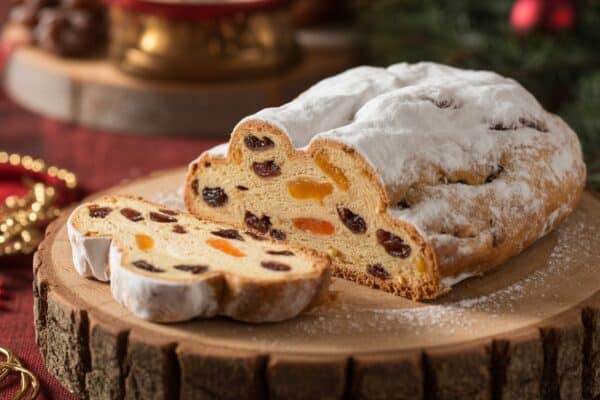
Christstollen, the Christmas cake that comes from Dresden
Christstollen, the Dresden Christmas loaf with candied fruit and icing sugar: origins, symbolism and which Alsace markets to find it on.
Read the article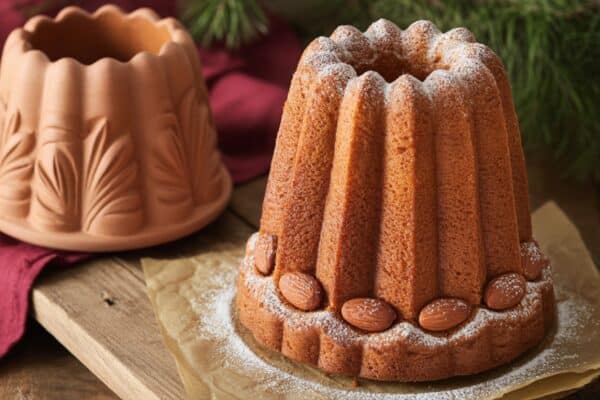
Kougelhopf, the Golden Crown That Tells the Story of Alsace
Kougelhopf, the ring-shaped Alsatian brioche: the Ribeauvillé legend, the Soufflenheim mould, sweet and savoury versions, and where to taste it at the markets.
Read the article
Celebrating Christmas in a royal setting: our château markets
Christmas market at a château: our pick of the finest estates (Chantilly, Versailles, Vincennes, Lunéville, Pau) for a royal setting.
Read the article