
 Illustrative image
 The Most Beautiful Medieval Christmas Markets in France
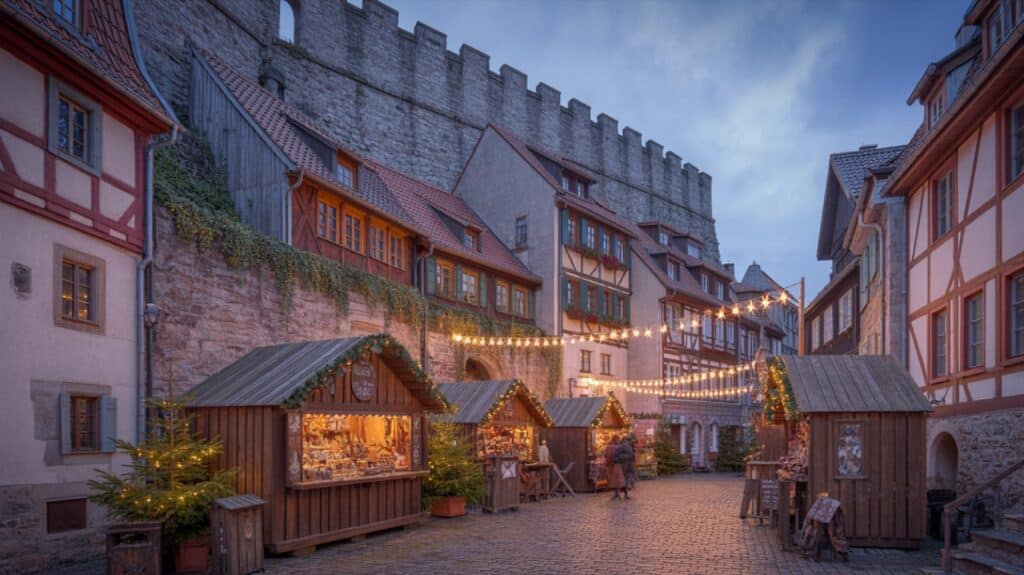
A medieval Christmas market does more than line up chalets on a modern square: it sets out its stalls at the foot of ramparts, between half-timbered houses and cobbled lanes that have survived for centuries. The setting does half the work. When the fairy lights come on against twelfth-century stone and the smell of mulled wine drifts up a narrow alley, you are no longer visiting a market, you are stepping back in time. We have gathered here a selection of towns where history is not a marketing line but something carved into the façades, each with a link to its own page so you can plan your visit.
Why a medieval setting changes everything
Much of the magic of a Christmas market comes from its surroundings. On a concrete square, chalets are just chalets. Backed against a fortified gate or a Gothic cathedral, they take on another dimension. Old stone catches the warm glow of the lights, narrow streets concentrate the smells and the sounds, and the outline of a keep or a belfry reminds you that these markets carry on a tradition several centuries old. Scale plays its part too: between high, tightly packed walls, the crowd, the music and the braziers feel far more enveloping than on an open esplanade.
Some towns go further and commit to the theme all the way: traders in costume, troubadours, period craft workshops, food and drink inspired by the Middle Ages. Elsewhere, the architecture alone creates the atmosphere, with no re-enactment at all. Both approaches work, and our selection mixes the two to cover several regions. We deliberately left out recent markets set up in neutral surroundings, keeping only places where the old stone is part of the show.
Provins, a full-scale medieval market
Hard to find anywhere more authentic than Provins. This town in Seine-et-Marne has been a UNESCO World Heritage Site since 2001 for the preservation of its medieval ensemble: ramparts, timber-framed houses, towers, tithe barn and underground passages. On the weekend of the medieval Christmas market, the upper town plays the part wholeheartedly. Close to 80 craftspeople and traders in period costume take over the Place du Châtel and Place Saint-Quiriace, with jewellery, pottery, wooden toys and local produce.
The atmosphere is not confined to the stalls. Fire shows, troubadours, jugglers and a medieval ball fill the two days, and as dusk falls the lights come on along the ramparts and the half-timbering. The market runs over a single weekend in mid-December, so it is an outing to pencil in as early as autumn, because the window is short. Provins has the advantage of being reachable from Paris by train, which makes a car-free day trip easy. The Provins Christmas market remains the benchmark when you want full immersion, with costumed extras and entertainment, not just a pretty backdrop.
Carcassonne, chalets at the foot of the ramparts
Carcassonne plays a different tune. Here the fortified Cité and its floodlit towers serve as the backdrop to a whole month of festivities, from early December to the very start of January. The market itself sets up in the lower town, on Place Carnot, around an ice rink where you skate on real ice next to the Neptune fountain. Craft chalets, sweet treats and local produce make for a festive, brightly lit stroll.
The medieval side is felt above all in the Cité, where encampments host craft demonstrations: leatherwork, coin striking, introductions to the arts of the Middle Ages. When the ramparts light up, the town takes on the look of a fairy tale, and the double ring of stone walls that made Carcassonne famous becomes a spectacle in its own right. Allow for a steep cobbled climb between the station and the Cité, or take a bus, if you want to do both districts in one go. The Carcassonne Christmas market thus combines two pleasures: the classic bustle down below around the rink, and the spectacular heritage up on the ramparts.
Ribeauvillé, the Alsatian medieval gathering
In Alsace, Ribeauvillé leads the way in all things medieval. Its medieval Christmas market draws on a dense network of local associations and turns the historic centre into an open-air stage over two weekends in December. Troubadours, jugglers, dancers, fire-eaters and street performers bring the lanes to life, with hands-on workshops and costumed guides for young and old.
One detail sets the tone for the local standards: imported goods are banned from the stalls, and what you taste there is food and drink of medieval inspiration. The programme holds a few surprises from one year to the next, from meeting the Three Kings to exotic animals in the streets. This concern for authenticity explains why the Ribeauvillé Christmas market is among the busiest in the region, with the flip side that those two weekends draw large crowds. Plan to get there early in the day if you want to enjoy the entertainment in comfort.
Riquewihr and Kaysersberg, the fortified picture postcard
A few kilometres away, two villages on the Alsace Wine Route pack in everything we love about a well-preserved medieval setting. Riquewihr places its chalets on the Esplanade des Remparts, among cobbled lanes and old houses, for nearly a month between late November and 22 December. The town wall and the Dolder, its emblematic gate tower, frame the scene like a jewel box.
Kaysersberg banks on selection: the market, open on Fridays, Saturdays and Sundays until mid-December, showcases hand-picked exhibitors and handmade goods. The sixteenth-century half-timbered houses, the cobbled streets and the thirteenth-century imperial castle overlooking the valley make a setting that is hard to forget. Two complementary moods you can fit into the same day:
- Riquewihr Christmas market: fortified-village setting, chalets squeezed between the ramparts and the Dolder.
- Kaysersberg Christmas market: a demanding selection of craftspeople, medieval castle looking down from above.
If you drive for the day, add a mulled wine stop between the two: it is the signature drink of these markets, and our mulled wine guide details the regional variations so you can recreate the mood at home.
Obernai, Eguisheim and Sélestat, the half-timbered trio
Alsace has a rare piece of luck: its medieval towns have stayed lived-in and alive, not frozen into museums. Three of them earn a place in this selection for their setting of stone and timber.
Obernai wraps its market around the Place du Marché and its Renaissance monuments, with the belfry and the ramparts in the background. The town has kept much of its fortified wall, and you drift from one chalet to the next without effort beneath the painted façades. Eguisheim, built in concentric circles around its castle, offers a medieval street plan you rarely find elsewhere: following its circular lanes under the lights is worth the trip on its own, and the village often ranks among the most beautiful in France. Sélestat, more low-key, holds a precious humanist heritage, including a library inscribed on UNESCO's Memory of the World Register, and an old centre that comes alive for the festive season.
| Town | What makes the setting | Mood |
|---|---|---|
| Obernai | Belfry, ramparts, Renaissance square | Family-friendly and lively |
| Eguisheim | Circular lanes, central castle | Intimate, highly photogenic |
| Sélestat | Old centre, humanist heritage | Authentic and unhurried |
To plan a loop over one or two days, the pages for the Obernai Christmas market, the Eguisheim Christmas market and the Sélestat Christmas market give the dates and practical access details.
Sarlat and Laon, the Middle Ages beyond Alsace
It is easy to forget that medieval heritage does not stop at the Rhine. In the Périgord, Sarlat spreads its market across the Place de la Grande Rigaudie and through the lanes of its old town with their honey-coloured stone façades, one of the best-preserved historic ensembles in south-west France. Golden lights, the smell of mulled wine and gingerbread, shows and a projection-mapping display every evening in the medieval heart make the capital of the Périgord Noir a stop that feels quite different from the markets of eastern France. Each year the market adopts a guest theme, which refreshes the stalls and the food events from one edition to the next. A full month in December leaves plenty of flexibility for planning your trip, without the scramble for the short dates of the Alsatian medieval markets.
In the Aisne, Laon plays another spectacular card: its hilltop town is crowned by one of the oldest Gothic cathedrals in France, and its ramparts take in the whole Picardy plain. The market sets up amid grey stone and ancient lanes that gain real intensity once night falls. The town remains less well known for its festivities than the Alsatian cities, which works in your favour if you are after a less predictable outing, under two hours from Paris or Lille. Two addresses to keep if you want to step off the usual Alsatian routes:
- Sarlat Christmas market: medieval lanes of the Périgord, projection mapping, convivial atmosphere.
- Laon Christmas market: hilltop town, Gothic cathedral, panorama over the plain.
Our tips for visiting a medieval market
These markets share a few constraints that come with their historic setting. Cobbled lanes get slippery fast in wet weather, so bring decent shoes. Parking in the heart of an old town is often limited, so aim for a car park on the edge and finish on foot, all the more so since the walk in is part of the pleasure. A few pointers for timing your trip:
- The most theatrical medieval markets, such as Provins or Ribeauvillé, often run over one or two weekends, while other markets last all of December. Check the dates before you leave, they change every year.
- Late afternoon and early evening bring the best light, when the illuminations come on along the ramparts.
- In Alsace, string together two or three nearby villages in a day: the tight cluster of the Wine Route lends itself well to this.
- Book your accommodation early for medieval market dates, those weekends draw crowds and rooms go quickly.
On the money side, these outings stay affordable: entry to the markets is free, and spending goes on what you eat, drink and take home. A handmade gingerbread, a turned-wood object or a piece of pottery make gifts that fit the theme, and the craftspeople at these markets often sell pieces you will not find in a supermarket. For accommodation, aiming for a small neighbouring town rather than the old town itself often works out cheaper and avoids the crush on busy weekends.
Whether you go for the costumed immersion of Provins, the illuminated Cité of Carcassonne or the cluster of fortified villages in Alsace, the common thread is the same: a stone setting that gives the festive season a depth few modern squares can recreate. The region and the date are yours to choose, and the linked pages cover the practical details for putting your itinerary together.
Where to stay near the markets mentioned
Availability with our partners, town by town.
Reviewed and approved by the editorial team
A question, a mistake or a problem on this page? Write to us
Also worth reading
Christmas markets in Brittany: harbours, crêpes and illuminated stone
Our pick of Christmas markets in Brittany: Rennes, Saint-Malo, Vannes, Quimper, Locronan, Brest, Lorient and Saint-Brieuc, between harbours and crêpes.
Read the article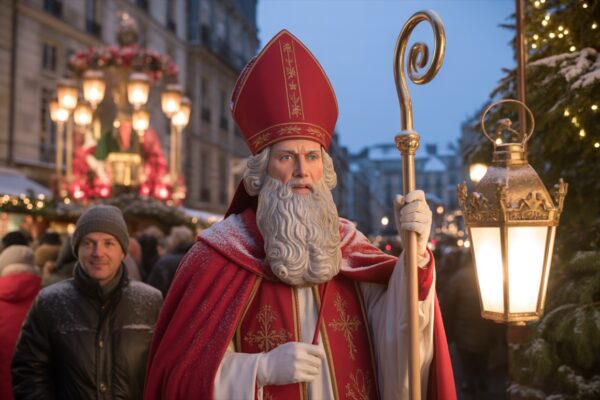
Saint Nicholas and Père Fouettard: 6 December in eastern France
Saint Nicholas and Père Fouettard, the 6 December tradition in eastern France: the legend of the salting tub, parades from Nancy to Épinal, manala and the link with Father Christmas.
Read the article
Saint Nicholas Day, a foretaste of Christmas in eastern and northern France
On 6 December, Saint Nicholas Day kicks off the run-up to Christmas in eastern and northern France: warm manala, the mannele/manala quarrel in Alsace, cards swapped between boys and festive markets.
Read the article