
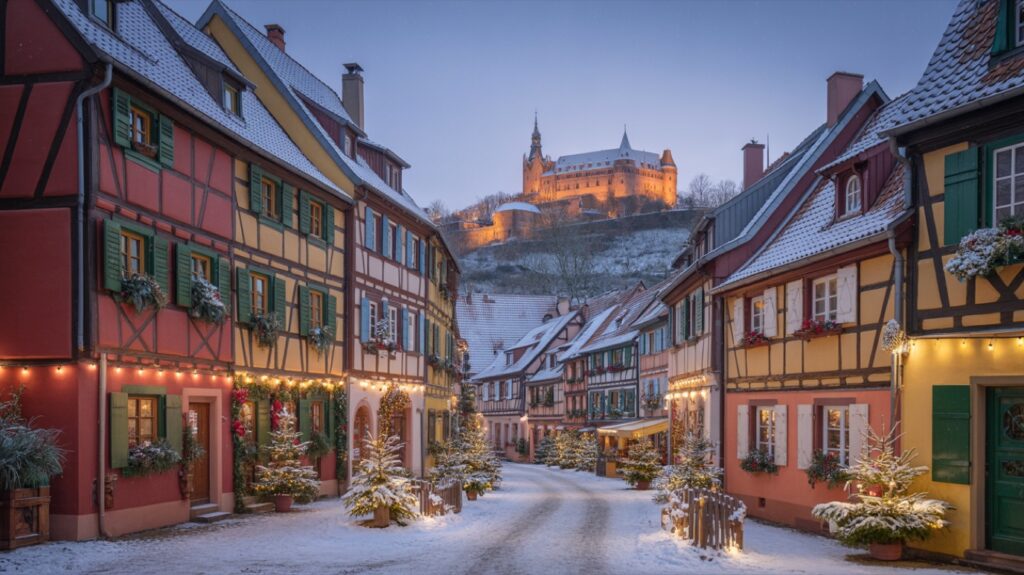
 Illustrative image
 Planning a trip to Alsace, the land of Christmas
A Christmas trip to Alsace starts with choosing your itinerary: how many markets to aim for, and in what order, so you don’t end the week stuck in traffic on the Route des Vins. The “land of Christmas” label the region has claimed for decades owes as much to the density of what is on offer as to the age of Strasbourg’s Christkindelsmärik. Between Strasbourg, the historic home of the Christkindelsmärik, and Colmar, the region has seven markets less than an hour’s drive from each other, plus a fortified castle, an open-air museum and a theme park open all winter. This guide suggests a route of three to four days, with the questions that matter before you book: where to stay, how to get around without wasting time in full car parks, and how much to budget for a family of four.
A Christmas trip to Alsace: building your itinerary
The route follows the geography: Strasbourg in the north, then the Route des Vins south to Colmar, with a possible detour to Haut-Kœnigsbourg or to Europa-Park, in Germany, less than an hour’s drive away. Over three days, you keep the circuit tight around Strasbourg and two or three villages on the Route des Vins. Over four days, you widen it to the Écomusée d’Alsace or the German park, without passing through the same place twice.
One point is worth clearing up before you set off: the Écomusée d’Alsace and Europa-Park run seasonal events (decorated village, indoor market, ice rink), but they remain paying sites with their own ticketing, separate from the free municipal Christmas markets. Fit them into your trip as two separate activities, not as extra stops on the market circuit.
- Strasbourg Christmas market, the largest, spread over a dozen squares in the historic centre.
- Obernai Christmas market, a square with half-timbered market halls and a 13th-century belfry.
- Ribeauvillé Christmas market, a medieval market over two December weekends, in the village lanes.
- Riquewihr Christmas market, ramparts and 16th-century half-timbered façades, almost intact.
- Kaysersberg Christmas market, a fortified bridge over the Weiss and a castle up above.
- Eguisheim Christmas market, lanes in concentric circles around the former counts’ castle.
- Colmar Christmas market, six markets spread across the centre according to the town, including the one in Little Venice.
Day 1: Strasbourg, the city that started the tradition
Strasbourg opens the trip with the Christkindelsmärik, considered one of the oldest Christmas markets in France, held since the 16th century. The city spreads its chalets over a dozen squares, from the cathedral to Place Broglie, with a Ferris wheel and a Christmas tree on Place Kléber. In 2025, the market ran from 26 November to 24 December; the 2026 dates have not yet been published on the official website.
One day is enough to explore the historic centre on foot: the cathedral and its spire, the Petite France district and its half-timbered houses on the Ill, then one of the smaller markets. In the evening, the illuminated façades are worth a second outing, at a calmer pace than during the day. The city’s StrasApp app brings together the day’s programme and the opening times of the smaller markets, handy for adjusting your route once you are there.
The chalets also sell something to warm you up: mulled wine is the most ordered drink at every market on the circuit. To make it at home, start with our article on mulled wine and its variations, not with this guide.
Day 2: Obernai, Haut-Kœnigsbourg and Ribeauvillé
Heading south from Strasbourg, Obernai makes a short first stop: a market square surrounded by half-timbered halls and a 13th-century belfry, a place you can see in half a day along with its Christmas market.
Haut-Kœnigsbourg Castle, on the heights above Orschwiller, fills your morning or early afternoon. In 2026, from 1 November to 31 December, it is open every day from 9.30am to 12pm and from 1pm to 5pm (Mondays from 10.30am), closed on 25 and 26 December and 1 January. A full-price adult ticket costs €12, with a family ticket at €30 (two adults, children aged 6 to 17) and free entry on the first Sunday of the month from November to March. Without a car, a shuttle links Sélestat station to the foot of the castle for €3 per journey, and also gives you the reduced rate.
The drive ends in Ribeauvillé, which holds its medieval market over two weekends in its lanes: enough to fill the late afternoon and evening, before a night there or in Sélestat.
Day 3: Riquewihr, Kaysersberg, Eguisheim and Colmar
Within some twenty kilometres, the Route des Vins brings together three of the most photographed villages in Alsace. Riquewihr has kept its ramparts and 16th-century half-timbered façades. Kaysersberg is built around the Weiss, crossed by a fortified bridge, with a castle overlooking the village. Eguisheim arranges its lanes in concentric circles around the former counts’ castle, a compact layout you can visit in an hour or two.
Three villages in a single day, markets included, already makes for a packed programme: better to pick two and keep the third for another visit, or speed up around midday if your aim is still to reach Colmar before nightfall.
Colmar closes this stage with six markets spread across the town, including the one in Little Venice, along the canals of the Tanners’ quarter. The number of chalets and the size of the historic centre justify spending the evening there, or even a full night before the rest of the trip.
Day 4: the Écomusée d’Alsace or a detour to Europa-Park
For a fourth day, there are two options that do not overlap, and each means giving up part of the rest of the programme.
The Écomusée d’Alsace, in Ungersheim, recreates an early 20th-century Alsatian village decorated for the holidays: around a hundred Christmas trees, a house of elves and tales, and traditional characters (Saint Nicholas, Hans Trapp, Christkindel) walking through the village in costume. In 2026, the site opens in several periods in December (4 to 6, 11 to 13, 18 to 23 and 26 to 30, then 1 to 3 January 2027), and is closed on 24, 25 and 31 December. An adult day ticket is listed at €16.50 on the museum’s 2026 price list, with a family pass advertised at €50. Allow 30 minutes’ drive from Colmar, 20 from Mulhouse.
Europa-Park is 45 minutes to an hour’s drive from Strasbourg, in Germany (Rust, Baden-Württemberg). For winter the park sets up an indoor market, an ice rink and shows, with more than 100 rides open. Tickets start at €56.50 online, with prices rising to €67 or €76 for an adult depending on the period, and €56.50 or €65 for a child aged 4 to 11. Both remain paying activities separate from the free municipal markets, with their own ticketing: place Europa-Park at the end of your trip, before heading home by road or rail, rather than as an intermediate stop on your market circuit.
Where to stay in Alsace during the markets, and when to book
Rooms in the centre of Strasbourg and Colmar are the first to go, often from October for December weekends: demand outstrips supply during the five weeks of the markets, and prices climb accordingly on booking platforms. A stay built around weekdays rather than a weekend gives you more choice for the same budget.
Choosing your dates matters as much as choosing your town. December Saturdays and the Christmas school holidays bring the biggest crowds to the major markets on the circuit: chalets under siege, queues for mulled wine, car parks full by midday. A trip starting on a Thursday or Friday, or in the very first weeks of the season (late November, early December), noticeably changes the atmosphere without taking anything away from the programme.
Three alternatives let you stay away from the most sought-after centres without straying too far from the markets:
- Mulhouse, about thirty minutes from Colmar and close to the Écomusée d’Alsace, with a wider choice of hotels.
- Sélestat, halfway between Strasbourg and Colmar on the Route des Vins, with its own market and a direct shuttle to Haut-Kœnigsbourg.
- In Germany, around Kehl or Offenburg, with a possible detour to Baden-Baden Christmas market, half an hour’s drive from Strasbourg.
For a family of four, accommodation on the outskirts with free parking often makes up for the extra travel time to the centre, especially on a busy weekend.
Car, train or shuttle: getting around
By car, the centres of Strasbourg and Colmar restrict traffic during the market season, and car parks in the historic heart fill up on Saturdays and during the school holidays. Park-and-ride car parks on the outskirts, combined with the tram or bus, remain the most reliable way to avoid driving round in circles looking for a space: find out where they are before you set off rather than once you arrive.
By train, the line running along the Route des Vins, from Strasbourg to Mulhouse via Sélestat and Colmar, directly serves most of the main stops on the circuit, so you can go several days without a car between the main towns. Getting to the smaller villages, starting with Riquewihr and Eguisheim, requires a bus or a last stretch by car from the nearest station. TER Grand Est generally steps up its regional services during the market season: check times and fares on the SNCF website before booking, especially for a weekend.
From Paris, the TGV reaches Strasbourg in 1h45 on the LGV Est high-speed line, and some trains continue to Colmar without a change. Weekend TGVs are fully booked several weeks ahead on the most popular December dates: book your ticket as soon as the market dates are known rather than waiting until the last week. For the detour to Europa-Park, rail access is via the Offenburg-Freiburg line in Germany, with a shuttle from Ringsheim station to the park entrance; by car, allow 45 minutes to 1 hour from Strasbourg via the A35 and then the Rhine bridge at Marckolsheim, or via the A5 on the German side.
Budget for a Christmas trip to Alsace for a family of four
It is hard to give a single figure for a Christmas trip to Alsace: the price of a room can vary threefold depending on the date and the town. The table below brings together the items with a verifiable official price, to be completed with accommodation and meals according to everyone’s tastes.
| Item | Amount | Details |
|---|---|---|
| Christmas markets | free | free entry to the streets and squares, across the whole circuit |
| Haut-Kœnigsbourg Castle | €30 | family ticket, two adults and children aged 6 to 17 |
| Écomusée d’Alsace | about €50 | family pass advertised on the official website |
| Europa-Park, 2 adults and 2 children | €247 to €282 | entry only, depending on the period, excluding food and parking |
| TGV Paris-Strasbourg, one way | price not available | varies with booking date, check on SNCF Connect |
| Accommodation, per night | price not available | varies with town and period, compare on booking platforms |
Pretzels, mulled wine, gingerbread: these street treats are hard to price precisely, as prices vary from one chalet to another and from one town to the next. Better to set aside a flexible amount for this item than a fixed sum in advance.
On paid entries alone, castle and open-air museum included, a family of four skipping the theme parks stays under €100. Adding Europa-Park changes the scale of the trip: treat it as a separate day, with its own budget, rather than as an extra stop on the market circuit.
Where to stay near the markets mentioned
Availability with our partners, town by town.
Reviewed and approved by the editorial team
A question, a mistake or a problem on this page? Write to us
Also worth reading
Hot Chocolate at Christmas Markets, a Story Going Back to the Aztecs
Hot chocolate at Christmas markets: Aztec origins, the Bayonne tradition, how to spot a good cup and the alcohol-free alternative to mulled wine.
Read the article
Speculoos, the little carved biscuit that tells the story of Saint Nicholas
Speculoos, the brown sugar biscuit linked to Saint Nicholas: Flemish origins, wooden moulds, spices and where to taste it at Christmas markets in northern France.
Read the article
Kougelhopf, the Golden Crown That Tells the Story of Alsace
Kougelhopf, the ring-shaped Alsatian brioche: the Ribeauvillé legend, the Soufflenheim mould, sweet and savoury versions, and where to taste it at the markets.
Read the article