
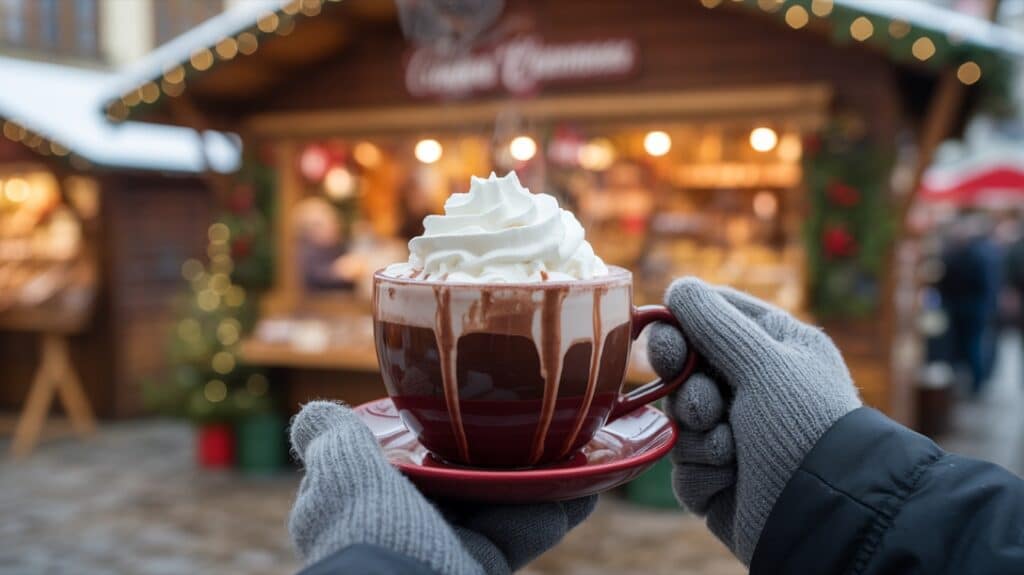
 Illustrative image
 Hot Chocolate at Christmas Markets, a Story Going Back to the Aztecs
A steaming cup between your hands, the mist rising to your face as you look at the lit-up chalets: hot chocolate belongs to the rituals of Christmas markets just as much as mulled wine does. Except that it brings the whole family along, children included, and that it drags behind it a history going back more than three thousand years. Behind the sweet cup hides a sacred drink of the Mesoamerican civilisations, a luxury item of the European courts, and a firmly rooted French chocolate-making tradition. Here is where this drink comes from, how to spot a good hot chocolate at a market, and why it is the ideal sociable choice when you want to warm up without alcohol.
At the origins: xocoatl, the sacred drink of the Aztecs
The first traces of cacao use go back more than three thousand five hundred years, in Mesoamerica. The Olmecs, then the Maya and the Aztecs, grew the cacao tree and ground its beans to prepare a bitter, thick, spicy drink: xocoatl. Nothing like the sweet beverage we know today. The mixture was sharpened with chilli, sometimes thickened with maize flour, and had more of the ceremonial pick-me-up about it than of indulgence. It was beaten to make it foam, that froth being the most prized part of the preparation.
This drink was not given to everyone. It was kept for religious ceremonies and for the elites. Legend has it that the emperor Moctezuma drank it from small gold cups, and that he consumed large quantities of it before receiving visitors. Cacao beans even served as currency: a rabbit or a day’s work was paid for in beans. Which is to say that cacao already carried a strong symbolic charge, long before it reached Europe, somewhere between power, the sacred and wealth. When the Spanish landed in Mexico, they came upon a cacao culture already several centuries old.
Arrival in Europe by way of Spain
Cacao crossed the Atlantic in the 16th century, in the holds of the Spanish conquistadors. The first transatlantic voyage falls around the 1520s. In 1585, a ship from Veracruz landed at Seville the first official cargo destined for Europe. Spain long kept a monopoly on this rare product, holding it almost secret for close to a century before it reached the rest of the continent.
The Spanish at first drank chocolate in the Aztec manner, as a thick, bitter drink spiced with chilli. Then they sweetened it by adding sugar, a precious commodity at the time, and replaced the chilli with milder spices such as cinnamon or vanilla. Hot chocolate then became a luxury drink, reserved for the nobility and the upper middle classes. Little by little it reached the other courts of Europe, where it established itself as a mark of refinement. In France its adoption sped up in the 17th century, carried by the royal alliances with Spain: the country discovered chocolate in 1615, at the wedding, celebrated in Bordeaux, of the Infanta Anne of Austria to Louis XIII, but it was Louis XIV and his wife Maria Theresa of Austria who made it part of court habits.
Chocolate pots, molinillos and the French court
Drinking chocolate in the 17th and 18th centuries called for a whole set of equipment. The chocolatière, that pot often made of silver or porcelain, had a hole cut into its lid. Through it you slipped a moussoir, also called a molinillo, a shaft with paddles that you rolled between your palms to emulsify the drink and cover it with foam. This utensil, which appeared in New Spain and spread from the end of the 16th century, followed cacao all the way to Europe and remains the founding gesture of hot chocolate as we know it.
At the French court, chocolate became a society ritual. Madame de Pompadour ordered her porcelain chocolate service from the Sèvres manufactory, and the chocolate pots were dressed in ever more precious materials. Chocolate was drunk on waking, served during visits, and it punctuated the social life of the aristocracy. It also found its way into the painting of the period, a symbol of sweetness and bourgeois intimacy. That culture of the hot, unctuous drink is what we find again today, in democratised form, in every cup handed over at a Christmas market.
Bayonne, the first chocolate-making town in France
If France has a chocolate capital, it is Bayonne. The first written mention of the word “chocolat” in the town dates from 1670, fifty-five years after chocolate’s arrival in France in 1615. From the end of the 17th century, a craft centre grew up thanks to the arrival of Portuguese Jewish families, driven out of the Iberian peninsula by the Inquisition and taking refuge in the Basque Country. Among them were merchants with links to the trading posts of South America and Spain, and artisans who held the secrets of making the drink.
These artisans passed their knowledge down from one generation to the next, and the town grew rich around that expertise. In the 19th century, Bayonne became the French capital of chocolate. That tradition can still be felt as you walk the Bayonne Christmas market, where hot chocolate is not a sideline but a local heritage openly claimed. The town’s chocolate makers keep up the old-fashioned grinding and offer cups that remind you how serious a business this drink is here.
Old-style or from a packet: how to spot a good hot chocolate
Not all cups are equal, and the difference comes first from the raw material. An old-style hot chocolate is made with real melted cooking chocolate, cocoa butter and all. The result: a thick, coating texture and an intense flavour that lingers in the mouth. It is the version that recalls the cups of the court and their chocolate pots.
The powdered version, for its part, rests mostly on defatted cocoa mixed with sugar and sometimes flavourings. The drink is thinner, sweeter, less rich in cocoa. That is not a bad thing in itself, it is simply another category of pleasure: practical and quick to serve, it does the job when the queue gets long. At a market, a few signs do not lie:
- The texture: a real hot chocolate coats the spoon or the sides of the cup, it does not run like coloured water.
- The bitterness: a clear base of cocoa, not just a sweet note that masks everything else.
- Visible preparation: an artisan melting chocolate or pouring from a chocolate pot rather than tearing open a sachet is a good sign.
- Whole milk rather than water: it brings the smoothness that makes all the difference.
- The smell drifting from the stall: cocoa you can smell from a distance often announces a good cup.
Whipped cream, cinnamon, chilli: the versions that tempt you
Hot chocolate lends itself to a thousand outfits. The best known is still the chocolat viennois, whose name points to Vienna, that capital of coffee houses and the Austrian art of living. Its signature: a generous layer of homemade whipped cream laid on a smooth chocolate made with melted chocolate, sometimes dusted with cocoa or shavings. It is the comfort version par excellence, the one that appeals to children and grown-ups alike. At a market, it is often the first instinct of the youngest in front of the stall.
Spices open another register, one that reconnects with the Mesoamerican origins. A pinch of cinnamon, a hint of cardamom or ginger warms the drink up. The more curious will find the Aztec gesture again with a touch of mild chilli, which lifts the chocolate without crushing it. A strip of orange zest or a few drops of extract bring a freshness that cuts through the richness of the cocoa. At markets, you will come across these variations:
| Version | What defines it |
|---|---|
| Chocolat viennois | Homemade whipped cream, melted chocolate, shavings or cocoa on top |
| Spiced chocolate | Cinnamon, cardamom, nutmeg, sometimes vanilla in the milk |
| Chilli chocolate | An Aztec nod, a touch of mild chilli over a clear cocoa base |
| Orange chocolate | Zest or extract, a freshness that lightens the drink |
Nothing stops you combining them: a chocolat viennois lifted with a pinch of cinnamon brings together the best of both worlds. The most inventive chocolate makers also offer versions with caramel, tonka bean or praline, to refresh the classic without betraying it.
The alcohol-free alternative to mulled wine
Mulled wine remains the star drink of the markets, with its spices and its warmth that hit you all at once. But it leaves part of the public out: children, people who do not drink alcohol, those driving home after the walk. Hot chocolate answers that need. It offers the same comforting function, the same gesture of holding a steaming cup between gloved hands, without a single degree of alcohol.
That is what makes it the genuinely family drink of the markets. A parent can share the same ritual as their child, raise the same contents in a toast, with no compromise. And on the indulgence front, hot chocolate stands the comparison: between a viennois version with whipped cream and a spiced mulled wine, the choice becomes a matter of taste rather than of constraint. Many families alternate between the two over the course of the evening, a mulled wine for the parents, a chocolate for the little ones, then they compare notes over a bretzel or a slice of tart.
Where to drink a good hot chocolate at the Christmas markets
The big food-loving cities are the best addresses for a quality hot chocolate, because that is where you find artisans working with real chocolate. At Strasbourg Christmas market, the oldest in France, the sweet chalets compete with each other and hot chocolate goes alongside gingerbread and bredele biscuits. In Colmar, the atmosphere of the old Alsatian town lends itself to a pause with a cup in hand between two stalls.
Further south, Lyon Christmas market benefits from a real culture of good eating and from the city’s well-known chocolate makers. In Paris, the market in the Tuileries offers carefully made versions, whipped cream included. And to close the historical loop, nothing beats the Bayonne market for tasting chocolate where France first made it. A few useful habits for choosing your chalet well:
- Look out for stalls advertising “chocolat à l’ancienne” or “chocolat fondu”, often a guarantee of a genuine preparation.
- See whether the seller offers a whipped cream or spice option: a sign that they take care over what they serve.
- Check that they work with whole milk, as the smoothness changes everything.
- A local chocolate maker is more likely to serve a good product than a generic stall.
From a gold cup of Moctezuma’s to a cardboard cup at an Alsatian chalet, hot chocolate has crossed the centuries without losing any of its comforting power. It is perhaps the finest way to warm your hands and your spirits when the cold settles over the lit-up rows.
Where to stay near the markets mentioned
Availability with our partners, town by town.
Reviewed and approved by the editorial team
A question, a mistake or a problem on this page? Write to us
Also worth reading
Celebrating Christmas in a royal setting: our château markets
Christmas market at a château: our pick of the finest estates (Chantilly, Versailles, Vincennes, Lunéville, Pau) for a royal setting.
Read the article
Where Do Christmas Markets Come From? Six Centuries of Tradition
The history of Christmas markets, from Dresden 1434 to Strasbourg 1570: medieval origins, the Reformation, the Advent wreath and the revival in France.
Read the article
The Christmas tree, a story born in Alsace
The history of the Christmas tree, from the medieval tree of paradise to Sélestat in 1521, then the glass baubles and its spread across France.
Read the article