
 Illustrative image
 Kougelhopf, the Golden Crown That Tells the Story of Alsace
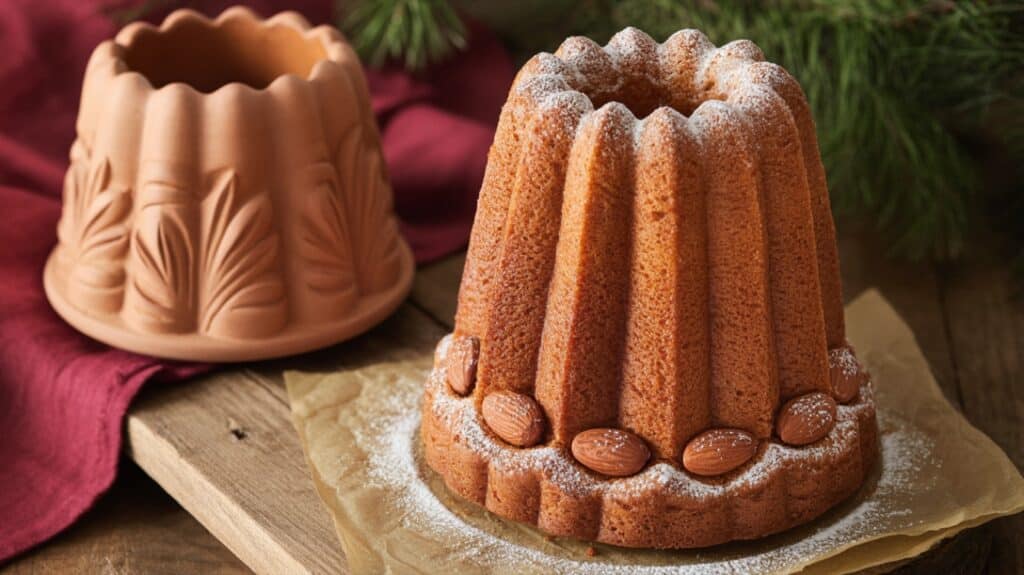
At an Alsatian Christmas market, one cake always catches the eye before it reaches the palate: kougelhopf, the tall fluted crown of Alsatian brioche dusted with icing sugar, an almond tucked into the hollow of each groove. The crumb is soft, scented with kirsch, dotted with raisins. Behind that instantly recognisable shape lie a stubborn legend, a clay mould shaped by hand and two quite distinct ways of eating it. Here is what you need to understand what you are biting into when you leave a stall with one tucked under your arm.
A name that wavers between several languages
Kougelhopf, kouglof, gugelhupf, kugelhof: the spelling drifts from bakery to bakery and across borders. That instability tells the cake's story better than any long speech. The word descends from the German Gugelhupf, where Gugel means a hood or a turban, and Hupf is thought to refer to Hefe, yeast. In plain terms: a risen brioche shaped like a headdress. In Alsatian you often hear that the shape recalls a turban, which fits the domed, ridged silhouette.
The cake belongs to a whole Central European family. You find it in Vienna, in Austria, in Bohemia under the name bábovka, in southern Germany. Alsace has made it an emblem, but the recipe travelled widely before settling there. That mixing explains why nobody really agrees on a single spelling.
This wavering over the name says a lot about the region itself, straddling two cultures. Depending on whether the emphasis falls on the potter's legend, on the pastry cook Kugel or on the dialect meaning of turban, the bakery will sell you a kougelhopf, a kouglof or a kugelhof. None of these spellings is wrong. They sit side by side on shop signs, sometimes in the same street, and nobody takes offence. It is the mark of a speciality that belongs to everyone rather than to a single house.
The Ribeauvillé legend and the Three Kings
In Ribeauvillé, the story goes that the first kougelhopf was born of a gesture of gratitude. Passing through the town, the Three Kings were said to have been taken in by a potter who gave them shelter. To thank him, they made overnight a cake whose shape recalled their turbans, baked in a mould fashioned for the occasion. Another version credits a pastry cook named Kugel, who is said to have given his name to the treat.
Yet another variant tells that one of the Three Kings forgot his turban, woven with gold thread and set with almond-shaped stones, at a Strasbourg pastry cook's. The baker is said to have drawn on it to carve a mould, and the cake kept the outline of the headdress. The almonds planted in the grooves then become the memory of the precious stones. A pretty image, but nothing backs it up.
These accounts belong to folklore, not to the archives. Historians place the appearance of the cake in the seventeenth or eighteenth century, relying on the oldest moulds found. The legend, though, dies hard, and the town keeps it alive: every June, Ribeauvillé holds its Kougelhopf Festival, where the bakers of the area bring out their finest crowns. If you visit the Ribeauvillé Christmas market in December, you are therefore walking on the ground of the founding myth, and you can round off the outing with the Riquewihr Christmas market, its neighbour on the Wine Route.
From Vienna to the French court
Kougelhopf enjoyed its moment of high-society glory thanks to two figures. Marie Antoinette, Austrian by birth, is said to have helped bring this familiar Viennese cake into fashion at the French court. A few decades later, the pastry chef Marie-Antoine Carême, a benchmark of French haute cuisine, is said to have brought the recipe back from the Austrian capital around 1810, gleaned from the chef of a great Viennese household.
From a domestic speciality, the cake then slid onto prestigious tables, before coming back down into Alsatian homes where it became the Sunday morning fixture. This to-and-fro between bourgeois cooking and court pastry gives it its particular status: at once popular and ceremonial. It is served as readily in a farmhouse in the vineyards as in a nineteenth-century Parisian drawing room.
That double life still shows today. Kougelhopf remains a simple cake to take home, without fuss, while keeping a festive aura. It has none of the preciousness of a pastry chef's entremets, yet it never sinks into the ordinary. One foot in peasant tradition, one foot in the history of the great kitchens: that is what gives it its place apart among Alsatian sweets.
The Soufflenheim mould, a piece of clay
Impossible to talk about kougelhopf without its mould. The traditional model is made of glazed earthenware, and it almost always comes from the same place: Soufflenheim, a potters' village in northern Alsace. The clay comes from the Haguenau forest, a resource worked for centuries under an extraction privilege granted to local potters that goes back to the twelfth century. The Haguenau Christmas market, in the area of the potters' workshops, is a good base for coming across this pottery and the brioche that goes with it.
The kougelhopf mould has precise characteristics:
- A glazed interior that makes the wall smooth and helps the brioche turn out cleanly.
- A weathered exterior, often decorated with hand-painted floral motifs, typical of Soufflenheim pottery.
- Pronounced fluting that sculpts the cake's famous grooves and multiplies the golden surface.
- A central funnel that spreads the heat and gives the ring shape.
A few kilometres away, the village of Betschdorf also works clay, but in a different register: salt-glazed stoneware, grey and cobalt blue, designed for jugs and pots rather than for baking in the oven. The two crafts coexist and make the pottery reputation of the region. A Soufflenheim mould is often handed down from one generation to the next, seasoned by repeated bakes.
This clay changes the baking. It stores heat and releases it gently, which gives a thicker crust and an amber colour on the fluting. A metal mould bakes faster and hotter, but it does not give the same patina. The Soufflenheim potters also offer moulds in every size, from individual portions to large models for big tables, often signed by hand. Many visitors bring one back from the Christmas market, as much for the object as for the brioche it lets them bake. The painted motifs, flowers and scrolls, vary from one workshop to the next, so that no mould looks quite like its neighbour.
Sweet or savoury, two cakes in the same mould
Kougelhopf comes in two versions that share nothing but their silhouette. The best known remains the sweet version, a buttery brioche scented with kirsch or rum, filled with raisins plumped up beforehand in the spirit and studded with whole almonds lodged in the grooves. It is eaten plain, at breakfast or teatime, or put through the toaster the next day when it has dried out a little. A buttered slice with a coffee, and the whole Alsatian Sunday morning sits on the plate.
The savoury version, more discreet, swaps the raisins and almonds for bacon and walnut halves. It is served with an aperitif, cut into slices, with a glass of Alsace white wine. The table below tells them apart at a glance:
| Version | Filling | Flavouring | Moment |
|---|---|---|---|
| Sweet | Raisins, almonds | Kirsch or rum | Breakfast, teatime |
| Savoury | Bacon, walnuts | Pepper, nutmeg | Aperitif |
Both share a dough left to rise for several hours, close to brioche, which calls for patience more than technique. The secret lies in buttering the mould and in resting the dough, never rushed. A hurried dough stays dense, a rested dough gains that stringy crumb that makes all the difference when you eat it. Alsatian bakers speak of a cake that will not be hurried: it takes the time it needs.
A cake for big occasions
For a long time, kougelhopf was not an everyday treat. It was made for christenings, weddings, religious festivals and Sunday meals. During the grape harvest, it was baked in large quantities to feed the pickers. Offering a kougelhopf was a way of welcoming or thanking someone, a gesture of hospitality rooted in Alsatian culture.
At Christmas it holds a special place on the table. Its golden crown, dusted with icing sugar like a coat of snow, suits the spirit of the season. At the markets it sits next to the gingerbread and the little Advent biscuits. If you want to carry on the subject on the sweet side, our article on gingerbread tells of another sugary tradition of the region, also rooted in the Alsatian winter.
Kougelhopf accompanies the moments that matter all year round, but winter suits it well. The rich brioche, the toasted almond and the scent of kirsch make up a cold-season flavour. In many families, one is baked on an Advent Sunday, and it is gone before noon. That regularity is part of the charm: it is not a cake kept for a single date, it is a faithful companion of the family table.
Where to taste a real kougelhopf at the markets
The good news: kougelhopf can be found everywhere in Alsace during Advent, from the big cities to the wine villages. Every bakery has its recipe, more or less buttery, more or less boozy. A few market addresses are worth a look for combining the stroll with the tasting:
- The Strasbourg Christmas market, the largest in the region, where speciality stalls abound.
- The Colmar Christmas market, spread across several squares of the old town, with its half-timbered houses.
- The Obernai Christmas market, at the foot of the ramparts, renowned for its local producers.
- The Eguisheim Christmas market, in a village laid out in concentric circles, where crafts sit alongside good food.
To recognise a good one, rely on a few simple markers: a stringy, airy crumb, an honest buttery smell, raisins that are soft rather than dry, and a crust that keeps a clean trace of the fluting. A kougelhopf that is too pale has been underbaked, a heavy kougelhopf has not rested enough. Pair it with a glass of mulled wine and you have the perfect duo for wandering the aisles on a December evening.
Taking it home with you
If you feel like making it yourself, the Soufflenheim mould remains the best souvenir to bring back from an Alsatian market. Butter it generously, place an almond in each groove before pouring in the dough, and let the brioche rise in its own time. The result will not have the regularity of an industrial mould, but the earthenware gives an incomparable crust and a story to tell at the table. Between the golden crown, the legend of the Three Kings and the know-how of the potters, kougelhopf brings together everything that makes an Alsatian Christmas so appealing.
Where to stay near the markets mentioned
Availability with our partners, town by town.
Reviewed and approved by the editorial team
A question, a mistake or a problem on this page? Write to us
Also worth reading
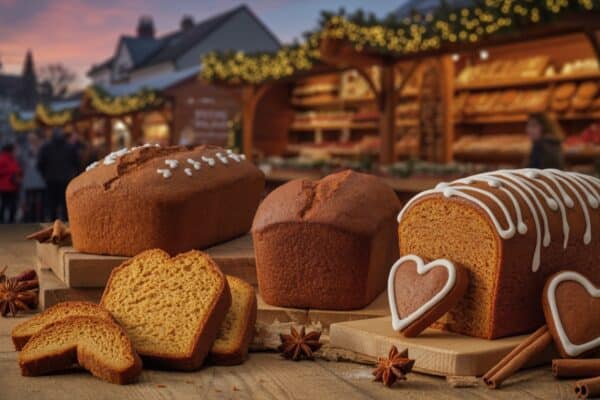
Pain d’épices: the brown gold of the Christmas markets
Pain d’épices, the French spiced honey gingerbread, is one of those scents that announces Christmas before the first tree goes up. On the Christmas markets,…
Read the article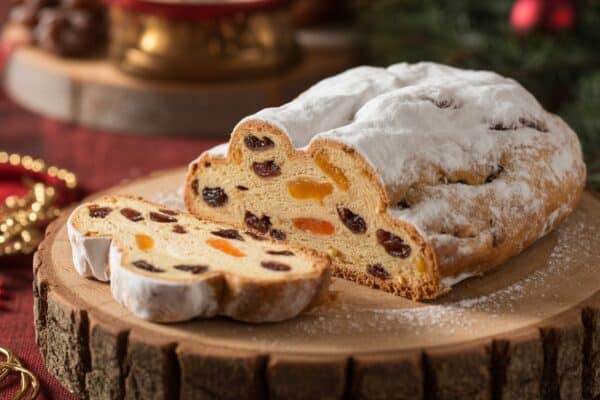
Christstollen, the Christmas cake that comes from Dresden
Christstollen, the Dresden Christmas loaf with candied fruit and icing sugar: origins, symbolism and which Alsace markets to find it on.
Read the article
The Advent calendar: from devotional pictures to giant façades
The Advent calendar, from the German devotional picture of 1908 to the giant façades of towns in Alsace and the Black Forest. Origins and traditions.
Read the article