
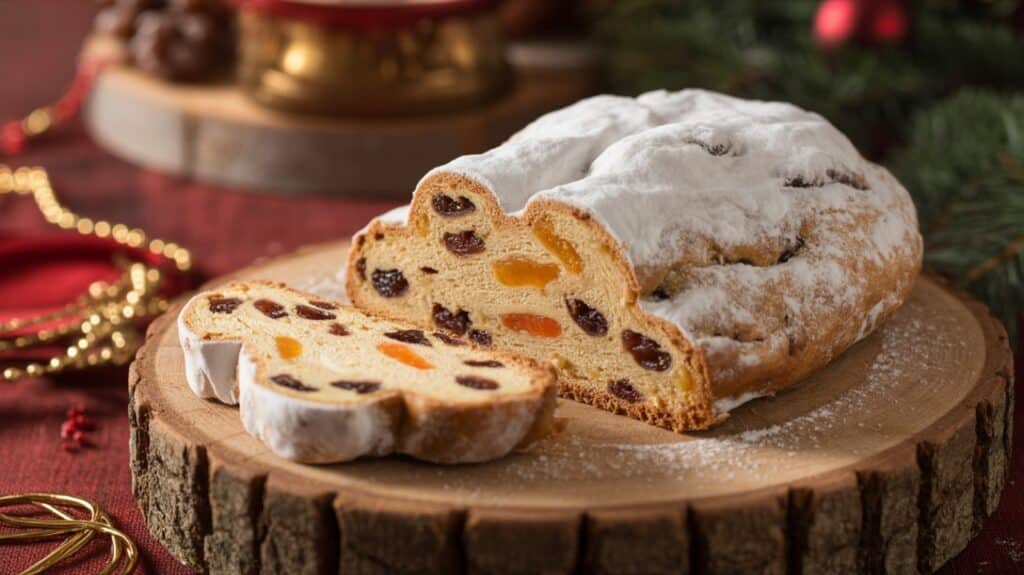
 Illustrative image
 Christstollen, the Christmas cake that comes from Dresden
A heavy, dense loaf dusted with a thick layer of icing sugar and packed with raisins and candied fruit: the christstollen (the German Christmas stollen) is one of the treats you will find on almost every Christmas market in Alsace and along the German border. Behind its rustic look lies a history going back to the Middle Ages, a rather touching religious symbolism and a craft so codified that a German association watches over its recipe. A short cultural guide to understanding what you are eating when you bite into one, and above all where to find it.
What exactly is a christstollen?
The christstollen is a festive bread made from yeasted dough, enriched with butter, raisins, candied fruit (orange and lemon peel), almonds and spices. After baking, it is brushed with melted butter and rolled in icing sugar, sometimes in two or three layers. This sugary crust is not just decorative: it seals the bread and stops it drying out. The result is a cake that keeps for a long time and whose aromas develop over the weeks.
It is often mistaken for a brioche, but the texture is different: tighter, less airy, almost compact. A thin slice is enough. It is a cake to be eaten in small slices, with a coffee or a tea, and it accompanies the whole of Advent rather than a single meal.
There are several variations depending on the region and the baker. Some slip a log of marzipan into the centre of the loaf, in which case it is called a marzipan stollen. Others go all in on the fruit, or replace the raisins with nuts and poppy seeds. The classic christstollen, with candied fruit and almonds, remains the reference version, the one associated with Christmas for generations.
A history that starts in Dresden
The cradle of the stollen is Dresden, in Saxony. The first written record of it being made there dates from 1474, in the accounts of one of the city’s hospitals. At the time, the cake looked little like today’s: during Advent, a period of fasting, the Church forbade butter. Bakers therefore worked a lean dough of flour, water and oil, with little in the way of pleasure for the palate.
Legend has it that the Elector of Saxony eventually asked the Pope for permission to use butter. Once that permission was granted, the recipe grew richer and the stollen became the dense, buttery treat we know. From the 17th century it settled into the traditions of Advent, and the Dresden court gradually made it a festive dish. So the cake took several centuries to find its final form.
This story of the butter says a lot about how Christmas treats came to be. Many Advent specialities were born of a religious constraint that bakers got around with ingenuity. The stollen follows that path to the letter: from an austere fasting bread to a generous festive cake, one dispensation and one century at a time. What we eat today is the fruit of that slow transformation.
Why this shape and this name?
The word comes from the Middle High German “Strutzel” or “Striezel”, which referred to an elongated yeasted pastry. It is the same term that gave its name to Dresden’s famous Striezelmarkt, one of the oldest Christmas markets in Germany.
The oblong shape and the coat of white sugar are no accident. Christian tradition sees in them a representation of the swaddled infant Jesus: the icing sugar evokes the newborn’s spotless swaddling clothes, and the elongated shape recalls the child’s body. That is where the “christ” prefix of christstollen comes from, the Christmas stollen. So here is a cake whose appearance tells the story of the Nativity quite openly.
A recipe protected by a label
In Dresden, nobody jokes about stollen. The Dresdner Christstollen holds a Protected Geographical Indication: only stollen produced in the Dresden area, using traditional methods and by bakers who belong to the protection association, may carry that name and its oval golden seal. It is the same kind of recognition as Lübeck marzipan or Black Forest ham.
The permitted ingredients are defined to the letter: flour, butter and clarified butter, raisins and sultanas, candied orange and lemon peel, sweet and bitter almonds, milk, yeast, rum, icing sugar and a house blend of spices. Each baker keeps a personal touch, a particular spice dosage here, a few extra raisins there, a double buttering after baking. The framework is rigid, but the room for style is real.
| Element | Role in the stollen |
|---|---|
| Raisins and sultanas | Softness and natural sugar, often steeped in rum |
| Candied fruit (orange, lemon) | Tangy notes that balance the richness |
| Almonds | Crunch and roundness |
| Butter | Richness and keeping quality |
| Icing sugar | Protective crust and symbol of the swaddling clothes |
Dresden’s stollen and its giant festival
Since 1994, Dresden has devoted an entire festival to its cake: the Stollenfest, held every year on the Saturday before the second Sunday of Advent. The highlight is a giant christstollen, billed as the largest in Germany, paraded through the streets on a horse-drawn carriage before being cut up and sold to the public. The 2026 edition takes place in early December, in keeping with the Stollenfest tradition.
This staging says a lot about the cake’s place in local culture. In Dresden, the stollen is not one pastry among many; it is a symbol of Advent that brings bakers and residents together around a shared craft.
The Striezelmarkt, named after the old word for the cake, remains one of the oldest Christmas markets in Germany. The link between the market, the festival and the stollen has held for centuries in the same place. When you taste a real Dresdner Christstollen, you are biting into a piece of that continuity, with a specification that has barely changed.
The Alsatian take on christstollen
On the other side of the Rhine, Alsace adopted the christstollen long ago, to the point of making it one of its own Christmas treats. You will find it on the stalls alongside bredele, gingerbread and pretzels. The Alsatian version stays true to the original spirit, sometimes with local variations in the spices or the addition of marzipan at the heart of the loaf.
It should not be confused with the berawecka, its Alsatian neighbour. The berawecka (the “pear bread”) is denser still, almost a concentrate of dried fruit and dried pears bound by very little dough, often flavoured with kirsch. The christstollen, on the other hand, keeps a proper base of buttery yeasted bread. Two Advent cakes that look alike from a distance, but which their texture clearly sets apart.
To find your way around a stall, remember the main families:
- Christstollen: buttery yeasted bread, raisins, candied fruit, almonds, icing sugar crust. Soft slice.
- Marzipan stollen: the same base with an almond heart, richer and sweeter.
- Berawecka: very little dough, lots of dried pears and dried fruit, dense and flavoured with kirsch.
- Kougelhopf: a soft, airy brioche with raisins, baked in a fluted mould, not to be confused with the others either.
Which markets to find it on
Alsace remains the best hunting ground in France. Strasbourg Christmas market, the oldest in the country with its Christkindelsmärik, sells it on several of its squares, notably those devoted to food specialities. An hour away, Colmar Christmas market gathers its food stalls around the old town, and the stollen sits there alongside the other Alsatian sweets.
In the vineyards, the villages also play the tradition card. Ribeauvillé Christmas market, with its medieval atmosphere, and Obernai Christmas market have bakers and pastry chefs who make their own stollen. Further north, on the German border, the Wissembourg Christmas market benefits from its proximity to the Palatinate, where the stollen tradition is very much alive. And in Munster, at the foot of the Vosges, you will come across it on the food stalls too.
One tip for recognising the real thing from Dresden: look for the oval golden seal on the packaging, which guarantees production in line with the specification. For the Alsatian versions, trust the baker and ask about the recipe; most are delighted to talk about it.
On the markets along the German border, you will also come across stalls straight from across the Rhine, with stollen made in the Saxon tradition. The seal and the words Dresdner Christstollen mark the difference between a protected product and a free interpretation. Neither is better as a matter of principle, but knowing what you are buying helps you choose, especially if you plan to bring some home as a gift.
How to eat and store it
Christstollen is cut into thin slices, across its length. Thanks to its sugar crust, it keeps for several weeks at room temperature, wrapped in paper and then in an airtight tin. Many families make it well before Christmas, precisely so its aromas can mature. A stollen made before Advent and eaten at Christmas will have gained in depth.
As for pairings, it goes very well with a hot drink that recalls the atmosphere of the markets. A strong coffee, a black tea, or a spiced mulled wine whose notes of cinnamon and orange answer the cake’s candied fruit. A slice of stollen and a steaming mug in your hands: that is one of the simplest pleasures of the season on a Christmas market.
The stollen also makes a lovely gift to bring home. Its long shelf life makes it easy to transport and to give long after the markets have closed. Wrapped in its original paper, it will last until the festive season without any trouble. Many people buy one for home and a second to give away, with the golden seal as a guarantee of quality.
In the end, the christstollen sums up what makes Christmas markets so endearing: a cake born in the Middle Ages, loaded with symbolism, protected by a label and yet simple to enjoy on a bench, slice in hand. Its story starts in Dresden and its Striezelmarkt, its shape tells the Nativity, and its recipe has come down the centuries keeping the essentials: butter, fruit and plenty of patience. Next time you spot a stollen generously coated in icing sugar on an Alsatian stall, you will know where it comes from and why it looks like a little white parcel set down there on purpose for the season.
Where to stay near the markets mentioned
Availability with our partners, town by town.
Reviewed and approved by the editorial team
A question, a mistake or a problem on this page? Write to us
Also worth reading
5 traditions to know before you visit
From medieval origins to today's markets Christmas markets date back to the 14th century, in the German-speaking towns of central Europe. In France, it is…
Read the article
Christmas foie gras, from the marché au gras to your table
Christmas foie gras from south-west France: duck or goose, IGP, raw or preserved, where to buy it at the marchés au gras and how to choose a good one.
Read the article
Alsatian Christmas Specialities: a Guide to the Treats of the Market
Bredele, gingerbread, manala, pretzel, tarte flambée: the guide to Alsatian Christmas specialities and the markets where you can taste them.
Read the article