
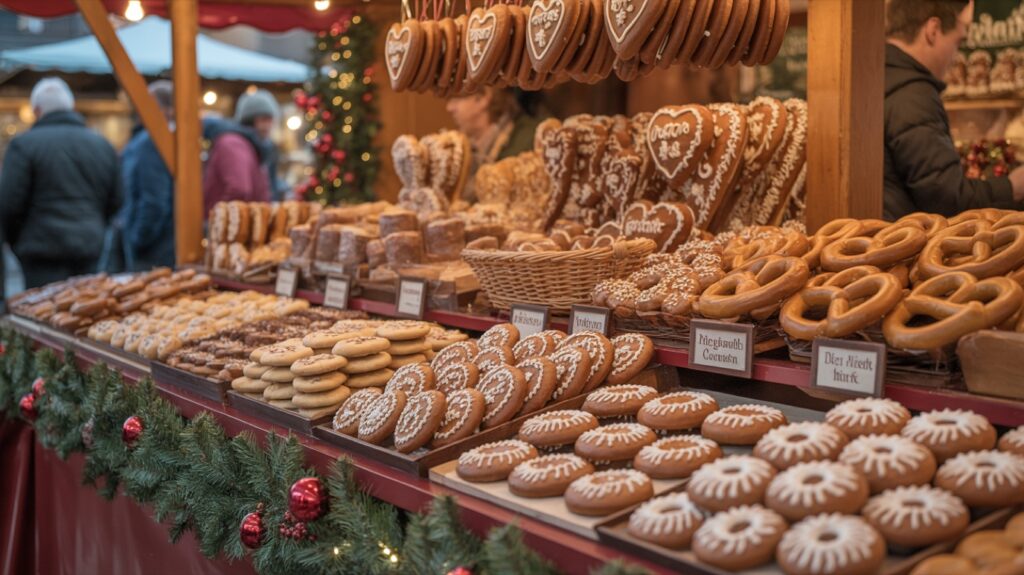
 Illustrative image
 Alsatian Christmas Specialities: a Guide to the Treats of the Market
Walking through an Alsatian market in December means following your nose. The hot sugar of Alsatian Christmas specialities drifts between the chalets, pulled along by the butter of the bredele, the cinnamon of the gingerbread and the smoke of a tarte flambée oven. This guide gives you the overview: what people eat, where it comes from, when it is eaten, and which pages and articles to head for to dig into each treat. A hub article, in short, so you miss nothing of the Alsatian spread.
Alsace does not cook Christmas the way the rest of France does. The tradition comes from across the Rhine, blended with Germanic festivities, and it starts early: from Saint Nicholas' Day, 6 December. Sweet dominates, but savoury holds its own with steaming trays. Mulled wine serves as the thread running through it all, a cup in hand while you graze. A quick tour, so you know what to taste and in what order.
Bredele, the sweet soul of an Alsatian Christmas
Impossible to talk about Alsatian treats without starting with bredele (also spelt bredala, depending on the village), the small Christmas biscuits of Alsace. These little dry biscuits come in endless varieties: cinnamon shortbreads, aniseed stars, butter crescents, coconut macaroons, chocolate spritz. Every family keeps its own recipe, handed down from one generation to the next, and baking starts as early as late November to last the whole month. It is a family ritual as much as a treat: you bake together, fill the tins, give them away.
At the markets you will find them sold by weight or in small decorated bags, perfect for nibbling as you walk. The tins, meanwhile, are filled at home and last until Twelfth Night. The variety is the whole charm: a single table can line up eight or ten different shapes, each with its own texture, from melting shortbread to a dry biscuit that snaps between the teeth. It is the first reflex to have when you arrive at an Alsatian market, and the best way to compare the bakers' hands from one town to the next.
Gingerbread, king of the markets
Gingerbread rules over the sweet chalets. A soft cake scented with honey, cinnamon, clove and aniseed, it is sold in thick slices, as iced hearts to hang up, or as small individual loaves wrapped for the road. Its scent accompanies the stroll from start to finish, and it goes as well with a mulled wine as with a coffee.
Its roots go back a long way, well beyond Alsace, but the region has made it a signature of its festive season, to the point of having specialist houses going back generations. To learn all about its history, its regional recipes and the good addresses to buy it, we have put together a complete feature on gingerbread. It is the kind of treat that keeps for several days, so a good souvenir to bring home in your suitcase, and an easy gift to slip into a bag.
Manala, mannele: the little man of Saint Nicholas' Day
6 December opens the festivities, and with it comes the manala (or mannele, or mannala depending on the area), a small brioche shaped like a little man. Often studded with raisins for the eyes and buttons, it is eaten at breakfast or for an afternoon snack, dipped in hot chocolate. Bakeries turn out whole baskets of them throughout the first days of the month, and it is a classic gift given to children for Saint Nicholas' Day.
Simple, soft, slightly sweet: it is the treat of the youngest, the one that marks the start of Advent in Alsace. At the markets you will come across it mostly in the first half of December, around Saint Nicholas' Day. Some bakers go to the trouble of glazing it with egg and letting it rise high, for a plump little man that fits in the hand.
The pretzel, savoury or sweet
These crossed arms of golden dough are everywhere in Alsace, and not only at Christmas. At the markets the pretzel is eaten hot, sprinkled with coarse salt, or topped with melted Munster cheese for a more generous version. Expect to pay just a few euros, enough to take the edge off your hunger between two chalets without breaking the bank. Its glossy crust comes from a dip in an alkaline bath before baking, the secret of its colour and its taste.
Its shape tells an old story, somewhere between religious symbol and courting custom: in days gone by, a young man would offer a New Year pretzel to the girl he fancied. The gesture is gone, the treat remains. A salted version with an aperitif, a sugared brioche version for teatime, it plays both sides and suits every hour of the day. You will also find it as small snack pretzels sold in bags, dry and crunchy, easy to take home. If you want to understand why it ended up symbolising an entire region, it is a treat worth lingering over, somewhere between bakery and folklore.
The big cakes: berawecka, christstollen, kougelhopf
Three more imposing pieces complete the sweet picture, each with its own character. These are the cakes shared at the table, the ones that keep the festivities going well beyond the market.
- Berawecka (also spelt beerawecka or bierewecke), the Alsatian dried-fruit loaf, is a dense bread of dried fruit: pears, figs, dates, walnuts, hazelnuts, all bound together with candied fruit, spices such as cinnamon and aniseed, and a dash of spirit. Made without leaven, it is cut into very thin slices and keeps for weeks. A concentrate of flavours, for those with a taste for rich, heady sweetness.
- Christstollen, or stollen, is a brioche of Germanic origin with dried and candied fruit, dusted with icing sugar. Its shape evokes the swaddled infant, and its first written mention, in Dresden, dates back to 1474. Some versions hide a heart of marzipan, in which case it is called marzipanstollen.
- Kougelhopf, the brioche baked in a twisted ring mould, comes in a sweet version with raisins and almonds as well as a savoury version with bacon. Less strictly tied to Christmas, it remains a classic of Alsatian festive tables, from Sunday brunch to Christmas Eve dinner.
These three travel home well: they survive the journey and are shared with the family long after you get back. Berawecka and stollen in particular even improve if you wait a few days before cutting into them.
On the savoury side: enough to keep you going all the way round
The cold builds an appetite, and Alsace has an answer. The savoury chalets serve hot plates that warm your hands as much as your stomach. You eat standing, shoulder to shoulder, the steam of the broth in your face, between two purchases.
| Speciality | What it is | Best moment |
|---|---|---|
| Tarte flambée (Flammekueche) | Thin base with cream, onions and bacon, cooked over a wood fire | A meal on your feet, to share |
| Choucroute garnie | Fermented cabbage, sausages and smoked meats, served in a tray | The real market meal |
| Grumbeerekiechle | Grated potato fritters, fried until crisp | Hot snack on the go |
| Pretzel with Munster | Hot pretzel coated in melted cheese | Peckish between two chalets |
| Knack | Grilled Strasbourg sausage in a small roll | Quick bite while walking |
Tarte flambée comes out of the mobile ovens on a board to share, choucroute is served in individual portions, and the potato fritters are eaten scalding hot, with a little cream or apple sauce. Enough to turn the stroll into a proper meal if the mood takes you. Bring some change and a good appetite: here you graze from chalet to chalet rather than sitting down at a table.
And mulled wine to warm it all up
The steaming cup that goes with all of this is mulled wine. Heated without ever boiling, scented with spices and orange, it is served as a red on a pinot noir base or, a local speciality, as hot white wine made with gewurztraminer or riesling, lighter and more aromatic. The deposit cup is often kept as a souvenir, each market having its own, decorated in its colours.
We will not go into the recipe here: our guide to mulled wine and its variations runs through the versions served from one market to the next and points you to the recipe. On the spot, let yourself be carried along: every market has its house recipe, and that is what makes the difference from one chalet to the next. For children and those who do not drink alcohol, hot apple juice with cinnamon plays the same comforting role.
Each treat has its moment, and here is where to find it
An Alsatian Christmas follows a calendar, and the specialities come one after another over the weeks rather than all arriving at once. Understanding that rhythm helps you not to miss a seasonal treat. The manala opens the ball with Saint Nicholas' Day, at the start of December: it is the first sign that the festivities are beginning. The bredele follow almost straight away, since families bake their tins from late November to make them last until Epiphany.
Gingerbread and pretzels, on the other hand, can be found from the first day of the market to the last, with no marked season. The big cakes such as berawecka and christstollen are prepared more as 25 December approaches, for the Christmas Eve table and the days that follow. On the savoury side, tarte flambée, choucroute and potato fritters hold the stall for as long as the market stays open. Most Alsatian markets start on the last weekend of November and close between 23 and 30 December, Strasbourg and Colmar being among those that carry on to the end of the year. A useful marker for timing your visit, depending on what you want to taste.
That leaves the question of where to go. All these treats can be found at the big Alsatian markets, with slightly different accents from one town to the next. Where to start? From the largest to the most intimate, each has its own personality.
- The Strasbourg Christmas market, the Capital of Christmas, gathers the widest choice of specialities across its many chalets spread throughout the city.
- The Colmar Christmas market spreads its food stalls across several squares of the historic centre, each with its own atmosphere.
- In Ribeauvillé and Riquewihr, two pearls of the vineyards, you taste bredele and mulled wine against a backdrop of half-timbered houses.
- The Kaysersberg Christmas market and the one in Eguisheim bank on the mood of the wine villages, tighter and gentler.
- In Obernai, at the foot of Mont Sainte-Odile, the savoury and sweet chalets share the Place du Marché.
Each page gives you the dates, opening hours and practical information to organise your tasting. The best advice remains the simplest: come with an empty stomach, follow your nose, and taste as you go, one sweet mouthful for every savoury one. Alsatian Christmas specialities are best enjoyed unhurried, one chalet after another, between two strings of lights.
Where to stay near the markets mentioned
Availability with our partners, town by town.
Reviewed and approved by the editorial team
A question, a mistake or a problem on this page? Write to us
Also worth reading
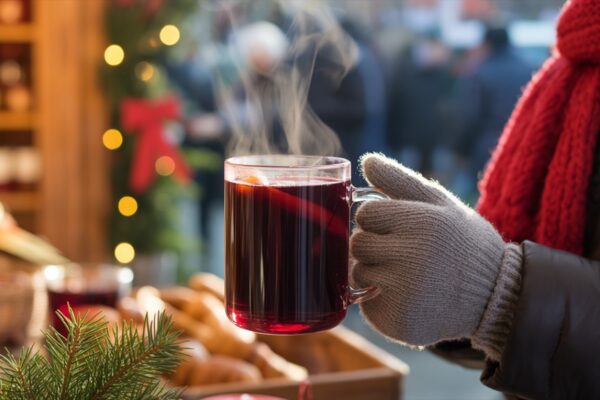
Mulled Wine and Its Variations, from Alsace to Scandinavia
Glühwein, Alsatian mulled wine, glögg, Austrian Punsch: a tour of Europe's mulled wine variations served at Christmas markets, with no recipe.
Read the article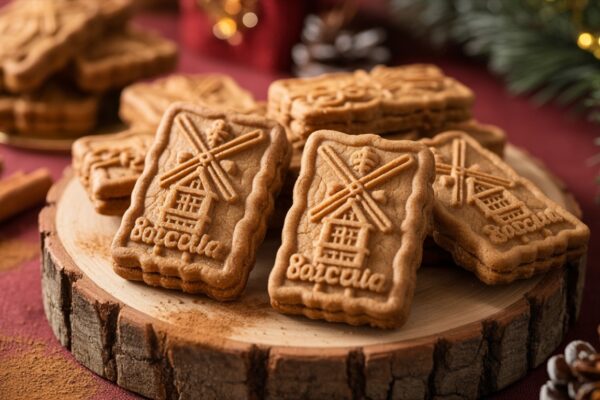
Speculoos, the little carved biscuit that tells the story of Saint Nicholas
Speculoos, the brown sugar biscuit linked to Saint Nicholas: Flemish origins, wooden moulds, spices and where to taste it at Christmas markets in northern France.
Read the article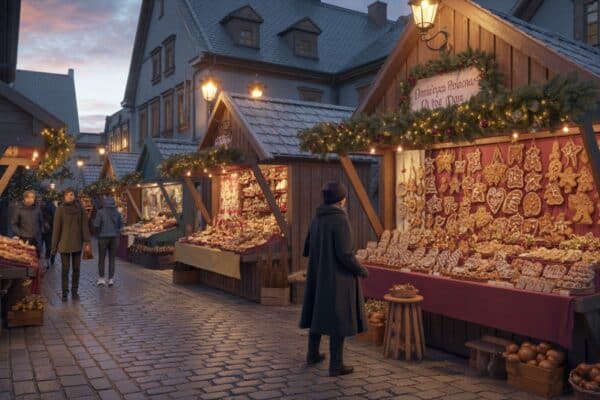
Where Do Christmas Markets Come From? Six Centuries of Tradition
The history of Christmas markets, from Dresden 1434 to Strasbourg 1570: medieval origins, the Reformation, the Advent wreath and the revival in France.
Read the article