
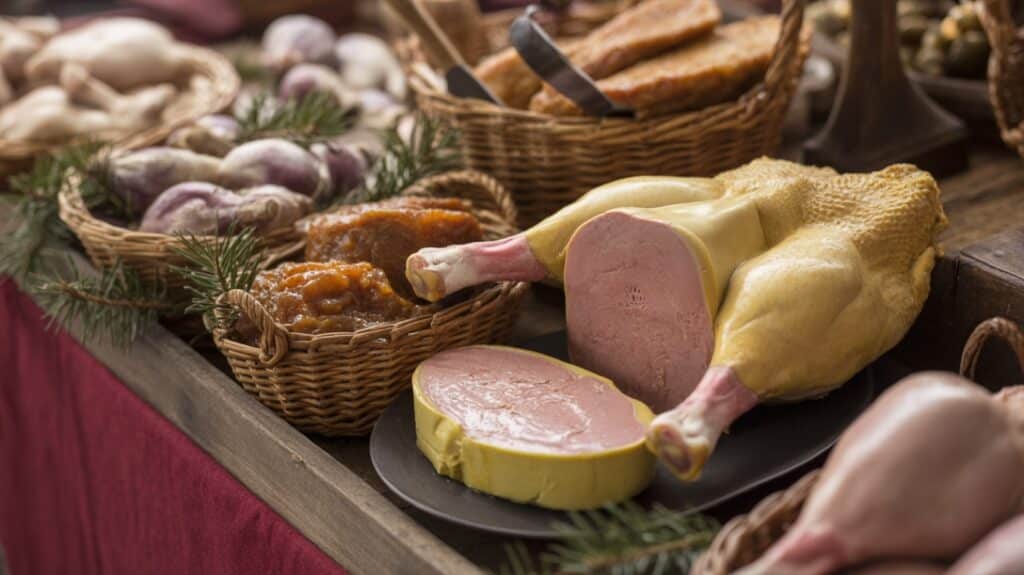
 Illustrative image
 Christmas foie gras, from the marché au gras to your table
On the market stalls of south-west France, Christmas foie gras takes on a special status as soon as winter sets in. It is not a product you come across everywhere in the same way: in the Périgord, the Chalosse, the Gers or the Landes, it is still sold raw, by weight, at markets with a very specific name, the marchés au gras. Understanding where it comes from, how to recognise a good one and how to serve it helps you make a sound choice for the holidays, without breaking the bank or getting it wrong. This guide covers the subject from both the local and the practical angle, with no recipe.
Christmas foie gras, a story of south-west France
Foie gras is rooted in the greater south-west, an area covering the Chalosse, Gascony, the Gers, the Landes, the Périgord and the Quercy. The tradition goes back a long way: from mid-November, families long made a habit of preserving and stocking up for special occasions, with foie gras kept for Christmas and confit for family meals. This seasonality still matches the festive calendar, which explains why the product keeps such a strong aura in December.
French law itself has enshrined this status: since 2006, foie gras has been part of the country’s protected cultural and gastronomic heritage, and the Rural Code defines it as the liver of a duck or goose fattened by force-feeding. We will come back to that below, without beating about the bush. For now, remember that this product owes as much to farming know-how as to the food culture of towns like Sarlat or Périgueux, where winter markets set the rhythm of local life.
This geography matters if you want to understand the product. Maize grown in the region is the basis for fattening, and the climate and the landscape of free-range farms shape an industry that has largely stayed family-run. Many producers raise their own ducks, fatten them and process the livers themselves, from magret to preserves. It is this short supply chain you find on the winter stalls, where you talk directly to the person who produced what they are selling. For Christmas foie gras, this closeness changes everything: it gives you access to a fresh, traceable product that is often impossible to find in this form in a supermarket.
Duck or goose foie gras: what is the difference?
The first question you ask yourself at a stall is whether to go for duck or goose. The two differ both in taste and in how widely they are available.
- Duck is by far the most common in the south-west. Its taste is bold, rustic and more pronounced. It is the liver you will see most often on the markets of the Périgord and Gascony.
- Goose is a speciality more associated with Alsace. Its flavour is finer and more delicate, sought after by palates that prefer subtlety to power.
In terms of regulations, a raw liver must weigh at least 300 g for duck and 400 g for goose to qualify as foie gras. At a marché au gras you will mostly find duck, whole or deveined, next to magrets, confits and carcasses. The duck versus goose debate has no universal right answer: it all depends on your taste and what you plan to do with it.
A useful rule of thumb to help you decide: duck stands up better to strong accompaniments (chutney, fig bread, cracked pepper) because its flavour holds its own against them, whereas goose is best served more simply to let its finesse come through. If you are making your first homemade terrine, duck is more forgiving of small cooking mistakes and often costs less per kilo. Goose, rarer and finer, is better kept for meals where it will be the star of the starter.
IGP Sud-Ouest, Périgord, Label Rouge: reading the labels
Labels are not there for decoration. They tell you about origin and quality, two separate things that are worth telling apart.
The IGP Canard à foie gras du Sud-Ouest (a protected geographical indication), granted in 2000, guarantees that the ducks are raised, fattened, processed and packaged within the south-west area. The specifications allow two types of duck, the Muscovy and the mulard, raised outdoors and fattened on non-GMO maize from the region. It is above all a guarantee of origin and traceability.
Label Rouge, on the other hand, focuses mainly on taste and the level of flavour quality. The two labels can also appear on the same product. The table below sums them up at a glance:
| Label | What it certifies |
|---|---|
| IGP Sud-Ouest / Périgord | Geographical origin and traceability (rearing, force-feeding, processing within the area) |
| Label Rouge | Superior flavour quality, checked against a set of specifications |
On the markets of Toulouse, Agen or Cahors, a producer can tell you in person where their produce comes from. That is often the best guarantee of traceability, backed up by the IGP logo on the label.
Raw, mi-cuit or preserved: which should you choose?
Three forms exist side by side, and the choice depends less on quality than on how and when you plan to eat it.
- Raw foie gras is the raw material. It is the one sold by weight at the marchés au gras, to be cooked yourself within a few days of buying it (it keeps for about 7 days at 0 to 4 °C). Ideal if you want to make your own terrine.
- Mi-cuit is cooked at a low temperature, around 70 to 85 °C. Its texture is melting, its colour pinker and its taste more pronounced. It keeps for about 8 to 10 days in the fridge. A good compromise between freshness and convenience.
- Preserved foie gras is cooked above 90 °C. It keeps for several months at 2 to 4 °C and even improves with time. Handy for getting ahead for the holidays or bringing home a souvenir of the south-west.
None of these three forms is better in absolute terms. Raw rewards those who like to roll up their sleeves, preserved is a lifesaver when you want to plan ahead, and mi-cuit sits in between. For a festive meal, many people buy preserved or mi-cuit several weeks in advance and leave raw to those who want to try a homemade terrine. A seasonal tip: a jar bought in December keeps until the following year and even becomes rounder, which makes it a good buy when you pass through a south-west market with no immediate chance to cook it.
The marchés au gras of south-west France: where and when
The marché au gras is a winter institution. From November to March, producers and food lovers gather around fresh livers, magrets, confits and rillettes. Two markets in the Dordogne are the benchmarks:
- Sarlat: the marché au gras is held every Saturday morning, from late November to mid-March, in the heart of the Périgord Noir.
- Périgueux: on Place Saint-Louis, every Wednesday and Saturday between November and March, with around thirty producers from all over the department.
The tradition reaches far beyond. In the Tarn, the Landes and the Quercy, the winter markets of Albi, Montauban, Mont-de-Marsan or Dax offer their share of whole ducks, raw livers and local specialities as the holidays approach. On these stalls you will find breasts, fat, confits and sometimes breasts stuffed with foie gras, enough to put together a complete Christmas meal.
A practical tip for these winter markets: get there early. The finest livers often go in the first few hours, and producers take the time to give advice while the crowds are still reasonable. Bring a cool box too if you are buying raw and have a long drive home, as the cold chain is not negotiable with this product. Many of these markets combine foie gras and black truffles at the same time of year, which makes them a complete foodie outing in late autumn and the depths of winter.
How to choose raw foie gras at a market
Faced with a raw liver, a few simple pointers help you avoid unpleasant surprises. Colour, feel and weight tell you a lot.
- Colour: a good raw liver has an even, slightly glossy caramel-blond colour. Not too reddish or greyish, with no visible traces of blood. A liver that is too pink and dull lacks fat.
- Feel: firm and supple at the same time. Your finger sinks slightly into the lobe, then the liver springs back as soon as you let go. If it keeps a deep imprint, move on.
- Weight: for a terrine, aim for a liver of 600 to 700 g. Too large, and it will lose a lot of fat during cooking; too small, and it will not melt as well.
- No blood spots, which give a stronger taste and spoil the finesse.
One last useful habit: ask the producer about the exact origin and check for an IGP label. Direct contact remains the big advantage of the market over the supermarket.
Serving foie gras: temperature, bread and wine
Serving matters as much as the product. Too cold, foie gras numbs the taste buds and does not release its aromas properly; too warm, it loses its shape. So serve it chilled but not ice-cold, taken out of the fridge a little while before you sit down to eat.
Bread brings the crunch that balances the melting texture: good country bread or toasted slices do the job, and some prefer a brioche note or a bread with dried fruit. A touch of acidity, such as a chutney or a tart fruit, gives structure to the tasting and stops the palate from getting overloaded.
For wine, the classics are still sweet wines such as Sauternes, but a dry, taut white (Riesling, Savennières) or a vintage Champagne also cuts through the richness with elegance. At the market itself, foie gras is often eaten standing at the stall, where you happily reach for a cup of mulled wine to warm up between purchases. It is not the pairing you would choose at the table, more a moment’s pleasure in the cold air of the aisles.
The question of force-feeding, in a few words
You cannot talk about foie gras without mentioning how it is produced. Under French law, foie gras is by definition obtained by force-feeding ducks or geese. The practice is controversial: several European countries, including Germany, Italy and the United Kingdom, ban its production on their soil while allowing imports, and in 2021 the European Parliament adopted a non-binding resolution calling for a ban on force-feeding. Methods of production without force-feeding are being studied.
The aim here is not to settle the debate; everyone makes up their own mind. We give you the facts so you can choose with full knowledge, whether you are buying a raw liver in Sarlat or a jar to bring home for the holidays. For many people, the marché au gras remains a living part of the food heritage of south-west France, worth visiting at least once when December comes round.
Where to stay near the markets mentioned
Availability with our partners, town by town.
Reviewed and approved by the editorial team
A question, a mistake or a problem on this page? Write to us
Also worth reading
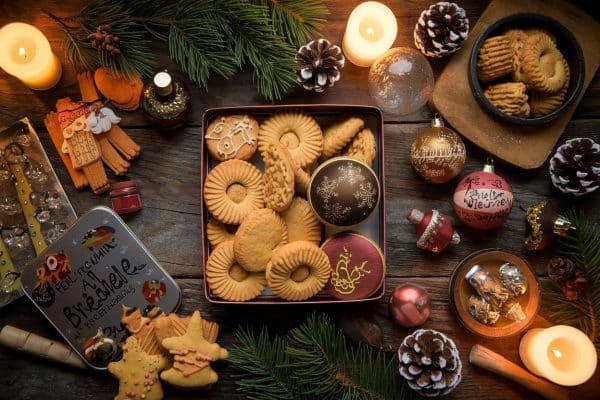
10 souvenirs to bring home from a Christmas market
Beyond the mass-produced baubles The classic Christmas market trap is coming home with decorations identical to the ones in the supermarket. The best souvenirs are…
Read the article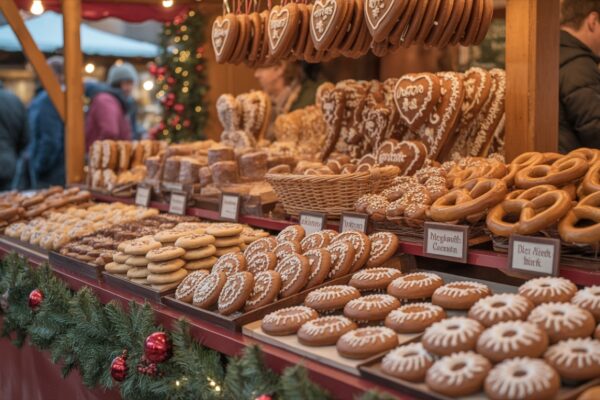
Alsatian Christmas Specialities: a Guide to the Treats of the Market
Bredele, gingerbread, manala, pretzel, tarte flambée: the guide to Alsatian Christmas specialities and the markets where you can taste them.
Read the article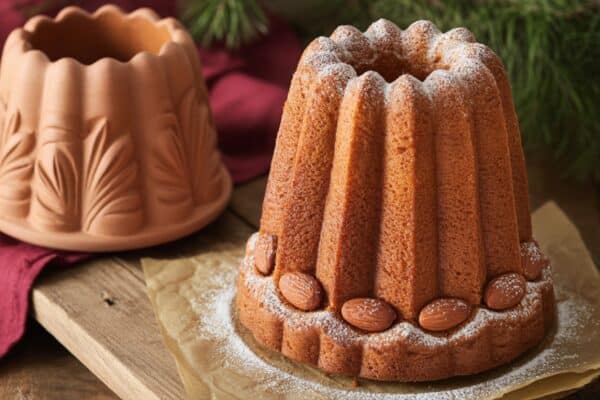
Kougelhopf, the Golden Crown That Tells the Story of Alsace
Kougelhopf, the ring-shaped Alsatian brioche: the Ribeauvillé legend, the Soufflenheim mould, sweet and savoury versions, and where to taste it at the markets.
Read the article