
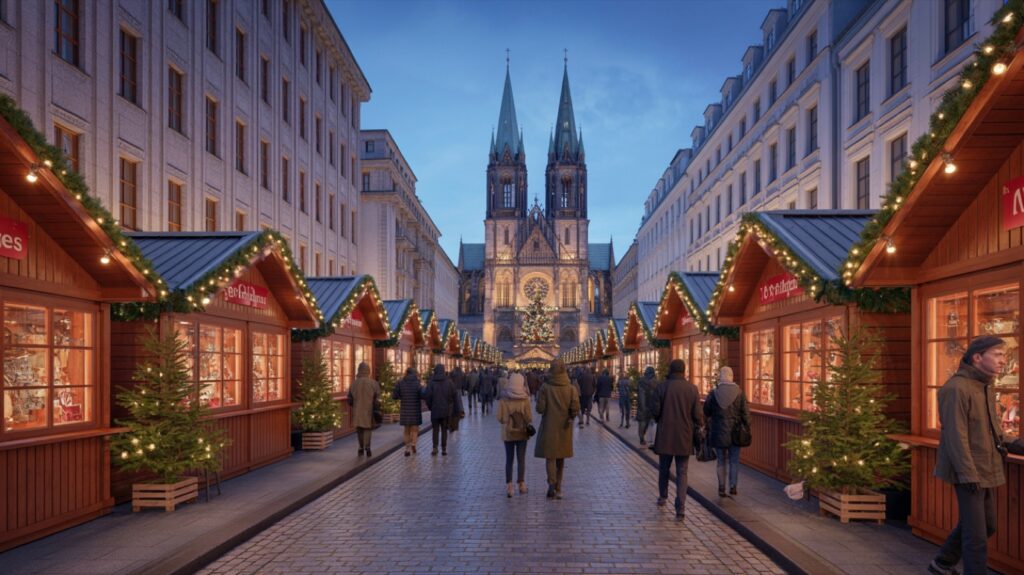
 Illustrative image
 The Christmas Markets That Come Into Their Own After Dark
A Christmas market by night is nothing like its midday self. The same chalets, the same lanes, the same mulled wine, but as soon as the lights come on, everything shifts register. The cold bites a little harder, the shop windows glow warmer, the façades step out of the shadows. This selection looks at the markets from that precise angle: what makes their evenings beautiful, town by town. A great fir tree bursting into light, a cathedral that starts telling stories, reflections sliding across a canal. The programme of dates changes every year, so the exact times are on each town's page.
Why a Christmas market by night is worth it
The switch happens around 4.30pm in December, when the day fades fast and the lights come on one by one. That is the most interesting slot, the one at dusk: the sky still keeps a little deep blue while the first bulbs light up, and for twenty minutes or so natural and artificial light answer each other. Arriving in the late afternoon lets you live that transition, wander the aisles before the crowds, then stay on once full night has settled in.
In many towns, switching on the illuminations is an event in its own right. In Montbéliard, the ceremony is repeated every evening around 5pm and the whole town is suddenly covered in thousands of points of light. That flip you simply will not see if you only come in the afternoon. It is the real reason to time your visit for the evening rather than lunchtime.
As for crowds, the peak comes around 7pm at weekends. If you prefer calm, a Tuesday or Wednesday in the early evening is still very pleasant, with the lights on and far fewer people in the lanes. Evening also changes what you eat and drink: mulled wine and roasted chestnuts make complete sense once the temperature drops, and the smell of cinnamon carries better in cold air than in a mild afternoon.
There is a sensory dimension that only exists once the light has gone. The stalls of crystal, blown-glass baubles and candles throw back reflections you would not notice at noon. Church stained glass, when lit from within, colours the square. And the breath misting in front of mouths, the smoke of the braziers, this whole little winter theatre only really works in the evening.
Strasbourg and its great tree on Place Kléber
The Strasbourg Christmas market has an anchor everyone knows: the great fir tree on Place Kléber. It stands around thirty metres tall, chosen in the forests of the Moselle, dressed with several hundred ornaments and kilometres of lights. In the evening it lights up in cycles, with sequences set to music at certain hours and then in light alone later on, until midnight.
All around, the Capital of Christmas rolls out its illuminations across the whole centre: the Grand'Rue, the Place de la Cathédrale, the bridges spanning the Ill. The cathedral itself, floodlit, serves as a landmark above the rooftops. It is a market that grows in stature in the evening, when the pink sandstone starts to glow under the spotlights.
Not far away, Alsace offers other evenings in the same vein. Colmar, Mulhouse and its canvas of colours, or villages such as Riquewihr and Eguisheim are worth a visit at the moment the half-timbering lights up.
A tip for Strasbourg: the Kléber tree draws enormous crowds from the moment it is switched on, so if you want a quiet photo, come early or stay after 9.30pm, when the music stops and the crowd thins out. The rest of the market, scattered over some ten squares, is better explored on a weekday evening. Place Broglie, the oldest, and the sharing village on Rue de la Mésange both gain from the evening light.
Colmar, reflections on the canals of the Little Venice
If Strasbourg plays the monumental card, Colmar goes for the intimate. The Little Venice district, with its half-timbered houses leaning over the water, becomes in December a setting where the fairy lights double themselves in the canals. The Colmar Christmas market has several sites, but it is here, between the bridges, that the evening takes on a romantic character.
The town announces dozens of kilometres of lights, hundreds of baubles hanging in the trees and thousands of light motifs spread across the lamp posts. The appeal, once the lights are on, lies in the water: every bulb has a twin trembling on the surface. The moored boats, the ochre and red façades, everything is reflected. To make the most of it, aim for the blue hour and walk along the quays before the crowds gather there.
Colmar spreads several markets across the centre: the children's one in the Little Venice, Place des Dominicains around the collegiate church, Place Jeanne d'Arc for food. In the evening these sites form a circuit you can walk in an hour or two. The floodlit Saint-Martin collegiate church acts as a beacon. And since the town stays compact, you pass from one mood to the next without ever straying far. One thing to note: Colmar is full on December weekends, so for an evening with room to breathe, a weekday changes everything.
Reims, when the cathedral starts telling stories
In Reims, the evening has a leading actor: the cathedral. The Regalia show, created by a studio renowned for its projections on great monuments, dresses the façade in light and replays a day of royal coronation. It is free, it lasts around ten minutes, and it is scheduled on several evenings in December. The Gothic stone becomes a screen, the statues of the portals come back to life beneath the colours.
The Reims Christmas market sets up nearby, on the promenades, with its many chalets of craftspeople and producers. The town also projects mappings onto other landmark buildings in the evening, which turns a simple stroll between the stalls into a trail of light. Between two cups of mulled wine, you move from the Christmas village to the cathedral forecourt, and the contrast in scale makes all the impact.
Amiens, a cathedral in colour and a panoramic tower
Amiens holds the largest market in northern France, and its evening trump card has a name: Chroma. The show projects onto Notre-Dame cathedral the medieval colours that originally adorned its Gothic portals. A digital projection restores that lost polychromy, every evening throughout the period, for around fifty minutes. The result has already been seen by more than one and a half million people over the editions.
In 2025, the town replaced its big wheel with a noticeably taller panoramic tower, with heated cabins, installed on the same spot. From up there you take in the illuminations of the Amiens Christmas market and of the whole town, with the floodlit cathedral as the focal point. The lighting, now switched to LED, paints a white, sparkling Christmas. Between the enlarged ice rink and the evening show, Amiens has clearly designed its experience for after 5pm.
Montbéliard and Metz, two moods from Franche-Comté and Lorraine
Back to Montbéliard, whose Lumières de Noël recently celebrated their 39th edition. The daily lighting ceremony, around 5pm, remains the highlight: the old town blazes into light around the Saint-Martin temple, in a maze of courtyards and lanes made for an evening stroll. The ice rink set up on Place Denfert-Rochereau adds a gliding, illuminated backdrop, with themed sessions. The Montbéliard Christmas market draws hundreds of thousands of visitors and ranks among the great French gatherings.
A little further north, Metz plays another card: Jaumont stone, the yellow limestone that gives the town its natural golden hue. Once lit up in the evening, Saint-Étienne cathedral and the squares of the centre take on a particular warm light. Metz spreads its market across several squares, which makes it a true night-time trail from one square to the next. Nancy, under an hour away, with Place Stanislas illuminated, rounds off a Lorraine stay built around the evenings.
Big wheels and ice rinks, the evening changes everything
Two attractions change their nature at night: the big wheel and the ice rink. By day, a wheel is just a wheel. Once lit, it becomes a landmark visible from afar and, once you are in a cabin, it gives you a bird's-eye view over the lights of the whole town. Amiens grasped this by putting up its heated panoramic tower, but markets such as Lille, with its big wheel on the Grand'Place, or Nantes play the same night-time panorama card.
The ice rink, for its part, takes on another dimension in the evening. Spotlights on the ice, skaters turning as coloured shadows, the mist rising: it is a striking winter scene. Montbéliard sets up its rink on Place Denfert-Rochereau, with themed sessions depending on the evening. Many towns put up a temporary one, whose location moves from one year to the next, so check the town's page before turning up with your skates.
Lyon, light as a signature
Lyon has an unusual relationship with light, thanks to its Fête des Lumières in early December. Even outside that weekend, the city takes care over its night-time displays: floodlit quays along the Saône, the façades of the Presqu'île, the hill of Fourvière overlooking it all. The Lyon Christmas market, on Place Carnot, is best experienced in the evening, with Perrache station lit up in the background and the aisles of chalets filling up after work.
If you can time your visit to coincide with the Fête des Lumières, you combine the market with a festival of projections and light installations across the whole city. Two experiences for the price of one evening. Outside those dates, the market keeps its end-of-day atmosphere, with the lights taking over as soon as the sky darkens over the two rivers.
Making the most of a Christmas market in the evening
A few practical pointers so that the evening is enjoyed rather than endured:
- Arrive around 4pm to catch the dusk and see the switch-on. It is the photo moment par excellence, while the sky is still turning blue.
- Wrap up properly: standing in the cold for two or three hours is not the same as walking. Hat, gloves, thick soles, a flask if you like.
- Favour public transport. City-centre parking on a December evening quickly turns into a headache.
- Note the show times in Reims, Amiens or elsewhere: the projections run on a loop at set times, so plan your warm-up break around them.
- A Tuesday or Wednesday evening is far quieter than a Saturday, with the same lights.
Every market has its own calendar and its own late-opening hours, which shift from one year to the next. The exact dates, switch-on times and show days are detailed on the pages of the towns mentioned here. A last cup of mulled wine in hand, a cathedral changing colour in front of you: the stage is set for a fine winter evening.
Where to stay near the markets mentioned
Availability with our partners, town by town.
Reviewed and approved by the editorial team
A question, a mistake or a problem on this page? Write to us
Also worth reading
The Largest Christmas Market in France: Which One Really Wins?
Which is the largest Christmas market in France? Strasbourg, Colmar and Amiens compared by chalets and visitor numbers, with verified 2025 figures.
Read the article
Christmas foie gras, from the marché au gras to your table
Christmas foie gras from south-west France: duck or goose, IGP, raw or preserved, where to buy it at the marchés au gras and how to choose a good one.
Read the article
Alsace Christmas markets: the guide to planning your trip
Alsace Christmas markets: which ones to visit, when to go and how to combine Strasbourg, Colmar and the villages of the Route des Vins.
Read the article