
 Illustrative image
 Christmas markets in Brittany: harbours, crêpes and illuminated stone
When December settles over the western tip of France, a Christmas market in Brittany doesn't look quite like those in the rest of the country. The smell of hot butter sometimes replaces that of mulled wine, chalets are reflected in harbour waters rather than on enclosed squares, and it is not unusual for a bagad or a pair of pipers to pass between the stands. This selection brings together eight Breton towns where the Christmas spirit blends with the region's maritime and Celtic identity. Each has its own character: privateer city, marina, historic capital or stone village. It's up to you to choose according to the atmosphere you are after.
What makes a Breton Christmas market different
Brittany approaches Christmas with its own codes. Mulled wine does exist, but it shares the table with hot spiced cider, chouchen (a fermented mead, sweet and strong at the same time) and grog. For treats, you will rarely find gingerbread front and centre: here, it is crêpes made to order, warm kouign-amann (the caramelised pastry born in Douarnenez, made from dough, salted butter and sugar) and far breton with prunes that rule the sweet stands. Salted butter caramels, a speciality that has become a regional reflex, find their way into almost every basket.
The other difference is the soundtrack. Many towns schedule Celtic music concerts, performances by bagadoù (pipe bands), sometimes a fest-noz alongside the market. The fest-noz, a community dance where people link arms in a chain to the sound of the biniou and bombarde, has been on UNESCO's Intangible Cultural Heritage list since 2012. Coming across a ring of dancers right in front of a galette stand is an experience you won't have in quite the same way anywhere else. Some markets take the idea further, mixing Celtic crafts and contemporary objects on the same trestle tables.
And then there is the light. Granite façades and damp cobbles catch the lights in a particular way, and harbour water multiplies every reflection. It is this combination of stone, sea and garlands that gives Breton markets their signature. The weather plays its part too: a passing shower, then the sky clearing over the masts of a marina, and the atmosphere suddenly turns magical.
A word on crafts, while we're at it. Breton stands give pride of place to local skills: jewellery with Celtic patterns, Quimper faience, embroidery, pottery, woollens, seaweed-based cosmetics. You find real gifts to take home, far from the imported trinkets you see everywhere. It is one of the things that keeps regulars coming back year after year.
Rennes, the capital that brings several markets together
You can't talk about Christmas in Brittany without starting with its capital. Rennes does not put everything in a single square: the city spreads its festivities over several hubs. The chalets set up on the Mail François-Mitterrand, the craft market takes over Place Hoche, and a big Christmas tree stands in front of the Parliament of Brittany. This spread turns the visit into a walk through the historic centre, between half-timbered houses and cobbled lanes.
For anyone travelling from afar, Rennes has the advantage of good transport links: TGV station, metro, everything is set up for arriving without a car. The Rennes Christmas market is a good first introduction to Breton traditions, with enough variety to please young and old. Check the events programme before you go, as it varies from one site to another across the city. Light projections on façades and street shows often fill the evenings, which gives you a reason to stay once the day is done.
Rennes also makes a logical base for exploring further. From the centre, you reach the north coast in under an hour, so you can pair the city with a trip to Saint-Malo or the Côtes-d'Armor the next day. If you are travelling with children, the mix of rides, food chalets and a big tree keeps everyone in a good mood.
Saint-Malo, Christmas at the foot of the ramparts
The privateer city plays a card no one else holds: the setting. The market nestles at the foot of the ramparts, facing the sea, and the salty air comes with every bite. Stallholders showcase very local creations: Celtic-inspired jewellery, spices from the Roellinger house, and Bordier butter, famous far beyond Brittany. Galettes are as popular here as crêpes.
The tradition that really hits the mark in Saint-Malo is the ice rink set up during the holidays on the Esplanade Saint-Vincent. Skating at the foot of the city walls, with sea spray not far off, sums up pretty well what the town offers in winter. The Saint-Malo Christmas market works well as a day trip, perhaps extended with a walk on the ramparts once night has fallen.
A tip for making the most of the walled city: arrive in the early afternoon to wander the lanes while it is still light, then let the light fade. The ramparts change as the lights come on, and that is when the market takes on its true dimension. If the tide is high, the sea air turns sharper: a slice of warm kouign-amann and a hot cider will soon set everyone right.
Vannes, chalets reflected in the harbour
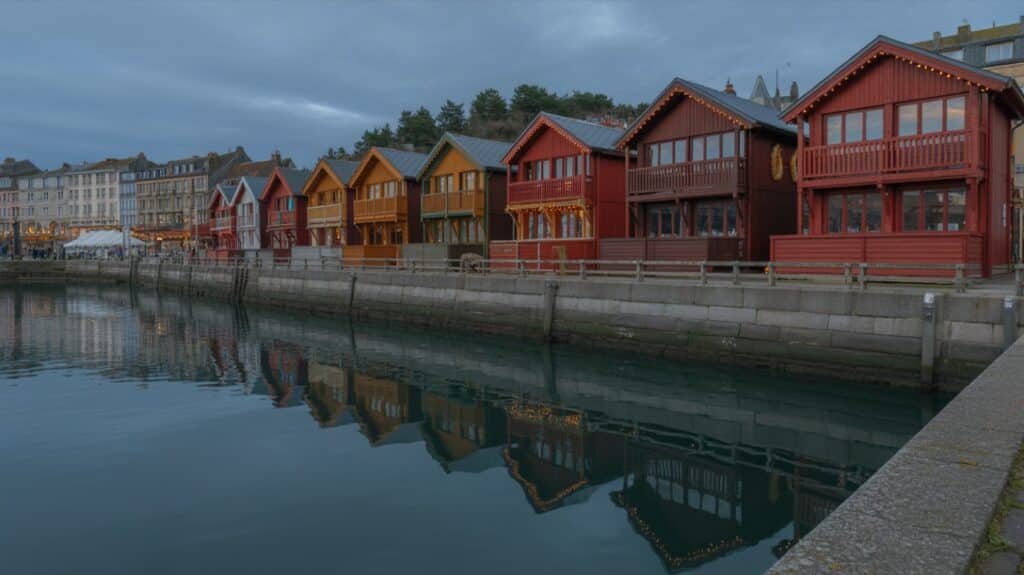
Vannes takes care of its setting every winter with a Christmas village on the right bank of the harbour. The effect is instant: the lights reflect in the water, and the row of wooden chalets makes a maritime picture that is a change from classic town-centre markets. Breton treats hold a good place, and handmade crafts fill the stalls.
The old town is worth the walk up: ramparts, half-timbered houses and little squares to slip into between two stands. Vannes is easy to explore on foot, so you can combine the illuminated harbour and the medieval centre in the same outing. The Vannes Christmas market is a good choice if you like harbour atmospheres and settings that play with water.
Quimper and Locronan, the inland Finistère duo
Two faces of Finistère to bring together over one weekend. In Quimper, the Christmas village spreads out on Place Terre au Duc, in the pedestrian area of the centre, with around fifteen wooden chalets gathered a stone’s throw from Saint-Corentin cathedral, on the other side of the Steir. The capital of Cornouaille cultivates a way of life where faience, embroidery and local food easily meet on the stands.
Less than twenty kilometres away, Locronan works on a completely different scale. Listed among the most beautiful villages in France, this granite village puts up lights that catch the old stone and cobbles. Crafts are showcased with care: turned wood, pottery, sculpture, woollens, plus crêpes and salted butter caramels to nibble as you walk. The village has been used as a film set several times, and you soon see why once you stand on the square lined with Renaissance houses. In winter, visitor numbers stay reasonable, which leaves time to chat with the craftspeople.
Pairing the Quimper Christmas market with the Locronan Christmas market means going from the bustle of a town of art to the intimacy of a postcard setting. Allow about twenty minutes’ drive between the two, enough for a lovely day: Quimper in the morning for the market and the cathedral, a quick lunch, Locronan in the afternoon for the light fading over the granite.
Brest and Lorient, the energy of the big ports
The two big port cities of Finistère and Morbihan approach Christmas on a grand scale. Brest, a rebuilt city facing its roadstead, sets up its market in the city centre and focuses on family activities. The atmosphere is straightforward and down-to-earth, like the city itself. The Brest Christmas market suits anyone looking for a no-frills outing with enough to keep a whole tribe busy.
Lorient goes all out: around fifty chalets, a hundred or so craftspeople and shopkeepers, an ice rink and events that carry on until the winter fair in January. Along the harbour, the town rolls out a packed programme where Breton treats sit alongside designers' products. The Lorient Christmas market holds its own against the liveliest in the region, ice rink included.
| Town | Setting | Highlight |
|---|---|---|
| Brest | City centre, near the roadstead | Family activities |
| Lorient | Along the harbour | Ice rink and winter fair |
Saint-Brieuc, the big wheel of the Côtes-d'Armor
The main town of the Côtes-d'Armor, Saint-Brieuc gathers its market in the town centre, with craft chalets, entertainment and carefully designed lights. The big wheel put up for the holidays serves as a landmark and offers a view over the town dressed in lights. It is a market that draws a wide crowd every year, without taking itself too seriously.
The town's position, between the bay and the hinterland, makes it a practical stop if you are heading up the north coast towards Saint-Malo or back down to Finistère. The Saint-Brieuc Christmas market rounds off a Breton itinerary nicely, especially with children won over by the wheel and the rides. Côtes-d'Armor producers run well-stocked stands with farmhouse cider, honey and jams, enough to fill a basket of local treats to take home.
Planning your Christmas weekend in Brittany
The region lends itself to itineraries, as the towns are close to each other. A few combinations that work well depending on what you are looking for:
- North coast and privateer city: Saint-Malo for the ramparts and the ice rink, followed by Saint-Brieuc and its big wheel along the way.
- Finistère, between town and village: Quimper for the buzz, Locronan for the stone setting, and perhaps Brest for the scale of a big port.
- Maritime Morbihan: Vannes and its harbourside chalets, Lorient and its ice rink, two waterside atmospheres less than an hour apart.
- The capital and around: Rennes as a well-connected base, before heading out towards the coast.
On the practical side, always check dates on the town pages before you set off: opening periods vary from one town to the next, and some ice rinks only run during the school holidays. Bring warm, windproof clothing, as Breton damp makes itself felt quickly in the evening. And if you want to make your own mulled wine before hitting the road, you will appreciate it all the more once you are there, between two crêpes.
All that is left is to pick your side: the pounding sea of a privateer city, the calm of a granite village or the buzz of a big port. Either way, a Breton winter is well worth the trip, hot cider in hand and pipers never far away.
Where to stay near the markets mentioned
Availability with our partners, town by town.
Reviewed and approved by the editorial team
A question, a mistake or a problem on this page? Write to us
Also worth reading
5 traditions to know before you visit
From medieval origins to today's markets Christmas markets date back to the 14th century, in the German-speaking towns of central Europe. In France, it is…
Read the article
Pain d’épices: the brown gold of the Christmas markets
Pain d’épices, the French spiced honey gingerbread, is one of those scents that announces Christmas before the first tree goes up. On the Christmas markets,…
Read the article
Hot Chocolate at Christmas Markets, a Story Going Back to the Aztecs
Hot chocolate at Christmas markets: Aztec origins, the Bayonne tradition, how to spot a good cup and the alcohol-free alternative to mulled wine.
Read the article