
 Illustrative image
 Celebrating Christmas in a royal setting: our château markets
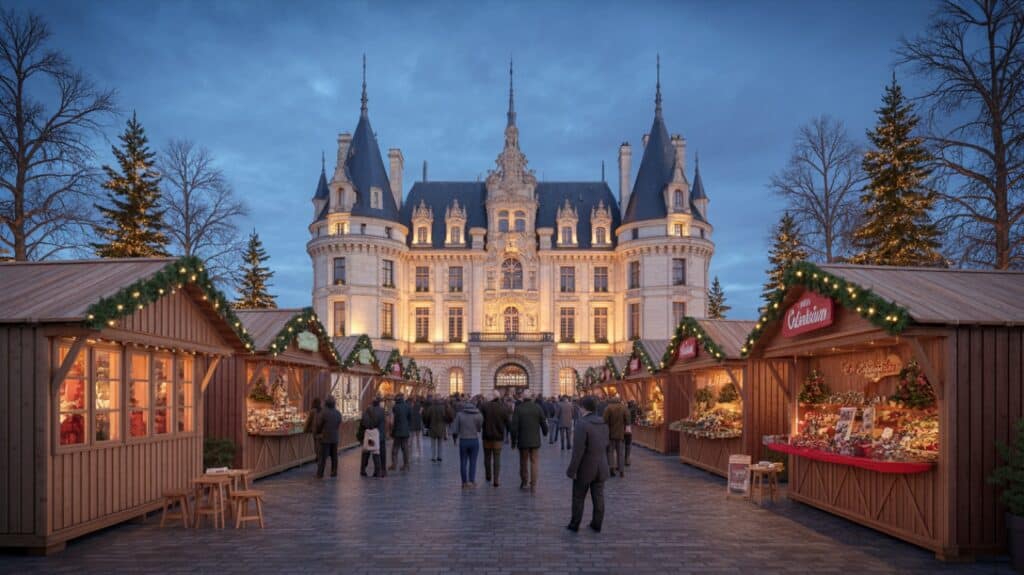
A Christmas market at a château instantly changes the scale of the experience. The setting doesn't just dress up the chalets: it tells a story, one of kings, royal courts and grand winter receptions. A classical facade lit up at night, a cobbled courtyard, a park stretching out under the frost, and in the middle of it all, the smell of gingerbread and mulled wine. We've gathered here the events where heritage really lifts the celebrations, each with its own atmosphere. Some markets are held within the grounds of the estate itself, others at the foot of its walls, and that nuance makes a big difference to the experience.
What a historic setting brings to a Christmas market
The difference comes down to very little and a great deal at the same time. On a town-centre square, you look at the stalls. In front of a château, your gaze travels further: towards a lit wing, a frozen pond, an avenue of illuminated trees. The market becomes the foreground, and the historic stone becomes the backdrop. The organisers of these sites often go all out on spectacle, with projection mapping on the facades, light trails through the gardens and concerts beneath ancient vaults.
There's also a storytelling side that plays out in full. These walls have seen entire royal courts, winter banquets and celebrations described in detail in the archives. Walking through a courtyard where people danced three centuries ago, a cup of mulled wine in hand, adds a layer that a simple row of chalets will never have. That extra touch of imagination is what you pay for when entry is charged, and it usually lives up to its promise.
Two formats come up again and again, and it's worth knowing which one to expect:
- The market inside the estate: you pass through the gates, walk in the courtyard or the park, and you're fully immersed. Often paid, sometimes by booking only.
- The market at the foot of the château: set up on the square or in the nearby streets, usually free, with the monument always on the horizon.
Neither is better than the other. The first offers the big heritage thrill, the second is more relaxed, coffee in hand, with no ticket to show. Many towns in this selection combine the two: a free market in the town centre and a paid trail on the estate. You can pick according to your budget and what you feel like on the day.
One last factor tips the balance: the season. Châteaux start their festivities earlier than town markets, sometimes from mid-November, and often carry on into early January. That gives you a wider window to plan your visit, away from the packed weekends of mid-December.
Chantilly: the château, the park and a horse show
Chantilly probably makes the most ambitious offer in this selection. From mid-November to the first days of January, the estate puts on a trail of lights that crosses the park and leads to the Grandes Écuries (Great Stables). The highlight of the programme is the equestrian show created for the season, an end-of-year production that fills the riding arena and enchants children and adults alike.
As for the market, some sixty stallholders set up in the town centre, with decorations, gourmet produce, jewellery and toys. The formula therefore works in two parts: the town for the craft market, the estate for the magical lights and the horses. Allow a generous half-day if you want to do both. The Chantilly Christmas market listing gives the opening hours and how to get to the estate.
The venue is well suited to a family outing. The Grandes Écuries, a monument in their own right, house horses all year round and take on a fairy-tale look during the holidays. Between the trail of lights, meeting Father Christmas and the show, children have enough to keep them busy for a long afternoon. Book early: the late-afternoon slots, which offer the best illuminations, go fast from mid-December.
Fontainebleau: festivities at the foot of a palace
In Fontainebleau, the market isn't held in the château but close by, on Place de la République and in the town hall courtyard. Some fifty illuminated chalets set up for a single weekend, with craftspeople, treats and family entertainment. The appeal of the location is its immediate proximity to the palace, one of the largest royal residences in France, which you can visit straight afterwards during the school holidays.
The château, for its part, offers a Christmas show, concerts and tours designed for children. So you can plan your day: the market in the morning, the royal apartments in the afternoon. This double offer makes the town a pleasant choice for a short break. Opening hours and access are detailed in the Fontainebleau Christmas market listing.
Lunéville, the “Versailles of Lorraine” lights up
Lunéville is nicknamed the “Versailles of Lorraine”, and the château that dominates the town fully deserves the compliment. Its monumental facade and formal French gardens make a rare setting for Advent. Lorraine adds an ingredient you won't find everywhere: Saint Nicholas, celebrated in early December, whose feast blends into the Christmas festivities with parades, storytelling and brioches shaped like little men.
| Feature | In Lunéville |
|---|---|
| Setting | 18th-century château, formal French gardens |
| Highlight | Saint Nicholas + Advent market |
| Specialities | Brioches, Lorraine produce, local crafts |
The market takes place in town, while the château hosts its own winter events, led by workshops and embroidered creations. An ideal choice if you're looking for a Christmas that's both steeped in heritage and firmly rooted in its region. The programme is given in the Lunéville Christmas market listing.
Vincennes: a medieval keep as a backdrop
A change of century with Vincennes, whose royal medieval château, keep and Sainte-Chapelle offer a striking contrast with the classical palaces on the rest of the list. Here, the Christmas atmosphere unfolds in a fortified setting, more austere and more mysterious, which gives the illuminations a special charm. The market comes with a Christmas village, an open-air ice rink and little trains for children.
Its closeness to Paris means you can get there by Metro, making it an easy outing for a late afternoon that slips into evening. The Bois de Vincennes all around adds a green breathing space that's rare in the Paris region. Remember to check the dates in the Vincennes Christmas market listing.
The keep, one of the tallest in medieval Europe, lit up on a winter night, creates a scene that the palaces of the Grand Siècle can't match. If you're looking for a Christmas outside the usual register of gilding and formal gardens, this fortress atmosphere is worth a look. The ice rink and the carousel take on a special flavour at the foot of these ramparts.
Versailles and Saint-Germain-en-Laye: two royal neighbours
You can't write about Christmas at châteaux without mentioning Versailles. During the festive season, the estate offers a dedicated programme, with family activities and gourmet events featuring makers and flavours. The town keeps its own market and illuminations, against the backdrop of the most visited palace in France. You can combine a visit to the château with a festive stroll on the same weekend, as long as you book your entry tickets in advance.
The contrast is worth it: after the grandeur of the galleries and the Hall of Mirrors, the warmth of a chalet and a steaming mug bring you back down to earth. Versailles sometimes suffers from its reputation for crowds, especially in high season. The workaround: aim for a weekday or the end of the day, when the market takes on its softest colours under the garlands.
A few kilometres away, Saint-Germain-en-Laye plays a more intimate tune. Its Christmas village, ice rink and food chalets set up not far from the château where Louis XIV was born. Churros, Alsatian specialities and mulled wine set the tone along the aisles. If you'd like to make your own drink before setting off, this mulled wine recipe does the job nicely. The two towns are so close that you can visit both in a day. Details in the Versailles Christmas market and Saint-Germain-en-Laye Christmas market listings.
Pau: Henri IV's birthplace in festive dress
We head south to finish, with Pau and its château, birthplace of King Henri IV. Perched facing the Pyrenees, the monument offers a view that alone is worth the trip in winter, when the peaks are covered in snow. The town comes alive for the holidays with its market, its lights and a warm Béarn atmosphere, helped along by the mild local climate. The château stays open to visitors and takes you back into the history of the French Renaissance, right down to the famous tortoise shell said to have served as the future king's cradle.
The contrast between the castle stone, the mountains and the Christmas lights gives the town an identity all its own. Here, you're far from the Paris-region model: the market has a South-West accent, with Gascon produce, sheep's cheeses and a friendliness that warms you as much as the mulled wine. For a different kind of weekend, mixing royal heritage and regional food, it's a sound choice. You'll find the details in the Pau Christmas market listing.
Planning your visit to a château Christmas market
A few good habits help you avoid disappointment when the setting is historic. Enclosed estates often use timed tickets, online booking and slots that sell out quickly in December. Check this before you travel, especially for Chantilly and Versailles, where crowds build up at weekends.
Also keep these practical details in mind:
- The monument's opening hours don't always match the market's: read both calendars.
- Parking fills up early near châteaux; take the train when the station is close, as in Fontainebleau or Vincennes.
- Evening brings out the illuminations: plan your visit for the end of the day if you want to see the facade lit up.
- The cold bites in large open parks; wrap up more warmly than for a sheltered town-centre market.
Finally, there's the question of budget. Markets at the foot of châteaux are free, but the light trails on the estates and the shows are paid, sometimes costing about as much as a museum ticket. It's worth it when the programme lives up to its promise, which is the case for the sites in this selection. It's up to you to choose the atmosphere that appeals most, from medieval keep to classical palace.
Reviewed and approved by the editorial team
A question, a mistake or a problem on this page? Write to us
Also worth reading
Christmas markets in Brittany: harbours, crêpes and illuminated stone
Our pick of Christmas markets in Brittany: Rennes, Saint-Malo, Vannes, Quimper, Locronan, Brest, Lorient and Saint-Brieuc, between harbours and crêpes.
Read the article
Christstollen, the Christmas cake that comes from Dresden
Christstollen, the Dresden Christmas loaf with candied fruit and icing sugar: origins, symbolism and which Alsace markets to find it on.
Read the article
Marrons Chauds: the Paper Cone of Roasted Chestnuts That Warms Every Christmas Market
Roasted chestnuts at Christmas markets: marron versus châtaigne, the perforated pan, the AOP growing regions and tips for choosing and peeling them well.
Read the article