
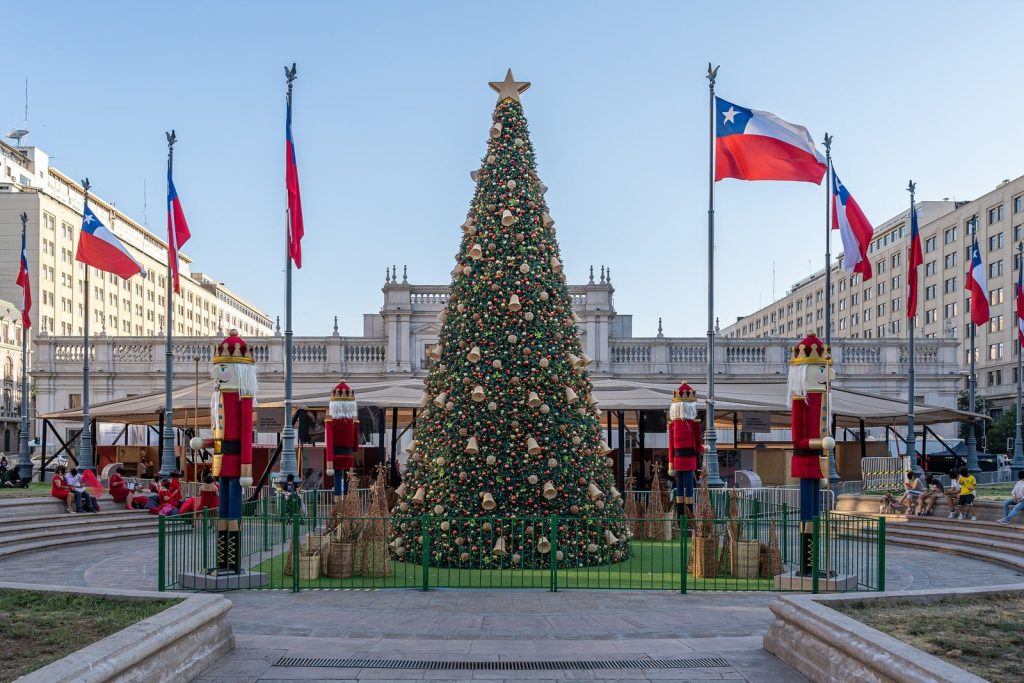
Christmas in Chile: Nochebuena dinner in the southern summer
Christmas in Chile falls in the middle of the southern summer, four days after the December solstice. The celebration takes place on the evening of 24 December, the Nochebuena (Christmas Eve). As in every place that celebrates Christmas in the Southern Hemisphere, the evening arrives with the long summer nights.
Christmas traditions in Chile begin on the evening of 24 December
The midnight mass, the Misa del Gallo, is celebrated on the 24th, before or after the meal. The gifts, said to be brought by the Viejito Pascuero, are opened at midnight.
The following day, Friday 25 December 2026, is an irrenunciable public holiday (one that cannot be waived: rest is mandatory) for shop workers. As the 25th falls on a Friday, the Christmas weekend lasts three days. Many families spend the day at an asado (barbecue) outdoors, at the beach or in a park. The only other holiday in December, Tuesday 8 December (Immaculate Conception), is not irrenunciable, and shops may stay open.
The Nochebuena table: turkey, pan de pascua and cola de mono
The dinner on the 24th is a roast or grilled turkey, or an asado, with salads. Some tables add the ensalada chilena (tomato and onion) and papas duquesas (duchess potatoes). Dessert is pan de pascua, ice cream or fresh fruit.
Pan de pascua is a dark cake with candied fruits, raisins, nuts and spices, sometimes with honey. It is eaten between Christmas and New Year. Its origin remains disputed: it is compared to the German christstollen and the Italian panettone. The cola de mono accompanies it: a cold drink made from aguardiente (brandy), milk, coffee and spices. Several legends circulate about its name: one derives it from the Colt revolver of President Pedro Montt, nicknamed “el mono Montt”, the other from the monkey label on Anís del Mono. To toast at midnight, many families serve wine or sparkling wine.
Viejito Pascuero, Chile’s Father Christmas in midsummer
In Chile, Father Christmas is called the Viejito Pascuero (or Viejo Pascuero). The word Pascua meant Christmas, a usage that came from Spain, and Pascuero means “of Christmas”. Viejito, “little old man”, comes from his old man’s appearance. Before him, it was the Three Kings who brought the gifts. Our article on the names of Father Christmas around the world compares him to his equivalents in other countries.
Tradition places the origin of this name in 1905: the display window of the Bazar Alemán of the Krauss brothers, on the Plaza de Armas in Santiago, then showed a white-bearded man dressed in red. Passers-by are said to have nicknamed him Viejito Pascuero, and the shop is said to have later hired a costumed actor in the middle of summer. The character is imagined on a sleigh pulled by nine reindeer led by Rodolfo.
Christmas in Chile in December 2026: Santiago and Lo Vásquez
Every year, the Lo Vásquez pilgrimage takes place on 7 and 8 December. In 2026, the 8th falls on a Tuesday public holiday. Hundreds of thousands of pilgrims reach the sanctuary of Lo Vásquez, in the municipality of Casablanca on the road to Valparaíso, on foot, by bike, motorcycle or cart. Many walk at night to avoid the heat, some making the last kilometres on their knees. The statue of the Virgin is carried in procession on 8 December.
In Santiago, the “Navidad 2026” programme schedules the lighting of the giant Christmas tree on Plaza de Armas on 30 November 2026 at 8pm, followed by Christmas carols by the Coro Sinfónico of the Universidad de Chile. Free villancicos (Christmas carol) concerts take place from 3 to 21 December in churches in the centre, up to a lyric gala on 18 December at the Palacio Cousiño.
For over thirty years, the Chilean post office, Correos de Chile, has run a letter-sponsorship campaign. The “Apadrina un Sueño 2026” edition began on Thursday 19 November and runs until Friday 18 December 2026. It allows you to sponsor a child’s letter addressed to the Viejito Pascuero on navidad.correos.cl. The gift is dropped off free of charge at any post office in the country.
Christmas markets in Santiago in December 2026
Central Santiago hosts three municipal markets in 2026. The Mercado Navidad Santiago 2026 sets up on the Paseo Bulnes from 18 to 24 December, from 10am to 6pm. The Feria M1M occupies the esplanade of the Bellas Artes metro from 21 to 25 December, same hours. The Mercado Navideño Pueblos Originarios (indigenous peoples) takes over the Plaza de Armas on 21 and 22 December, from 10am to 6pm.
Every mid-December, ferias navideñas (Christmas fairs) of artisans and creators also set up in the communes of Ñuñoa, La Reina, Las Condes and Providencia. In Valparaíso, Christmas artisan fairs should be held in the centre.
December weather: from Santiago’s heat to Punta Arenas’s cool
In Santiago, December is dry and hot (29 °C in the afternoon on average, 12 °C at night). Further south, Punta Arenas shows an average maximum of 15.2 °C.
Christmas decorations in the summer sun
Despite the summer, houses and streets are decorated with lights, trees and artificial snow, accompanied by Christmas carols. In the centre of the country, from Valparaíso to the Maule, the sun sets around 9pm and Nochebuena meals often last until midnight in the garden or under quinchos (covered shelters for barbecues). In the south, from Biobío to Los Lagos, the more variable weather leads many families to celebrate indoors.
Reviewed and approved by the editorial team
A question, a mistake or a problem on this page? Write to us
Also worth reading
Christmas markets in Brittany: harbours, crêpes and illuminated stone
Our pick of Christmas markets in Brittany: Rennes, Saint-Malo, Vannes, Quimper, Locronan, Brest, Lorient and Saint-Brieuc, between harbours and crêpes.
Read the article
The Origins of the Christmas Market, from Bautzen to Strasbourg
Bautzen 1384, Dresden 1434, Strasbourg 1570: the verified origins of the Christmas market, from the Protestant Reformation to its spread in France.
Read the article
5 traditions to know before you visit
From medieval origins to today's markets Christmas markets date back to the 14th century, in the German-speaking towns of central Europe. In France, it is…
Read the article