
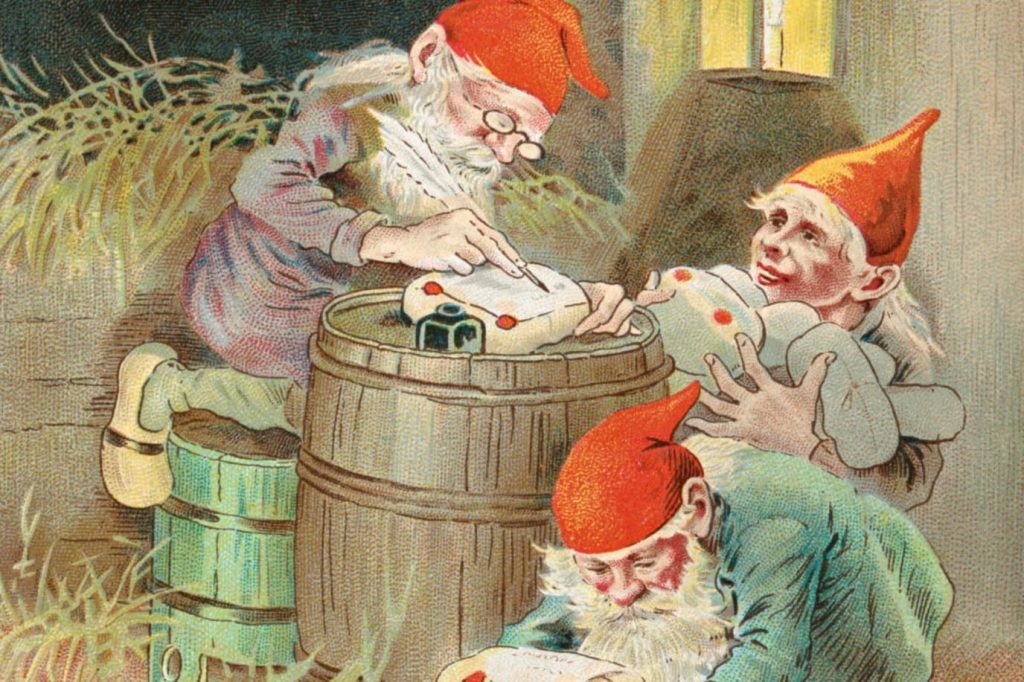
The Names of Father Christmas Around the World: Weihnachtsmann, Babbo Natale, Sinterklaas, Ded Moroz…
The name of Father Christmas changes from one country to the next, and the character changes with it. A child in Rotterdam opens presents on the evening of 5 December, a child in Madrid waits for the morning of 6 January, and in between come a bishop, a winged Christ Child, a farm sprite, a goat, thirteen lads down from the mountains and an old woman on her broomstick. In the United States, Santa Claus comes down the chimney on the night of 24 to 25 December, and in France the Père Noël fills the shoes left at the foot of the tree: the story of this red-clad grandfather, from Saint Nicholas to Coca-Cola, is told in our article on the origins of Father Christmas. Here, we follow Father Christmas around the world through the gift calendar, from early December to Epiphany, to see who comes, when, and under what name.
The name of Father Christmas in English, German and Italian
In English, he is Father Christmas in the United Kingdom and Santa Claus in the United States. In German, he is the Weihnachtsmann, in Italian Babbo Natale, in Spanish Papá Noel. The table gives the name of Father Christmas in the languages of this site and in those of the North, with a column that counts as much as the name: the character behind it.
| Language | Usual name | The character behind the name |
|---|---|---|
| English (United Kingdom) | Father Christmas | A personification of Christmas, now merged with Santa Claus |
| English (United States) | Santa Claus | The American descendant of Saint Nicholas |
| German | Weihnachtsmann | A bearded old man in a hooded coat, rival of the Christkind |
| Italian | Babbo Natale | The Father Christmas of 25 December, who shares Italy with the Befana |
| Spanish | Papá Noel | A recent arrival up against the Three Kings |
| Dutch | Kerstman | The Father Christmas of 25 December, behind Sinterklaas |
| Danish | Julemanden | A former farm spirit, the nisse |
| Norwegian | Julenissen | The Norwegian Father Christmas |
| Swedish | Jultomten | The tomte, a farm spirit turned gift-bringer |
| Finnish | Joulupukki | The “Christmas goat”, in the literal sense |
| Russian | Ded Moroz | “Grandfather Frost”, who comes at New Year |
Translation can mislead. Look up “Father Christmas” in Czech and you get Ježíšek, in Basque Olentzero. The first is the Christ Child, the second a charcoal burner who comes down from the mountains. Two distinct characters, each with their own date, which we meet again further down.
6 December: Sinterklaas, Samichlaus and the Saint Nicholas family
The gift season opens with Saint Nicholas, whose legend and whip-carrying companion are in our article on Saint Nicholas and the Père Fouettard. In the Netherlands, Sinterklaas arrives in November by steamboat, “from Spain”, as the legend has it. His national entry takes place on a Saturday, at least three weeks before 5 December. Presents are opened on the evening of 5 December, pakjesavond, the “presents evening”. The Kerstman exists too, on the 25th, but the big children’s celebration remains that of Sinterklaas.
On 6 December, the saint does his rounds elsewhere under other names. In Belgium, he brings the presents that day, as Sinterklaas in Flanders. In Luxembourg, he is the Kleeschen, for whom children set out a plate or a slipper the night before, and who is followed by the Housécker. In German-speaking Switzerland, the Samichlaus pays his visit with the Schmutzli, dressed in a dark robe, and the visit has become more kindly than punitive. In Germany, Nikolaus fills boots or shoes on the morning of the 6th.
Further south and east, the saint does not travel alone. In Austria and Bavaria, Nikolaus comes on 5 and 6 December with the Krampus, a tamed devil who frightens naughty children, and Krampus parades fill the streets around the 5th. In the Czech Republic, Mikuláš does his rounds on the evening of 5 December, flanked by an angel and a devil, the čert, a tradition still alive across the whole country.
Santa Lucia, 13 December in northern Italy
A week later, it is a saint who comes. On the night of 12 to 13 December, Santa Lucia brings small presents to the children of Verona, Brescia, Bergamo and Cremona, and also of Mantua, Lodi or Vicenza. Children leave out biscuits, and something for her donkey. Several hundred thousand children wait for her each year in Lombardy. In Verona, a legend links the custom to an epidemic that affected children’s eyes in the 13th century, Saint Lucy being the patron saint of sight.
This has nothing to do with the Swedish Lucia on the same 13 December, a procession of light with no presents.
The evening of the 24th: Christkind, Weihnachtsmann and the sprites of the North
Christmas Eve gathers the largest number of gift-bringers. The Christ Child, an old man in a coat, a farm sprite, a goat, a charcoal burner and a log share the same evening, from Vienna to Helsinki and from Prague to Barcelona.
Germany and Austria: Christkind or Weihnachtsmann?
In Germany, presents are opened on the evening of 24 December, at the moment of the Bescherung. Two characters share the country. The Weihnachtsmann dominates in the north and east, while the Christkind, the Christ Child in the guise of a winged, luminous figure, holds the south and west. The Christkind goes back to Luther, who wanted to turn families away from the cult of the saints and entrusted the presents to the “Holy Christ” rather than to Saint Nicholas. Many point out the reversal that followed: the figure born among Protestants is today that of the Catholic regions, and the Weihnachtsmann that of the Protestant regions. The observation comes up often, and it deserves to be taken with caution.
The Weihnachtsmann has his dated landmarks. Around 1835, Hoffmann von Fallersleben wrote “Morgen kommt der Weihnachtsmann”, to the tune of “Ah ! vous dirai-je, maman”, the melody of “Twinkle, Twinkle, Little Star”. In 1847, Moritz von Schwind illustrated, in the Fliegende Blätter in Munich, the poem “Herr Winter” by Hermann Rollett: a bearded old man in a hooded coat, carrying a fir tree. The image later lost its political meaning and became the ancestor of the bourgeois Weihnachtsmann.
Austria, for its part, belongs entirely to the Christkind, who brings the presents on 24 December. In the Czech Republic, it is Ježíšek, the little Jesus, who comes on the evening of the 24th, after the Štědrý večer dinner, a custom that came from the German lands centuries ago and took root in the 19th century. In Alsace, the Christkindel plays the same role.
From the farm sprite to the Joulupukki: the Nordic Father Christmas
In Denmark, the Julemanden leaves the presents under the tree on the evening of the 24th. He descends from the nisse, the protective spirit of the farm that families fed with rice porridge. Danish painters of the 19th century, Constantin Hansen and Johan Thomas Lundbye, turned him into a Christmas figure. The julemand himself only appeared later in the 19th century and blends Saint Nicholas, Father Christmas and the German “Father Winter”.
In Sweden, the same farm spirit, the tomte, became a gift-bringer at the end of the 19th century. Viktor Rydberg’s poem “Tomten”, in 1881, then Jenny Nyström’s Christmas cards fixed the image of the jultomte on thousands of cards. Tradition has it that before him a Christmas goat, the julbock, brought the presents. It survives as a straw decoration.
The goat, for its part, has stayed in the Finnish name. Joulupukki literally means “Christmas goat”. He knocks at the door on 24 December and asks whether there are any well-behaved children in the house. The origin of this goat remains debated: villagers dressed as goats, ancient rites, nothing is established.
His home, though, has a date. In 1927, the radio presenter Markus Rautio, “Uncle Markus”, placed Father Christmas on the Korvatunturi fell, the “Ear Mountain”, in Lapland, on the Russian border. No recording has survived, and a linguist later argued that Rautio had picked up an older belief rather than invented it. In June 1950, Eleanor Roosevelt visited Rovaniemi, and the cabin built in two weeks near the Arctic Circle to welcome her is still standing. The Santa Claus Village grew out of it. For the trip, read our guide to Christmas in Lapland.
In Iceland, there are thirteen of them. The jólasveinar, the “Yule Lads”, come down from the mountains one after another during the thirteen nights before Christmas. Children put a shoe on the windowsill: a small present if they have been good, a rotten potato otherwise. They are the sons of the troll woman Grýla, and the Christmas cat, the Jólakötturinn, eats anyone who has no new clothes.
The evening of the 24th also belongs to northern Spain, with two figures that are nothing like a grandfather in red. In the Basque Country, on both sides of the border, the Olentzero is a charcoal burner who comes down from the mountains to bring the presents on Christmas Eve. Since 1994, he has been accompanied by Mari Domingi, a character taken from a Basque Christmas song. His origin, like that of his name, remains debated. In Catalonia, the Tió de Nadal, the “Caga Tió”, is a log with a painted face, covered with a blanket and “fed” during Advent. On the 24th or 25th, children beat it with sticks while singing so that it “produces” sweets and small presents. Rural origins or fertility rites are often attributed to it, without certainty.
The morning of the 25th: Father Christmas, Babbo Natale and the Père Noël
In the United Kingdom, presents wait in the stockings on the morning of 25 December, and it is Father Christmas who filled them. The character is far older than Santa Claus: a personification of Christmas appears as early as the 15th century in a carol, “Sir Christëmas”. For centuries, he embodied the good cheer of the festive season, without presents being his main role. From the end of the 19th century, he gradually merged with the Santa Claus who came from America, and today the two names refer to the same character.
In Italy, Babbo Natale comes on 25 December. He shares the calendar with Santa Lucia in the North and with the Befana in January, which makes Italy a country with three visits. In France, the Père Noël fills the shoes at the foot of the tree for the morning of the 25th, Saint Nicholas having come on 6 December in the East and the North. In Belgium, the Père Noël, or Kerstman, comes in addition to Saint Nicholas.
Ded Moroz, the Russian Father Christmas of the New Year
In Russia, presents do not arrive at Christmas. Ded Moroz, “Grandfather Frost”, with his long coat and staff, comes on the night of 31 December to 1 January and leaves the parcels under the New Year tree, the yolka. He travels with his granddaughter Snegurochka, the “Snow Maiden”. He is often linked to a spirit of the cold from Slavic folklore, without that link being established.
This date is the result of a political history. In the late 1920s, the Bolsheviks fought Ded Moroz, denounced as an ally of the priest and the kulak. On 28 December 1935, an article by Pavel Postyshev in Pravda reinstated the New Year tree for children. The tree lost its religious meaning and shifted to New Year, with Ded Moroz as gift-bringer.
Snegurochka comes from a folk tale, brought to the stage. In Alexander Ostrovsky’s play “Snegurochka”, in 1873, she is the daughter of Frost and Spring. In the 1930s, she became the granddaughter and assistant of Ded Moroz. Since 1998, the town of Veliky Ustyug has been presented as the official residence of Ded Moroz.
6 January: the Befana and the Three Kings
The season ends at Epiphany, with two very different visits. In Italy, the Befana is an ugly but kindly old woman who comes down the chimney on her broomstick on the night of 5 to 6 January. She fills the stockings with sweets, and with coal for naughty children, a coal now made of sugar. Her name comes from Epifania, Epiphany, by popular corruption. The origin of the character, for its part, remains debated: some trace her back to before Christianity, and a legend presents her as an old woman who refused to follow the Three Kings. Nothing is settled.
In Spain, it is the Three Kings, the Reyes Magos, who bring the presents on the night of 5 to 6 January. On the evening of the 5th, the cabalgatas parade through the towns. The one in Alcoy, in the province of Alicante, is reputed to be the oldest in the country: it has been held since 1885, give or take a few editions, with a first record in 1866, and the Valencian Generalitat has declared it an asset of intangible cultural interest. Papá Noel has gained ground on 25 December.
Many families today combine several visits: Saint Nicholas then the Père Noël, Father Christmas then the Kings, Santa Lucia then Babbo Natale then the Befana. The name of Father Christmas changes from one country to the next, the date with it, and the children come out ahead.
Reviewed and approved by the editorial team
A question, a mistake or a problem on this page? Write to us
Also worth reading

The Meisenthal Christmas Bauble: Hand-Blown Glass from Lorraine for Your Tree
Hand-blown in the Northern Vosges, the Meisenthal Christmas bauble changes every year. Its history, the 2026 bauble, where to buy it and how to visit.
Read the article
Top 10 Christmas Songs: Our Guilty Pleasures, from Mariah Carey to Tino Rossi
Mariah Carey, Wham!, Tino Rossi… our 10 favourite Christmas songs, their records, their backstories and their videos, to enjoy without shame.
Read the article
Celebrating Christmas in a royal setting: our château markets
Christmas market at a château: our pick of the finest estates (Chantilly, Versailles, Vincennes, Lunéville, Pau) for a royal setting.
Read the article