
The Meisenthal Christmas Bauble: Hand-Blown Glass from Lorraine for Your Tree
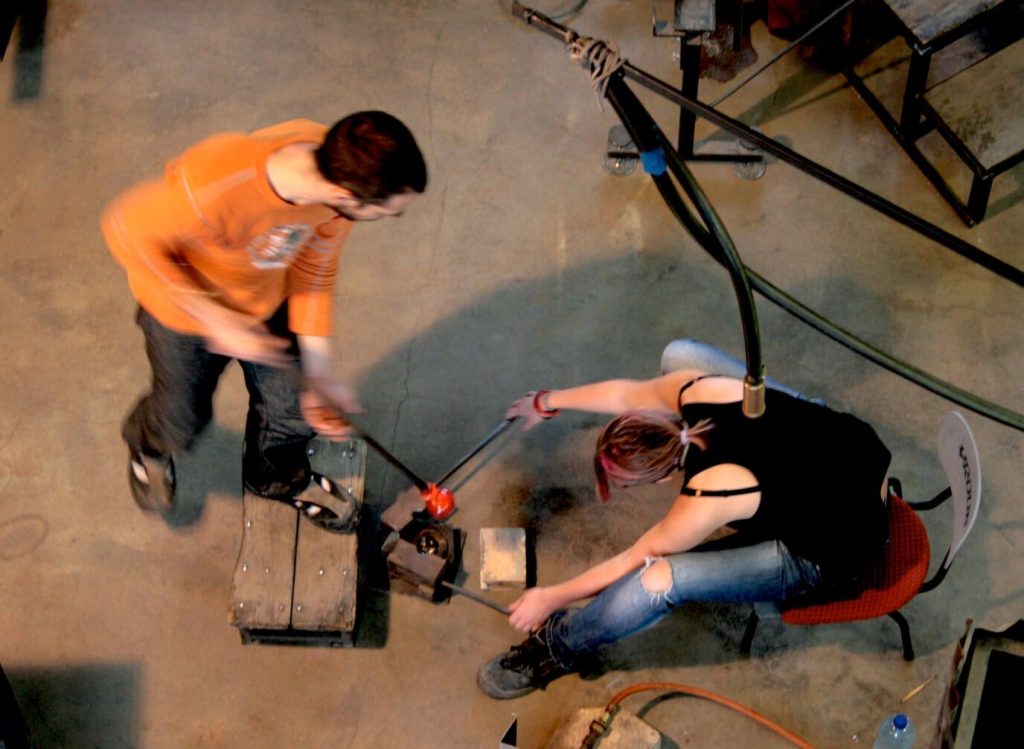
Every autumn, the Meisenthal Christmas bauble draws visitors deep into the Northern Vosges, in Moselle, for a blown-glass object that fits in the palm of your hand. Since 1999, the Centre international d’art verrier has released a new model every year, entrusted to a guest designer, and demand has grown to the point that mail-order sales have been stopped. We go back over the story of this bauble, the idea of the yearly edition, then the practical guide for 2026: where to buy it, when, and how to visit the glassworks during “Un Noël à Meisenthal”.
From Goetzenbruck to Meisenthal: a bauble rescued from oblivion
The founding story fits in a few lines. In 1858, a severe drought left the Northern Vosges without fruit, and a glassblower from Goetzenbruck, the village next to Meisenthal, blew glass balls to replace the apples and walnuts that families hung on the tree. This episode remains a legend, and we have already told it in our article on the history of the Christmas tree. One point is worth making clear: the glass Christmas bauble was not born in Meisenthal but in Goetzenbruck. Meisenthal preserved the craft, then revived it.
The Goetzenbruck glassworks, known for its optical glass, operated from 1721 to 2005. Its reflective decorative baubles, made from 1858 onwards, reached 250,000 pieces a year. In 1964, it stopped this production, and the bauble fell into oblivion.
In Meisenthal, the story is that of a glassworks founded in 1704, which produced tens of millions of pieces of everyday glassware. Between 1867 and 1894, it served as a laboratory for Émile Gallé, a leading figure of the École de Nancy, which is why the village presents itself as the cradle of Art Nouveau glass. The factory employed up to 650 workers before closing on 31 December 1969.
The revival began with the Musée du Verre, the glass museum whose origins date back to 1978, then with the creation of the CIAV, the Centre international d’art verrier, in 1992 in the former cutting workshop. In 1998, meetings brought together the last glassmakers of Goetzenbruck and the young glassmakers of the centre: the techniques of blowing and silvering the baubles were passed on before they disappeared. In 1999, the “Christmas baubles” line was born, with reissued traditional models and, every year, a contemporary bauble drawn by a guest designer invited to rethink the tradition.
A new Meisenthal bauble every year, signed by a designer
The principle has not changed since 1999. Every year, the CIAV invites a designer to draw a brand-new Meisenthal bauble, blown in the centre’s workshops, and this yearly edition joins the collection of previous years. The starting ideas are often offbeat. Two recent examples show it.
In 2025, the bauble was called Grip. Its designer, Lucas Lorigeon, born in 1997, grew up in the Allier and trained at the ENSCI. He started from the saying “Prevention is better than cure” to draw a non-slip bauble, bristling with ergonomic bumps that stop you from dropping it. It was unveiled on 10 November 2025 at the Halle verrière and went on sale at the counter from Thursday 13 November 2025, with a virtual queue to manage visits to the shop.
In 2024, Mark Braun, a Berlin-based designer born in 1975 who teaches at the HBKsaar in Saarbrücken, came up with Kaktus. He went back to the story of the glassmakers of the Pays de Bitche imitating the missing fruit after a drought, and wondered which fruit the glassmakers of a warmer future would imitate. His answer is a tropical Christmas where the cactus would replace the fir tree, with a bauble inspired by the prickly pear, 80 mm in diameter and 95 mm tall.
During the 2026 Christmas season, the Meisenthal counter offers the collection of past editions: Extra, Fizz, Helium, Kilo, Lab, Magma, Mix, Ovni, Rotor, Sylvestre, Tilt and Vroum, joined, depending on the quantities produced, by Arti, Cumulus, Diva, Grip, Kaktus, Piaf, Silex and Stella, as well as the traditional line. Production remains artisanal, and the CIAV never guarantees that every model will be available.
Meisenthal bauble 2026: what we know
The Meisenthal bauble 2026 is called Alma. It is signed by Marie Cornil and Alexandre Willaume, the French design duo Marie & Alexandre, who conceived it as a lucky charm to hold in the hollow of your hand. Alma is 85 mm in diameter, comes in several colours and costs from €30.
At the Meisenthal counter, Alma goes on sale from the opening of the season, on 19 November 2026, limited to 4 per household per day. The click & collect session takes place on Wednesday 25 November at 10am, while stocks last, with a maximum of 3. Remember to create your customer account before the sale opens. Orders are collected at the glassworks from 1 to 23 December 2026.
Where to buy a Meisenthal bauble in 2026 (and at what price)
The short answer: at the Meisenthal counter, during the season. Faced with the crowds, the CIAV has stopped home delivery to keep its production for the shop at the glassworks. The shop occupies a wave-shaped concrete building whose brick walls are what remains of the old factory’s acid-etching workshop.
During “Un Noël à Meisenthal”, access to the shop goes through a digital queue. The Pavillon opens at 11am: there you pick up a ticket or a queue number sent by text message, then the shop lets you in between 1.30pm and 6pm when you show that ticket or that text. The rest of the year, it is best to arrive when the shop opens at 1.30pm to get the widest choice. The models and colours available on the day are not given out over the phone.
Click & collect complements the counter. The 2026 edition is offered there on Wednesday 25 November at 10am, for collection from 1 to 23 December. Two models, Goutte and Vergo, are not sold in the shop and are only available through this November 2026 click & collect. The online shop no longer ships anything: orders are collected on site.
As for the price, Grip sold for around thirty euros at the counter in 2025. In 2026, Alma is also sold in Metz, Sélestat, Colmar and Strasbourg. In Strasbourg, the sale takes place at the Aubette, on place Kléber, during the OZ arts and crafts fair, from 12 to 22 December 2026, from 11am to 7pm. Purchases are made in a time slot booked in advance, and the booking details are published from 20 November.
Un Noël à Meisenthal: visiting the glassworks in December
The Meisenthal glassworks, on place Robert Schuman in the Pays de Bitche, opens its “Un Noël à Meisenthal” season on 19 November 2026 and closes it on 3 January 2027. The visitor trail brings together the Musée du Verre, the glassblowing demonstrations and the Halle verrière. The trail costs €6 and is free for under-18s. No glassblowing workshop open to the general public is announced for this season: you watch the glassmakers blow the bauble, you do not blow it yourself.
| Key facts | 2026 season |
|---|---|
| Dates | From 19 November to 20 December 2026, Tuesday to Sunday, then every day from 21 December 2026 to 3 January 2027 (closed on 24, 25 and 31 December and on 1 January) |
| Pavillon and digital queue | Opens at 11am, collection of the ticket or queue number by text message |
| Visitor trail | From 12pm to 6pm, last ticket sales at 5.15pm |
| Shop | From 1.30pm to 6pm, on presentation of the ticket or the text message |
| Trail prices | €6 full price, €5 with a discount voucher, €3 for students, people with disabilities and jobseekers, free for under-18s |
| Food and drink | Guinguette d’hiver from 11am, Bistrot de la Halle from 12pm with dishes of the day until 2pm (booking recommended) |
Trail tickets are bought at the Pavillon or in the shop, and groups book by email with the glassworks. The exhibition “Eugène Kremer, compagnon de l’Art nouveau”, open since 1 April 2026, can still be seen until 3 January 2027 and rounds off the visit to the workshops. The CIAV also announces a cultural programme and food stops throughout the season, the details of which are not yet known.
Seeing Meisenthal baubles at the Christmas markets of Alsace and Moselle
If Meisenthal is too far off your route, Sélestat offers an alternative. The Bibliothèque Humaniste hosts the free exhibition “Les boules de Meisenthal” from 21 November to 31 December 2026, closed on 25 and 26 December, with a train journey “from the North Pole to Sélestat”. In December 2025, the Sainte-Foy church displayed a chandelier of 173 Meisenthal baubles, which we describe on our page for the Sélestat Christmas market.
The Christmas markets of Strasbourg and Metz, where hand-blown glass Christmas baubles from Meisenthal were on sale in 2025, can be visited on the same trip.
Where to stay near the markets mentioned
Availability with our partners, town by town.
Reviewed and approved by the editorial team
A question, a mistake or a problem on this page? Write to us
Also worth reading
The Christmas Markets That Come Into Their Own After Dark
A Christmas market by night, from dusk onwards: the great tree in Strasbourg, the projection shows in Reims and Amiens, the reflections of Colmar. Our pick, town by town.
Read the article
The Most Beautiful Christmas Markets in France: Our Selection
The most beautiful Christmas market in France? Our annotated selection: Strasbourg, Colmar, Reims, Ribeauvillé, Nancy and the Alsace wine villages.
Read the article
Christmas in New Zealand 2026: barbecues, pavlova and red pōhutukawa in summer
Christmas in New Zealand falls in midsummer: outdoor lunches, pavlova, red pōhutukawa trees and Santa parades on 29 November and 6 December 2026.
Read the article