
Christmas in New Zealand 2026: barbecues, pavlova and red pōhutukawa in summer
Christmas in New Zealand falls on Friday 25 December 2026 in the middle of the Southern Hemisphere summer, during the school holidays. The country celebrates the same 25 December as Europe, like the other countries in our guide to Christmas in the Southern Hemisphere, but the season changes the celebration: Christmas arrives four days after the 21 December solstice, the longest day of the year, and much of the day is spent outdoors.
New Zealand Christmas 2026 falls in the long summer break
In 2026, Boxing Day falls on Saturday 26 December, and Monday 28 December is a day off for most employees. Christmas Day is a restricted trading day: almost all shops must close, with exceptions for essential shops and a few exempted areas.
Schools end their term by Friday 18 December 2026 at the latest, each school setting its own last day, after a term that started on Monday 12 October. Christmas thus falls within the long summer break. The Annual Holidays Act of 1944 grants two weeks of paid leave, and long summer holidays became a habit in the 1950s. New Zealanders say Kirihimete for Christmas and Meri Kirihimete for “Merry Christmas”.
Christmas traditions in New Zealand: lunch in the garden or at the bach
The main event remains lunch on 25 December, often taken outdoors in the garden, a park or by the water. Many families go camping or head to a bach (pronounced “batch”), a modest holiday home often by the sea. In the south of the South Island, the same house is called a crib.
Roast turkey and plum pudding from the Victorian era long dominated, and the pudding remained popular in the 20th century. Picnics came next, then, in the middle of the century, new potatoes and fruit salad joined the menu. Lamb and ham now stand shoulder to shoulder as the Christmas meats. Some families add a hāngī, food cooked in an earth oven, with kūmara (sweet potato). Strawberries are in season in December. The typical table includes:
- new potatoes, asparagus and salads
- barbecued lamb chops and seafood
- the pavlova, topped with strawberries, raspberries or kiwifruit
Australia and New Zealand both claim this meringue of the summer holidays.
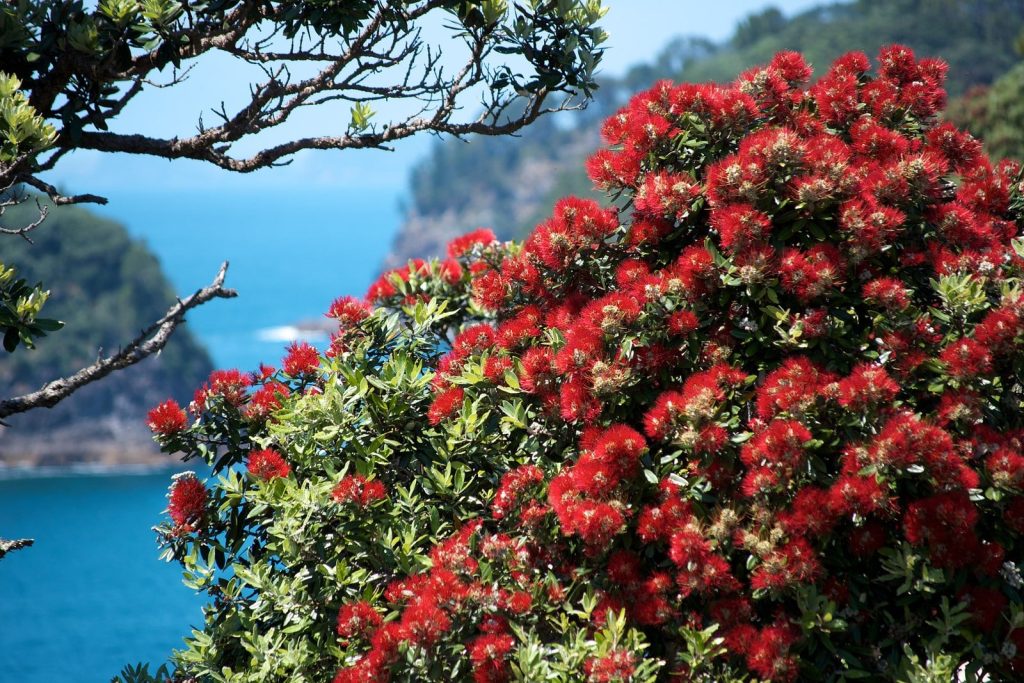
The pōhutukawa Christmas tree blooming red in December
The pōhutukawa (Metrosideros excelsa) covers itself in bright red flowers around Christmas. Since the 1850s, it has been nicknamed the “New Zealand Christmas tree”. In the 19th century, its branches and other greenery decorated houses, churches and meeting places in place of the holly of the Northern Hemisphere. A Māori legend says its crimson flowers are the blood of the warrior Tāwhaki. At Cape Reinga (Te Rerenga Wairua), at the northern tip of the country, an old pōhutukawa clings to the cliff. In Māori tradition, the spirits of the dead travel up the coast to it before reaching the underworld.
The Christmas tree, for its part, arrived by import. Popularised in Britain by Prince Albert in the 1840s, it remained for a long time reserved for schools, churches and wealthy families before becoming widespread in the 20th century. Our article on the history of the Christmas tree covers this adoption.
In Auckland, the giant tree Te Manaaki dominates Te Komititanga square, in front of the Waitematā station. Over 18 metres tall, it carries more than 10,000 LEDs, 4,000 pōhutukawa flowers and more than 200 giant baubles. The iwi (tribe) Ngāti Whātua Ōrākei gave it its name: manaaki means respect, care, hospitality. First lit in November 2024, it has been lit since Saturday 21 November 2026 and stays lit until 4 January 2027.
From the 1814 service to Te Harinui: a New Zealand Christmas carol
On 25 December 1814, at Oihi Bay in the Bay of Islands, the missionary Samuel Marsden held a service and preached under the protection of chief Ruatara, before Māori of the neighbouring pā (fortified village). This is considered the first Christian sermon in the country. The Marsden Cross, erected in 1907, marks the site.
This Christmas of 1814 inspired Willow Macky (1921-2006) in 1957 to write the carol Te Harinui. Its title takes up in Māori the “glad tidings of great joy” of the Gospel of Luke (2:10). Schools sing it and it exists in many arrangements. The carols from Europe and America are gathered in our selection of the best-known Christmas songs.
Santa parades in Auckland and Christchurch, 29 November and 6 December
In New Zealand, Santa goes by both Santa Claus and Father Christmas, names already used interchangeably in the New Zealand press between 1886 and 1930. No local character replaces him. It is the parades that mark his arrival in the cities.
In Auckland, the Farmers Santa Parade marches on Sunday 29 November 2026: entertainment from 12pm, the parade leaves at 1pm along Queen Street, then Santa’s Party on Aotea Square at 2:30pm. The free event is in its 93rd year and can be postponed to Sunday 6 December 2026. The Auckland Children’s Christmas Parade Trust organises it, with Farmers as title partner. The parade dates back to 1934, when the Farmers department store launched it.
In Christchurch, the Christmas Show Parade occupies the Canterbury Agricultural Park (Showgrounds) on Saturday 5 and Sunday 6 December 2026, from 11am to 4:30pm. The parade takes place on Sunday 6 December at 2pm. The site also hosts rides, two stages and food stalls. Entry is free and a free shuttle runs on Sunday. Born in the late 1940s under the name Hay’s Christmas Pageant, the parade was given to the city by Farmers in 1991.
December concerts and lights, from Christchurch to Wellington
Outdoor concerts also mark the season. Christmas in the Park offers a large free concert with fireworks on Saturday 28 November 2026 at 7:30pm at North Hagley Park in Christchurch, then on Saturday 12 December 2026 at 7:30pm at the Auckland Domain. The event, born in 1994, is associated with the charity Kindness Collective. In Wellington, the city’s celebration, “A Christmas Cracker”, takes over Waitangi Park on Saturday 12 December 2026 from 11am to 5pm: Santa’s grotto and mailbox, ice rink, workshops, choirs, brass bands, pantomime and food trucks. In Auckland, the Franklin Road Christmas Lights illuminate the street from 1 to 24 December 2026, and the “Swinging Bells” light swings turn on Aotea Square from 2 to 28 December.
19 to 22 °C in the afternoon in December, from Auckland to Christchurch
December 2026 falls at the start of the Southern Hemisphere summer. In December, average highs (1991-2020 normals) reach 22.0 °C in Auckland, with lows of 15.0 °C, 18.7 °C in Wellington by day and 12.4 °C at night, and 21.1 °C in Christchurch with 10.4 °C at night. Days therefore stay around 19 to 22 °C, with cooler nights in the south.
Christmas markets in Auckland and Christchurch in 2026
New Zealand has no large European-style Christmas market of national rank. It offers neighbourhood markets over one or two days, often by the water, and markets integrated into Christmas festivities.
In Auckland, the Karanga Plaza Christmas Market sets up on the Wynyard Quarter waterfront on Saturday 5 December 2026 from 10am to 6pm and Sunday 6 December from 10am to 3pm, with crafts, delicacies, workshops and a visit from Santa. The Catalina Bay Christmas Market Weekend takes place at Hobsonville Point on Saturday 12 and Sunday 13 December 2026, from 8:30am to 2pm, with crafts, music and Santa. Entry is free. In Christchurch, the only Christmas market announced for 2026 is that of the Christmas Show Parade, on 5 and 6 December at the Showgrounds. No 2026 Christmas market has been announced in Wellington at this stage.
Reviewed and approved by the editorial team
A question, a mistake or a problem on this page? Write to us
Also worth reading
Christmas in Australia: 25 December 2026 in the middle of summer
Christmas in Australia falls on Friday 25 December 2026 in midsummer: outdoor lunch, Carols by Candlelight in Melbourne and the Sydney Hobart race.
Read the article
Hotels for the Strasbourg Christmas Market: Neighbourhoods, Prices and Last Rooms
Strasbourg Christmas market hotel: what was still bookable on 15 November 2026, prices, the neighbourhoods near the tram and the Kehl option.
Read the article
The Most Beautiful Christmas Markets in France: Our Selection
The most beautiful Christmas market in France? Our annotated selection: Strasbourg, Colmar, Reims, Ribeauvillé, Nancy and the Alsace wine villages.
Read the article