
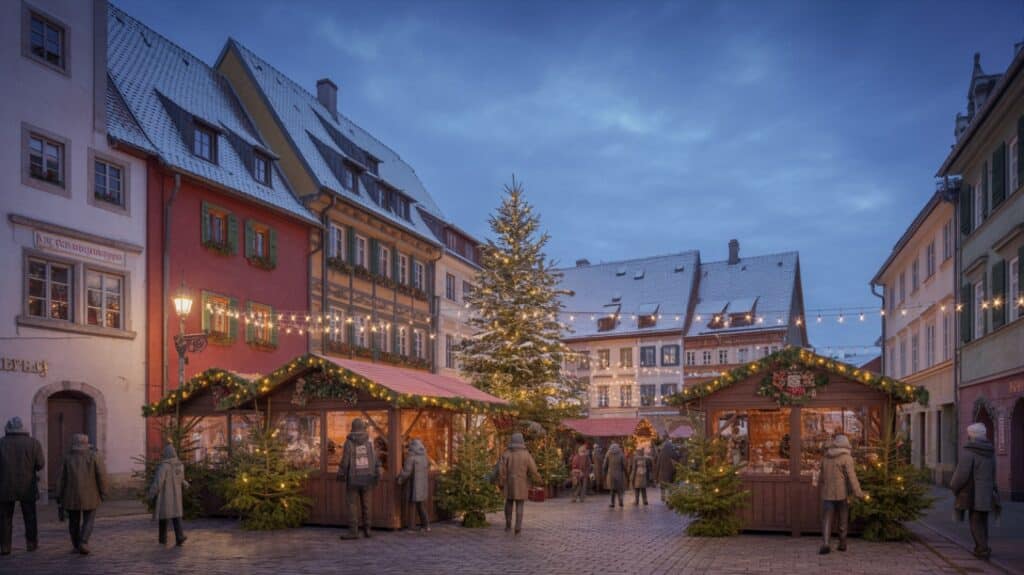
 Illustrative image
Christmas markets in Europe: where to go from France
A Christmas market in Europe often starts with a rail map rather than a travel guide. From Paris, Lyon, Strasbourg or Lille, several neighbouring countries can be reached by direct train, with no detour via an airport and no need to hire a car. Belgium, Luxembourg, Germany and Switzerland celebrate Christmas with their own traditions: illuminated canals in Bruges, a whole city decorated in Luxembourg, gingerbread and fir trees in Nuremberg, Alpine chalets around Lake Geneva. This overview looks at each country from France: which journey, which currency, which dates, and which cities to head for first. Enough to add a trip across a border to a tour already packed with Alsace or northern France.
Why look beyond French borders
France already holds a good share of Europe’s great markets, between Alsace and Hauts-de-France. But crossing the border changes little when it comes to organising the trip: a weekend is enough to reach a neighbouring capital, when a return trip to Alsace from some parts of France already takes as long by road. The neighbouring countries mainly add different atmospheres, from Flemish medieval squares to German Christkindlesmärkte, by way of Swiss Alpine settings and the fortified lanes of Luxembourg.
The site ranks each market by its reach, from “local event” to “worth the trip”. The cities featured here mostly fall into that last category on the foreign side: they justify a dedicated journey, not just a detour along the way. The logical order follows rail proximity from Paris: Belgium first, less than two hours away, then Luxembourg, Germany and Switzerland, reachable in a morning by train from most major French cities.
Belgium, the closest Christmas getaway
Belgium has several markets within train reach of northern France, direct for Tournai and Brussels, with a change at Kortrijk for Bruges and Ghent. Bruges Christmas market fills the squares of the medieval centre, between canals and stepped gables; the ice rink set up on the Markt and the Ferris wheel rising above the pointed roofs make it one of the most sought-after Belgian events for visitors from France, alongside Brussels. Under the name Plaisirs d’Hiver (Winter Wonders), the latter brings together a craft market across several squares of the historic centre, a big Christmas tree in front of the Bourse and a sound and light show projected onto the town hall façade, on the Grand-Place itself.
Further north, the Ghent market sets up its Winterfeesten along the Graslei, with an ice rink and a Ferris wheel facing the waterfront façades, in a setting less photographed than Bruges but just as true to Flemish architecture. About half an hour by train from Lille, Tournai offers a more compact scale, handy for a day trip from Hauts-de-France with no overnight stay needed. Mons and Antwerp complete the Belgian map, each with its own market, less talked about in France but reachable with one change from Brussels. Details of the Belgian markets, city by city, can be found on the site’s Belgium hub.
Luxembourg, a whole city under the lights
In Luxembourg, the Christmas market is called Winterlights and dresses the whole old town, from Place d’Armes to Place Guillaume II, by way of Place de la Constitution with its view over the Pétrusse valley. The 2026 edition is announced from 20 November 2026 to 3 January 2027, with a central Christmas chalet, a Ferris wheel and a craft market spread across several squares in the city centre, making it one of the longest runs on the European calendar.
The country has offered free public transport since 2020: buses, trams and regional trains can be used without a ticket across the whole territory, so once you arrive at the station you need no extra ticket to reach the centre. Because it applies nationwide, free transport makes it easy to organise a day between the market, the Bock ramparts and the museums of the district. From France, Luxembourg Christmas market can be reached by TER train from Metz or Thionville in just under an hour, or by car from the Moselle border on the motorway. The compact old town, built on a rocky spur between two valleys, lets you cover most of the market on foot in half a day, which makes it a realistic trip even for a single day.
Germany, the benchmark for Christmas markets in Europe
Germany claims the origin of the word Christkindlesmarkt and has the largest number of historic markets on the continent, some dating back to the late Middle Ages. The Cologne market spreads around the cathedral and along the Rhine, across several squares in the city centre, each with its own identity (crafts, food, a fairy-tale world for children); the exact dates of the 2026 edition are still to be confirmed, with the opening traditionally around mid-November. Nuremberg Christmas market, one of the oldest and best known in Europe, is announced from 27 November to 24 December 2026; its famous Zwetschgenmännle, little figures made of dried prunes, are among the market’s typical souvenirs.
Just across the Alsace border, Karlsruhe, Baden-Baden and Freiburg im Breisgau are less than two hours from Strasbourg, a distance comparable to a return trip between two neighbouring French cities. Aachen, an hour from Liège, adds its market around the cathedral and its gingerbread speciality, Printen. Stuttgart, Frankfurt, Heidelberg, Berlin and Munich extend the list for those who want to venture further into the country: each holds its market on the main square of its historic centre, with local variations in the crafts on offer. Heidelberg adds the backdrop of its ruined castle overlooking the Neckar, Frankfurt that of the half-timbered Römerberg, two classic images from German Christmas postcards. Saarbrücken, across the border from Moselle, can be reached by regional train from Forbach or Sarreguemines, making it one of the easiest German markets to reach for people living in eastern France.
German mulled wine, Glühwein, is served in a deposit mug at almost all these markets, often with its own spice recipe depending on the city and sometimes as a white version made with white wine. For a version to make at home once you are back, start with our article on mulled wine variations, which tells you where to find the recipe. The German market guides, from Cologne to Munich, are grouped on the Germany page.
Switzerland, between Lake Geneva and old watchmaking towns
In Switzerland, Christmas markets are paid for in Swiss francs (CHF), a currency separate from the euro as the country remains outside the eurozone: count on a little over one euro for CHF 1, a difference to bear in mind when comparing prices on site with those at neighbouring markets in euros. Bank cards are widely accepted in the big cities, but withdrawing a little cash in francs before you go avoids unpleasant surprises at the small chalets. Montreux Christmas market, set on the shores of Lake Geneva with a view of the Vaud Alps, can be reached from Paris by TGV Lyria to Lausanne and then a regional train, or, for those living in the border region, in under an hour from Évian-les-Bains, a little longer from Thonon-les-Bains and nearly two hours from Annecy.
In Geneva, the market is set up near the Bastions and the Jardin Anglais, a few minutes’ walk from Cornavin station, in a city where the closeness of the French border can be felt even among the market’s visitors. Zurich and Fribourg complete the Swiss offer: the first around its main station, known for its big tree decorated with crystals, the second in a medieval old town perched above the Sarine, each reachable by train from Geneva or Basel, changing at Lausanne or Bern if needed. These two stops suit those extending a Swiss stay beyond a simple weekend, combining mountains, lake and urban heritage on one trip. For the Swiss market guides, head to the Switzerland page.
Trains, currencies and calendar: planning your border crossing
The table below sums up the main practical points, country by country, for those setting off from France.
| Country | Cities mentioned | From France | Currency |
|---|---|---|---|
| Belgium | Brussels, Bruges, Ghent, Tournai | Direct train to Brussels (from Paris or Lille) and to Tournai (from Lille), change of train for Bruges and Ghent | Euro |
| Luxembourg | Luxembourg City | TER from Metz or Thionville, car from Moselle | Euro |
| Germany | Cologne, Nuremberg, Karlsruhe, Baden-Baden | Direct train or connection via Strasbourg | Euro |
| Switzerland | Geneva, Montreux, Zurich, Fribourg | TGV Lyria from Paris, direct or with a change | Swiss franc (CHF) |
One point deserves attention before you book: most European markets open in late November and close around 23 or 24 December, except for a few editions that run until New Year, such as Luxembourg’s. The exact dates of each 2026 edition can be checked market by market on the relevant guide, as some are only confirmed by local tourist offices in the autumn. As for formalities, the Schengen area means no systematic border checks for a short stay in these four countries; for French and other EU citizens, a valid identity card is enough, with no passport or visa required.
- Book your long-distance train ticket several weeks ahead: prices climb quickly as December weekends approach, when tourist demand is concentrated on a limited number of direct trains.
- Bring a little cash for Switzerland, as some chalets do not always accept bank cards.
- Check closing times on site: several German and Swiss markets close earlier on weekdays than at weekends, sometimes as early as 8pm.
- Allow an hour’s margin for cross-border connections at busy times, especially on the first weekend of Advent.
- Wear warm layers: markets are outdoors, often visited in the evening, and the wind is felt more near lakes and rivers.
Building your own European itinerary
Some combinations work well for a weekend from France. Brussels and Bruges pair up in a day by train from Paris or Lille, with a night in one of the two cities to avoid rushing. Strasbourg goes well with Karlsruhe or Baden-Baden for a day trip, as a regional train crosses the Rhine between the two banks in a few tens of minutes, without going through a major connecting station. Around Lake Geneva, Geneva and Montreux combine with Annecy or Thonon-les-Bains on the French side, for a weekend straddling two countries without changing car or luggage.
Finally, Luxembourg suits a short trip from Moselle, with no need for a car thanks to free transport on site. It then comes down to the time available and your transport budget: a neighbouring capital by direct train sometimes costs less than a return drive to Alsace in high season, once fuel, tolls and city-centre parking are counted. The guide to each market, with its dates, exact addresses and local features, remains the best basis for fixing your final itinerary before booking tickets.
Where to stay near the markets mentioned
Availability with our partners, town by town.
Reviewed and approved by the editorial team
A question, a mistake or a problem on this page? Write to us
Also worth reading
The Advent calendar: from devotional pictures to giant façades
The Advent calendar, from the German devotional picture of 1908 to the giant façades of towns in Alsace and the Black Forest. Origins and traditions.
Read the article
Saint Nicholas Day, a foretaste of Christmas in eastern and northern France
On 6 December, Saint Nicholas Day kicks off the run-up to Christmas in eastern and northern France: warm manala, the mannele/manala quarrel in Alsace, cards swapped between boys and festive markets.
Read the article
Pain d’épices: the brown gold of the Christmas markets
Pain d’épices, the French spiced honey gingerbread, is one of those scents that announces Christmas before the first tree goes up. On the Christmas markets,…
Read the article