
Where Does Santa Claus Come From? From Saint Nicholas to Coca-Cola, a Disputed Origin
The origin of Santa Claus often comes down to a claim you have probably heard: Coca-Cola supposedly invented him, red and white, to sell soda in winter. The short answer is that the brand fixed an image, but did not create it. Behind the jolly grandfather come, one after another, a fourth-century bishop, a handful of New York notables, a poem whose author is still disputed, a cartoonist from the Palatinate and an illustrator from Chicago. Each has been wrongly credited with the whole. We take the chain in order, all the way to a pyre built in Dijon in 1951.
From Saint Nicholas to Santa Claus: a saint who changes his name
The character descends from Saint Nicholas, bishop of Myra in the fourth century, who brings children their gifts on 6 December. His legend, and that of Père Fouettard who goes with him, are in our article on Saint Nicholas and Père Fouettard. In the countries that went over to the Reformation, Luther moves the gifts from 6 December to Christmas and entrusts them to the Christkind, an episode we tell in the origins of the Christmas market. The saint loses his date, but keeps his name: in Dutch he is called Sinterklaas, and that is the word Santa Claus comes from.
That leaves the question of how this Sinterklaas crossed the Atlantic. This is where the story gets complicated, and where the legends begin.
Who invented Santa Claus? New York, from 1773 to 1823
The name appears in print on 23 December 1773, in a New York newspaper: a Saint Nicholas celebration, “otherwise called Santa Claus”, held by descendants of the first settlers. Another mention follows in 1774, then nothing for nearly twenty years. This celebration was long presented as a legacy of the Dutch settlers of New Amsterdam, who supposedly celebrated Sinterklaas and passed the custom on to America. Historians have never been able to prove it: no trace of the celebration in the colony, nor during the century that followed the English takeover of 1664. The point is still debated, and it weighs on everything that follows.
The Santa Claus we know comes out of a small circle of New York notables in the early nineteenth century. John Pintard, founder of the New-York Historical Society in 1804, makes Saint Nicholas the patron of the society and of the city. For the society’s first Saint Nicholas dinner, on 6 December 1810, he commissions an engraving from Alexander Anderson at his own expense. The saint there still has the look of an austere bishop, a long way from the fellow in the sleigh.
A year earlier, in 1809, Washington Irving had published a mock history of New York, signed with the pseudonym Diedrich Knickerbocker. In this satire, Saint Nicholas flies over the treetops and appears in a dream to a settler. A good part of the legends about a Saint Nicholas of New Amsterdam is thought to go back to these invented pages.
The sleigh arrives in 1821. The Children’s Friend, a small illustrated book published in New York with no author’s name, shows “Old Santeclaus” arriving on Christmas Eve on a sleigh pulled by a single reindeer. It is the first known appearance of the reindeer, and the move from the feast of 6 December to Christmas night is already done.
The 1823 poem, and its uncertain author
On 23 December 1823, a newspaper in Troy, in New York State, publishes without a signature A Visit from St. Nicholas, which the English-speaking world knows as The Night Before Christmas. Everything is there, or almost: Christmas night, the descent down the chimney, eight reindeer named one by one. The last two are then called Dunder and Blixem, and will become Donder and Blitzen in an 1844 edition. The visitor is a “right jolly old elf”, “dressed all in fur”, covered in ashes and soot, with rosy cheeks and a nose like a cherry. Not a word about the colour of his clothes. Keep that detail in mind: it will matter further on.
The poem is attributed to Clement Clarke Moore, a professor in New York, from 1837, and Moore includes it in his collection of poems in 1844. The family of Henry Livingston Jr., who died in 1828, disputes his authorship. A stylistic study from 2000 leans towards Livingston, other analyses towards Moore, and no physical evidence settles it. The authorship of the text that fixed Santa Claus therefore remains disputed.
Thomas Nast, the cartoonist who gave him a face
The poem describes, but does not show. The figure comes from Thomas Nast, born in 1840 in Landau, in the Palatinate, and cartoonist for the weekly Harper’s Weekly from 1862. His first Santa appears on the cover on 3 January 1863: Santa Claus in Camp shows him in a starred coat and striped trousers, in the pattern of the flag, handing out gifts to Union soldiers. A wartime Santa, before being a Christmas Santa.
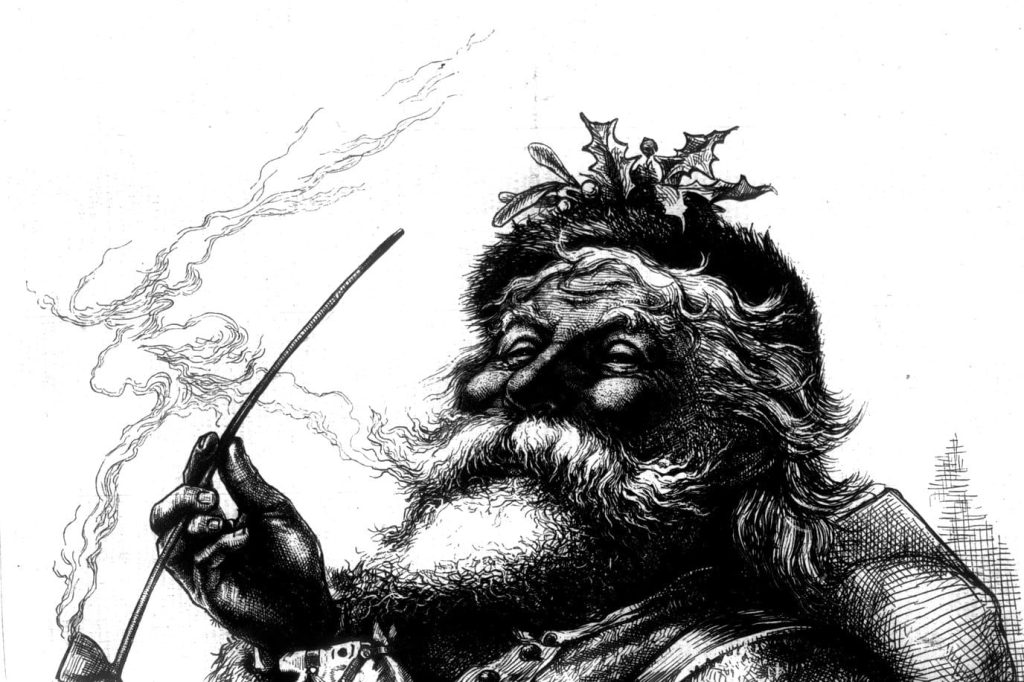
Nast comes back to him almost every year: 33 Christmas images for the same paper between 1863 and 1886, all but one with Santa. Above all he gives him an address: his drawings contain the first known references to a Santa Claus living at the North Pole. The most famous of the series, Merry Old Santa Claus, appears on 1 January 1881, with the pipe, the toys and the holly. It is the image that opens this article.
One detail matters for what follows. These engravings are in black and white. His first Santas wear a brown suit, and the switch to red often attributed to him is still debated. Nast gives him his figure. The colour, for its part, still varies.
Why Santa Claus is red, and where the green Santa comes from
Throughout the nineteenth century, the costume changes from one image to the next. Santa Claus wears gold, blue or brown coats. An edition of the poem printed in Boston in 1864 shows him in brown, another illustration from the same year in yellow. Red does not wait for 1931: an advertisement for sugared almonds, in 1868, already puts him in a red jacket, with a green hat. And on 3 December 1902, the cover of Puck magazine, drawn by Frank A. Nankivell, shows a Santa Claus in a red suit trimmed with white fur, red hat and white beard. Ours in every respect, 29 years before Coca-Cola.
| Year | Image | Colour of the costume |
|---|---|---|
| 1863 | Santa Claus in Camp, Thomas Nast | Black and white engraving: starred coat and striped trousers, in the pattern of the American flag |
| 1864 | Edition of the 1823 poem printed in Boston | Brown |
| 1868 | Advertisement for sugared almonds | Red jacket, green hat |
| 1881 | Merry Old Santa Claus, Thomas Nast | Black and white engraving |
| 1902 | Cover of Puck, Frank A. Nankivell | Red trimmed with white fur, red hat |
| 1931 | First painting by Haddon Sundblom for Coca-Cola | Red and white, the version spread around the world |
And the green Santa Claus? He did exist, mostly on the English side. The Father Christmas of the Victorian era is often shown in a green robe, like the Ghost of Christmas Present drawn by John Leech for A Christmas Carol in 1843. But he coexisted with plenty of other colours. The widespread idea of a Santa Claus who stayed green until Coca-Cola turned him red does not hold: green existed, and so did red, long before 1931.
The Coca-Cola Santa Claus: what the brand really did
Coca-Cola runs Christmas advertising from the 1920s, in magazines, to go with the end-of-year shopping. Archie Lee, of the D’Arcy agency, then wants a Santa Claus both realistic and symbolic. The commission goes to Haddon Sundblom, a Chicago illustrator born in 1899, who paints the brand’s Santa from December 1931 to 1964. His first painting appears in The Saturday Evening Post in 1931.
Sundblom starts from the 1823 poem and its “jolly old elf”. For the face, he takes a living model, his friend Lou Prentiss, a retired salesman. After Prentiss’s death, he paints himself in a mirror, then works from photographs. Thirty-three years of paintings produce the plump, jovial grandfather that the brand spreads around the world.
The brand itself does not claim the colour. It acknowledges that Santa Claus wore a red coat before Sundblom and says it helped create his modern image, nothing more. Its version still has its shortcuts: Coca-Cola also lends the 1823 poem a red coat that the text does not contain. Even those who fixed the character tell a simplified story.
The verdict comes down to two phrases. “Invented by Coca-Cola” is false: the red-and-white outfit is on the cover of Puck in 1902, and the character is more than a century old in 1931. “Popularised by Coca-Cola” is right: the brand fixed a face, a body and a colour, then spread them around the world.
Dijon, 1951: the day the Church burned Santa Claus
In France, the red grandfather did not arrive without resistance. Two days before Christmas 1951, an effigy of Santa Claus around three metres tall is burned on the forecourt of Saint-Bénigne cathedral, in Dijon, in front of some 250 children from the parish youth clubs. The initiative comes from the local clergy, who see in the character a pagan usurper turning Christmas away from the Nativity. The argument centres on schools: Santa Claus and the Christmas tree are entering state schools, from which the nativity scene is banned.
The response comes from the town hall. The mayor of Dijon is then Canon Félix Kir, a priest and member of parliament, who takes the opposite line to the clergy: the very next day, the city has Santa Claus reappear on its rooftops. The affair is picked up as far away as the United States, and Claude Lévi-Strauss draws from it, in March 1952, an essay that remains famous, “Le Père Noël supplicié” (“Father Christmas Executed”). He reads in it a sign of the Americanisation of Christmas in France after the war, and links the character to far older rites. The city’s market has its own page: the Dijon Christmas market.
The red Santa Claus born in New York and fixed in Chicago has not wiped out the other figures. Each country has kept or invented its own, with its name, its date and its way of delivering the gifts. We go through them in our article on Santa Claus around the world.
Reviewed and approved by the editorial team
A question, a mistake or a problem on this page? Write to us
Also worth reading
Lyon in December: Combining the Fête des Lumières and the Christmas Market
Fête des Lumières and Lyon Christmas market: how the hours line up, 27 installations, car parks, TCL and hotel prices recorded on 16 November 2026.
Read the article
Hotels for the Strasbourg Christmas Market: Neighbourhoods, Prices and Last Rooms
Strasbourg Christmas market hotel: what was still bookable on 15 November 2026, prices, the neighbourhoods near the tram and the Kehl option.
Read the article
Christmas in New Zealand 2026: barbecues, pavlova and red pōhutukawa in summer
Christmas in New Zealand falls in midsummer: outdoor lunches, pavlova, red pōhutukawa trees and Santa parades on 29 November and 6 December 2026.
Read the article