
Where to find Tourcoing Christmas Market
Highlights of Tourcoing Christmas Market
- Chalets in the town centre, around the Grand-Place and the Town Hall
- Heated winter guinguette with food and entertainment
- Father Christmas every day from 5pm to 7pm in a covered space
- Northern specialities: waffles, merveilleux, bêtises, carbonnade, winter beers
- MUba Eugène Leroy and Le Fresnoy a short distance from the chalets
Where to stay near Tourcoing Christmas Market
Hotels, flats and rooms around the market, for the dates of your stay.
Check availability with our partners
Specialities to try
The flavours that make this market what it is
Waffles filled with vergeoise
merveilleux
bêtises de Cambrai
carbonnade flamande with beer
braised chicory
regional winter beers and spiced mulled wine
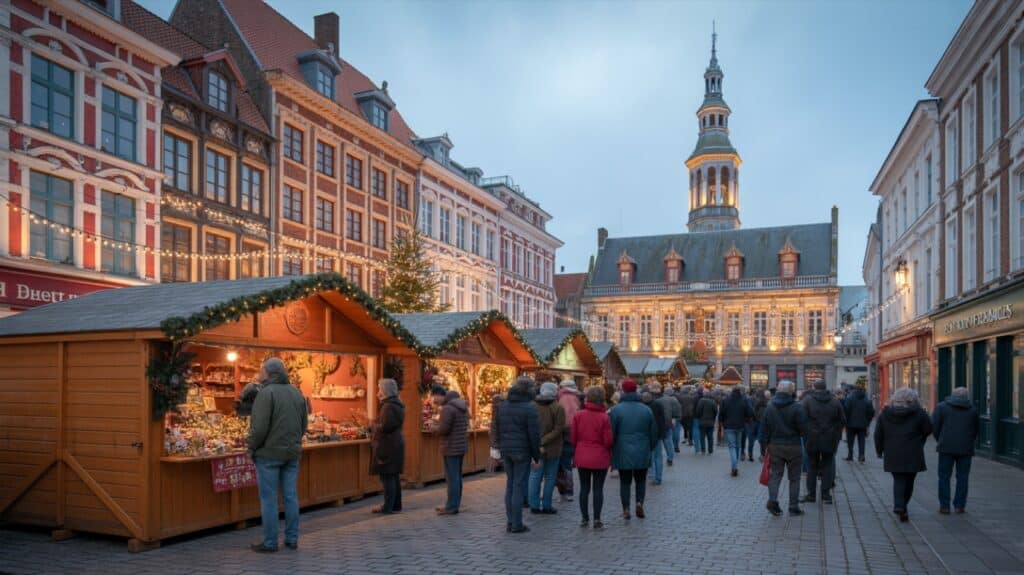
Tourcoing gathers its chalets right in the town centre, around the Grand-Place and the Town Hall, watched over by the belfry of the former chamber of commerce. Tourcoing Christmas market takes over pedestrian streets lined with Flemish façades, a few minutes from the MUba Eugène Leroy and Le Fresnoy, a former leisure hall turned school of the visual arts. This is wool country: the town built its fortune on wool combing and the wool trade, and its grand merchants’ houses still tell that story. Neighbour to Roubaix and sharing its industrial fate, Tourcoing has a more compact centre, where the squares follow one another and the whole market fits within the pedestrian zone. Tourcoing Christmas market brings together designers, food stalls and a heated guinguette where friends linger, close to the Belgian border.
The chalets, the Grand-Place and the winter guinguette
The wooden village sits at the heart of the historic centre, around the Grand-Place and the Town Hall, where Tourcoing’s four main squares (Grand-Place, Place de la République, Place Charles et Albert Roussel, Place Victor Hassebroucq) form a compact, lively centre. The chalets bring together designers, craftspeople and food stalls, with a community chalet set aside for local associations. You go from original gift ideas to food stalls in a few steps, without having to dash from one end of town to the other. Many of the stallholders come from the Lille metropolitan area, which makes for a market rooted in its area rather than a catalogue of interchangeable stands.
The winter guinguette is the market’s anchor. It is a heated space where you can eat, have a drink and catch activities throughout December: concerts, choirs and weekend events follow one after another, and it is often where the evening ends when the cold starts to bite. Father Christmas holds court every day from 5pm to 7pm in a covered, decorated space, which suits families nicely when the northern rain turns up. The Flemish façades of the centre, the garlands strung above the streets and the belfry rising over the rooftops create a setting that owes as much to the architecture as to the lights.
The town’s textile past is never far away. Tourcoing made its fortune from wool combing and the wool trade, to the point of becoming one of Europe’s wool capitals in the 19th century. The old merchants’ houses, tall and ornate, still line several streets in the centre, and the belfry of the former chamber of commerce recalls the time when wool from all over the world was priced here. This working and trading memory gives the market a slightly different setting from the big tourist squares: this is a town that worked, not just one that decorated.
Food at Tourcoing Christmas market: the North on your plate
When it comes to food, this is the land of the North and Flanders, and you can taste it from the very first chalets. The damp December cold calls for food that sticks to your ribs, and the regional cuisine has plenty to offer. Waffles filled with vergeoise or brown sugar take centre stage, as does the merveilleux, a dessert of meringue and whipped cream coated in chocolate shavings that has become an emblem of the region’s pâtisserie. Bêtises, mint sweets born in the nearby Cambrésis, find their way into gift bags. To warm up, carbonnade flamande stewed in dark beer and chicon (the local word for chicory) bring back seasonal cooking, and regional brewers pour their amber winter beers. Spiced mulled wine also passes from hand to hand between the stalls, and some offer hot cider, another classic of northern markets. For gifts, the craftspeople showcase soaps, pottery, jewellery and hand-turned wooden decorations, often made by designers from the region. If you want to keep the atmosphere going at home, a good mulled wine recipe with cinnamon and orange does half the work for you.
- Northern waffles, filled with vergeoise or brown sugar, soft and served nicely warm.
- The merveilleux, meringue and whipped cream coated in chocolate shavings, the pride of Lille-area pâtisserie.
- Bêtises de Cambrai, mint sweets striped with sugar, perfect for Christmas stockings.
- Carbonnade flamande with beer and braised chicory, northern cooking that keeps you warm in winter.
- Winter beers from regional brewers and spiced mulled wine, to go with your stroll between the chalets.
Dates, opening hours and getting there: practical information
Entry to the market is free: you only pay for what you eat, drink or take home. The 2025 edition was held in the town centre from early December to 24 December, opening with a visit from Saint Nicholas, Père Fouettard and his donkey, followed by highlights every weekend (choirs, Father Christmas descending with pyrotechnic effects, music and theatre performances). The opening hours were generous: late afternoon and evening on weekdays (roughly 4.30pm to 7.30pm), and longer slots at weekends, from late morning into the evening. On Wednesdays it opened from early afternoon, handy for fitting the outing around children’s schedules. For winter 2026, the exact dates are still to be confirmed by the town, which usually publishes the programme in the autumn: check the official website before planning your visit.
Tourcoing is easy to reach from Lille. Metro line 2 serves Tourcoing-Centre and Tourcoing station, and the T tram also links the centre, with a journey of about twenty-five minutes from Lille. With these connections, a car-free outing is the obvious choice, especially as the centre is pedestrianised. By car, several car parks ring the town centre, but spaces get scarce on December weekends: aiming for early afternoon or the end of the day helps. The centre is broadly accessible, although the cobbles of the Grand-Place call for a little care with a pushchair. Allow one to two hours to go round the chalets, longer if you move on to the guinguette and a food break. The Belgian border is just a few kilometres away, so a round trip to Menen or Kortrijk is doable in a day if you want to extend your outing beyond the Lille area.
What to see around Tourcoing Christmas market
Tourcoing has plenty to see beyond the chalets, and its wool heritage has left some fine traces. The MUba Eugène Leroy, the town’s fine arts museum, combines historic collections and contemporary art in a building right in the centre, a short distance from the market. Le Fresnoy, the National Studio for Contemporary Arts, occupies a former leisure hall redesigned by architect Bernard Tschumi: exhibitions, film screenings, concerts and performances fill its season, a one-of-a-kind venue in the cultural landscape of northern France. In December, its programme often reflects the festive spirit, and its footbridge suspended beneath the great roof is worth a look if you like contemporary architecture. Between the museum, the arts studio and the chalets, you have a whole afternoon without leaving the centre. The church of Saint-Christophe and its carillon stand on the Grand-Place, its bell tower ringing seasonal tunes above the market; the belfry of the former chamber of commerce and the wool merchants’ houses round off a walk to take between two showers. For architecture lovers, central Tourcoing reads like a book of industrial history, between Flemish façades, converted workshops and the old mansions of the wool bourgeoisie.
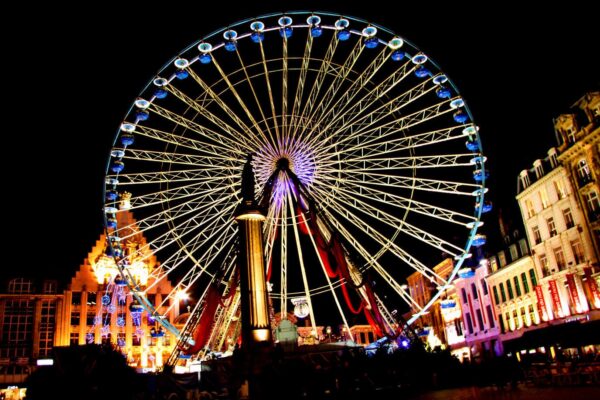
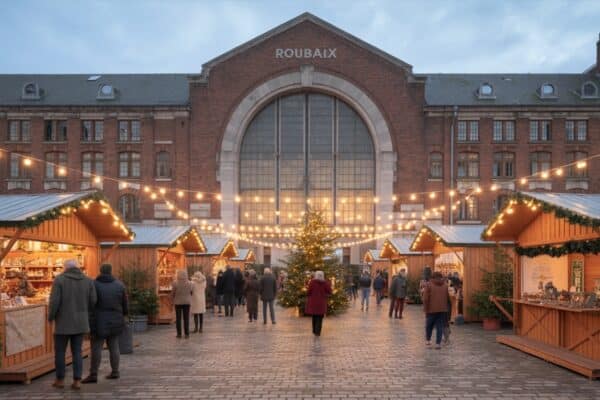
The town’s position, right by the Belgian border, also makes it a good base for a festive weekend in the Lille metropolitan area. Roubaix Christmas market, in the neighbouring town that shares Tourcoing’s textile history, is just a few minutes away by tram. Lille Christmas market and its Ferris wheel on the Grand-Place are a quarter of an hour away by metro, and Douai Christmas market completes a festive route through northern France, between belfries, waffles and mulled wine.
Our tip
Combine the market with the MUba Eugène Leroy and Le Fresnoy, and take the tram on to Roubaix or Lille for a festive weekend in the metropolitan area.
Reviewed and approved by the editorial team
Information checked against 4 official sources. Detailed sources available on request.
A question, a mistake or a problem on this page? Write to us
Markets nearby
Activities nearby
Parks and sites running a Christmas programme less than an hour's drive away. They aren't Christmas markets, and admission is charged.
 Opens in 57 days
Park
Opens in 57 days
Park
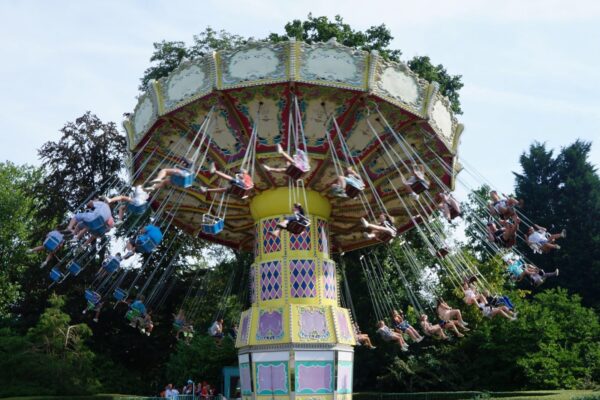
Bellewaerde at Christmas: the park near Ypres for the festive season
Ypres
From 5 December to 3 January 2027
Day out · Park
 Dates to be confirmed
Park
Dates to be confirmed
Park
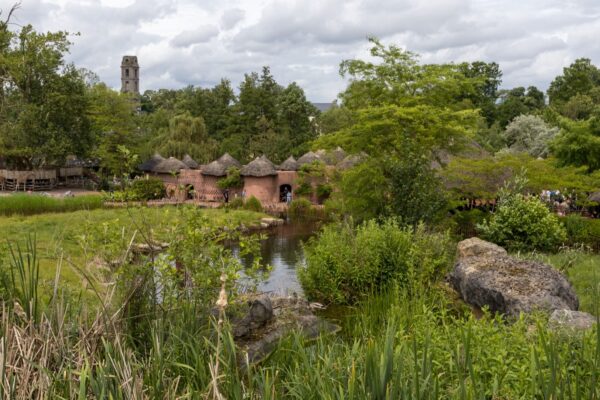
Pairi Daiza at Christmas: Christmas Time
Brugelette
Worth the weekend · Park
 Opens in 43 days
Park
Opens in 43 days
Park
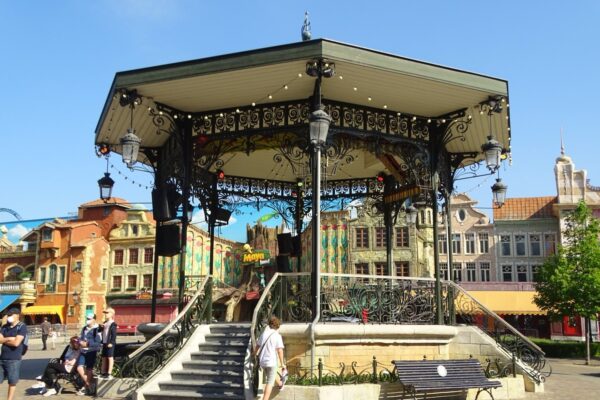
Plopsaland De Panne at Christmas: Magical Christmas
De Panne
From 21 November to 3 January 2027
Day out · Park