
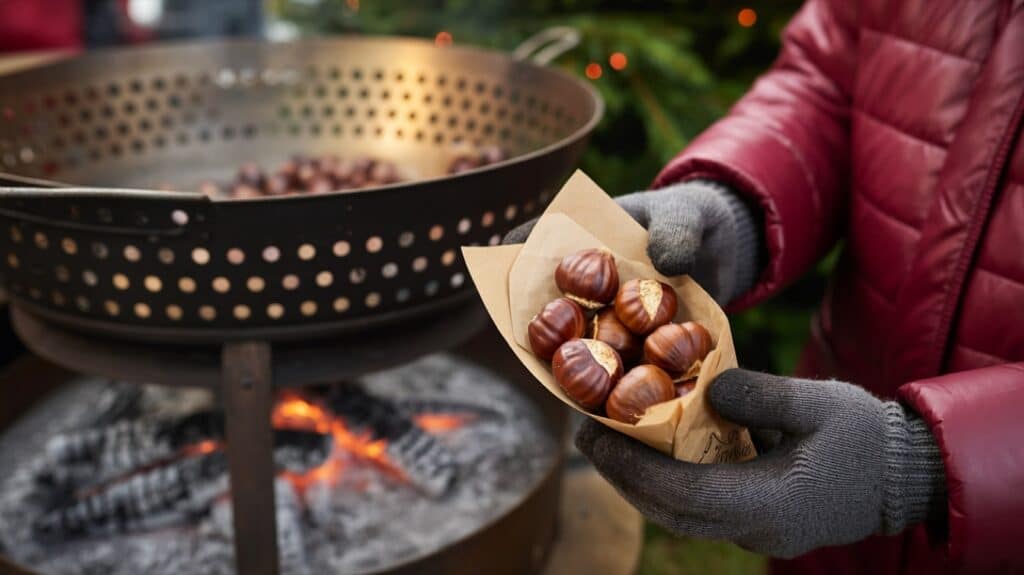
 Illustrative image
 Marrons Chauds: the Paper Cone of Roasted Chestnuts That Warms Every Christmas Market
At a Christmas market, your nose finds the stall before your eyes do. That smell of toasted sugar and wood smoke is the smell of marrons chauds, the roasted chestnuts sold by the paper cone. The vendor shakes his black pan over the embers, scoops out a steaming shovelful and hands you a scorching cone that you clutch between frozen hands. This little winter ritual has crossed centuries and cities. Behind the treat lies a story of terroir, a stubborn muddle over names, and a farming know-how that is still very much alive in the chestnut groves of France.
Marron, châtaigne, horse chestnut: which is which?
Let us clear up the misunderstanding first, because it stings. The marron you bite into at the market is not the fruit of the horse chestnut trees in school playgrounds. It is a large sweet chestnut. Both marron and châtaigne grow on the same tree, the sweet chestnut (Castanea sativa), but in the kitchen the word “marron” refers to fruit of a particular quality: a husk that holds a single large nut, with no inner membrane dividing it into segments. Chestnut growers have selected these varieties over generations to obtain that single fruit, which is easier to work for marrons glacés or chestnut cream.
The real trap falls from the horse chestnut (Aesculus hippocastanum), the ornamental tree of parks and avenues. Its seed looks like a giant chestnut, glossy and rounded, but it is toxic. Mixing them up leads to stomach pain, nausea and vomiting. According to ANSES, the French food safety agency, confusion between sweet chestnuts and horse chestnuts accounted for 11% of the plant mix-ups recorded between 2012 and 2018. Two clues are enough to settle it: the husk of a real sweet chestnut bristles with fine, densely packed spines and often holds two or three nuts, whereas the horse chestnut's case is almost smooth, with a few widely spaced points, and holds a single large round seed.
| Criterion | Sweet chestnut / edible marron | Horse chestnut (toxic) |
|---|---|---|
| Tree | Sweet chestnut (Castanea sativa) | Ornamental horse chestnut (Aesculus) |
| Husk | Fine, numerous spines | Smooth case, spaced points |
| Nuts per husk | Often 2 or 3 | A single one, large and round |
| Shape | Flat on one side, pointed tip | Round and domed |
| Use | Edible when cooked | Not edible |
The perforated pan, the tool behind the smoke
The secret of the flavour lies in a very plain object: a long iron pan pierced with dozens of holes. It is known as a chestnut pan. The holes let the heat of the embers reach the fruit directly, and above all they let out the moisture that would otherwise boil the chestnut rather than roast it. The vendor sets the pan over a wood fire or a brazier, shakes it constantly so nothing burns on one side, and lets the skin split, blacken at the edges and take on that toasted scent you can smell three stalls away.
Before it goes on the fire, each chestnut gets a nick from a knife. This cut prevents explosions: as it heats, the steam trapped inside the nut has to escape somewhere. Without the slit, it pops. With it, the shell opens into two lips that later let you peel it with a flick of the thumb. It is this gesture, repeated hundreds of times on a December evening, that gives the vendor his blackened hands and his eye for a nut cooked just right. Nothing clever about the tool, yet the whole result depends on it: the air flow, the constant shaking, the hot iron caramelising the outside while the centre steams.
The chestnut seller, a figure of winter
The silhouette of the street vendor belongs to the urban landscape of the cold season. Pan on the brazier, a cry to passers-by, “chauds les marrons, chauds!” (“hot chestnuts, hot!”), he sets up on the corner of busy streets, at the metro exit, on the forecourt of a church. In Lyon, the Vogue des marrons fair fills the Croix-Rousse district every autumn, and the very name of the festival is a reminder of how deeply this fruit has marked city life. The roasted chestnut was never a luxury item. It was the poor man's treat, filling and cheap, bought to warm your fingers as much as your stomach.
This scene inspired painters and photographers long before electric fairy lights. The glowing brazier, the cloud of smoke in the cold air, the queue of onlookers stamping their feet: the image is as much a Parisian cliché as the reality of dozens of towns. The trade nearly vanished, squeezed out by industrial stalls, then came back with the rise of Christmas markets, which gave small producers and old-fashioned gestures their place again.
It has to be said that the chestnut long played a vital role in the mountain countryside. Where wheat refused to grow, the “bread tree” supplied flour, soup and dried fruit stored for winter. Whole valleys lived to the rhythm of the autumn harvest, gathered by hand beneath the leaves and dried in slatted huts called clèdes in the Ardèche. The market's roasted chestnut descends in a straight line from that peasant economy: a survival food that became, over time, a seasonal pleasure shared while wandering between the lit-up chalets.
At Christmas markets, this character keeps his rightful place. The chestnut stall sits next to the mulled wine stand, and many visitors go for both: a steaming cup in one hand, a cone of chestnuts in the other. At the Strasbourg Christmas market, the oldest in France, the smell of roasting chestnuts mingles with that of gingerbread and bredele biscuits. The treat warms you up, but it also brings people together: you eat it standing, walking, chatting, with no cutlery and no plate.
Where the chestnuts in our cones come from
France has grown chestnuts for a very long time, on sloping land where few other crops survive. Three great growing regions share most of the production and each carries its own signature.
- The Ardèche leads the way. The Châtaigne d'Ardèche holds AOP status (protected designation of origin) and brings together 65 traditional varieties, each tied to a valley. The area produces around 5,000 tonnes a year, close to 60% of the national harvest, on terraced chestnut groves between 300 and 900 metres above sea level.
- The Cévennes secured their AOP in 2020. Chestnuts grow there in the Gard, the Hérault and the Lozère, with some thirty local varieties whose names sing: Aguyane, Bouche Rouge, Pellegrine, Marrouge. The tree long carried the nickname “bread tree”, so much did it feed families.
- Corsica contributes its AOP chestnut flour, a pillar of the island's cooking and the base of pulenda and traditional cakes.
This geography explains the map of markets where roasted chestnuts make the most sense. Near the Cévennes, the Montpellier Christmas market puts you within reach of the chestnut country of the Gard and the Lozère. In the greater south-west, the Carcassonne Christmas market carries on this culture of the autumn fruit. In the Velay, the Le Puy-en-Velay Christmas market stands at the gateway to a mid-mountain region where the chestnut tree fed generations. And the Sarlat Christmas market, in the heart of the Périgord, pairs chestnuts with walnuts and the other treasures of the local table.
Choosing your roasted chestnuts well
In front of the stall, you can spot a good batch in a few seconds. The nut should feel heavy in the hand, the skin taut and glossy, with no hole or stray crack. A light or dried-out chestnut sounds hollow: it has lost its water, the flesh will have shrivelled and will come away from the skin badly. Also watch out for small round holes in the shell, a sign that a worm has been through.
When you taste, proper cooking shows in the very first nut. The flesh should be soft and slightly floury, never hard at the centre nor charred. A hint of bitterness betrays a chestnut roasted too long or too old. A serious vendor lets you taste, keeps shaking his pan, and serves his cone piping hot, not lukewarm from a batch cooked an hour ago. One last detail: the price. It is charged by the cone or by weight, and an honest price almost always goes with a quality chestnut, cooked in front of you rather than reheated.
- Heavy, glossy nut, skin nice and taut.
- No wormhole, no suspicious crack.
- Soft, floury flesh when cut open.
- Served scalding hot, in a cone that is still steaming.
Peeling them without losing your fingers
The skin of a roasted chestnut comes off well as long as the nut is still burning hot. Wait for it to cool and you will struggle: the shell sticks, and the second skin, that bitter brown film known as the pellicle, clings to the flesh. The trick is to open the slit made before cooking, prise the shell away on both sides, then take the thin brown skin off in one go. If a piece resists, better to leave it than eat the pellicle, which is very bitter.
At home, if you bring raw chestnuts back from the market to prolong the pleasure, boiling remains the most convenient way to peel a lot of them. Score them, drop them into salted boiling water, take the nuts out in small batches and peel them while they steam. The perforated pan, for its part, gives that roasted flavour water cannot reproduce. Each has its purpose: water for quantity, fire for aroma. A hot oven, with the scored nuts laid on a tray, offers an honest compromise when you have neither brazier nor pierced pan. Allow about fifteen minutes, checking that the skin opens without the flesh drying out. A damp tea towel laid over the chestnuts as they come out of the oven softens the skin and makes peeling easier, a tip many mountain cooks pass down from one generation to the next.
More than a treat, a marker of the season
The roasted chestnut says something simple about Christmas markets. It costs next to nothing, you eat it without fuss, it keeps your hands busy while you look at the lights. Many people link it to a precise memory: an adult's hand holding out the cone, a snow-covered square, breath misting in front of the mouth. This modest fruit carries an emotional weight few sweets can match, because it comes from a time when people made do with little to treat themselves.
So next time you come across the blue smoke of a chestnut pan between two chalets, stop. Watch the vendor shake the pan, choose your cone, blow on the first nut before peeling it. Behind that gesture stand centuries of chestnut groves, a mountain know-how and an urban tradition that refuses to die out. For a fruit people once ate out of necessity, that is not bad at all.
Where to stay near the markets mentioned
Availability with our partners, town by town.
Reviewed and approved by the editorial team
A question, a mistake or a problem on this page? Write to us
Also worth reading
Christmas in Provence: santons, thirteen desserts and lit-up lanes
Our pick of Christmas markets in Provence: santon fairs, thirteen desserts and villages of the south, from Marseille to Nice, town by town.
Read the article
Christstollen, the Christmas cake that comes from Dresden
Christstollen, the Dresden Christmas loaf with candied fruit and icing sugar: origins, symbolism and which Alsace markets to find it on.
Read the article
Hot Chocolate at Christmas Markets, a Story Going Back to the Aztecs
Hot chocolate at Christmas markets: Aztec origins, the Bayonne tradition, how to spot a good cup and the alcohol-free alternative to mulled wine.
Read the article