
Where to find Stuttgart Christmas Market
Highlights of Stuttgart Christmas Market
- Hand-painted chalet roofs across the three squares of the historic centre
- Kinder-Märchenland with a little train, mini Ferris wheel and carousel for children
- Open-air ice rink of around 525 m² open throughout the market
- Finnish village with Nordic crafts near Schillerplatz
- Swabian specialities: Maultaschen, Spätzle, Lebkuchen and mulled wine
Where to stay near Stuttgart Christmas Market
Hotels, flats and rooms around the market, for the dates of your stay.
Check availability with our partners
Stuttgart Christmas Market in pictures
Specialities to try
The flavours that make this market what it is
Maultaschen
Spätzle
Lebkuchen and mulled wine are the market’s classics
alongside Christstollen and hot chestnuts
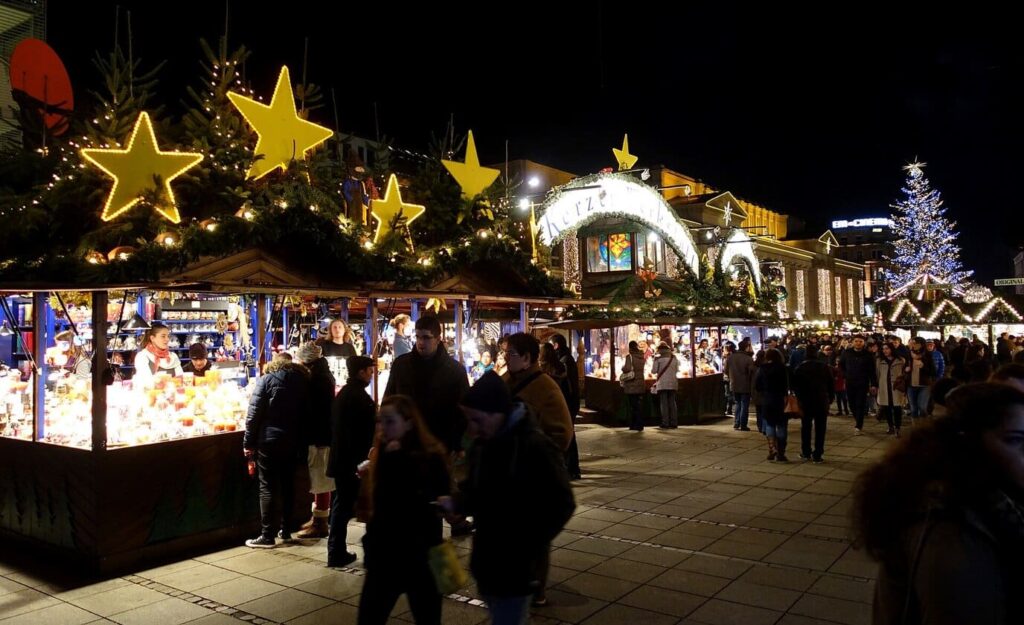
Stuttgart Christmas market covers three squares in the historic heart of Baden-Württemberg’s capital: Schlossplatz, Schillerplatz and Marktplatz. Under hand-painted chalet roofs, the Swabian city has been setting out garlands, gingerbread and wooden toys for more than three centuries, between the Neues Schloss and the Stiftskirche. Counted among the largest Christmas markets in Germany, the event brings together around 300 stalls every winter, on a route you can walk in under an hour, or much longer if you stop at every stand.
Schlossplatz, the heart of Stuttgart Christmas market
The first written mention of the market dates back to 1692, making it one of the oldest Advent events in Germany. For a long time it looked like a funfair, with animal handlers and street attractions, before taking its current form in the 1970s, when decorated wooden chalets replaced the temporary booths. The number of stalls has fallen sharply since then: there were around 1,200 in the middle of the 19th century, compared with around 300 today, spread over a tighter layout around the three squares.
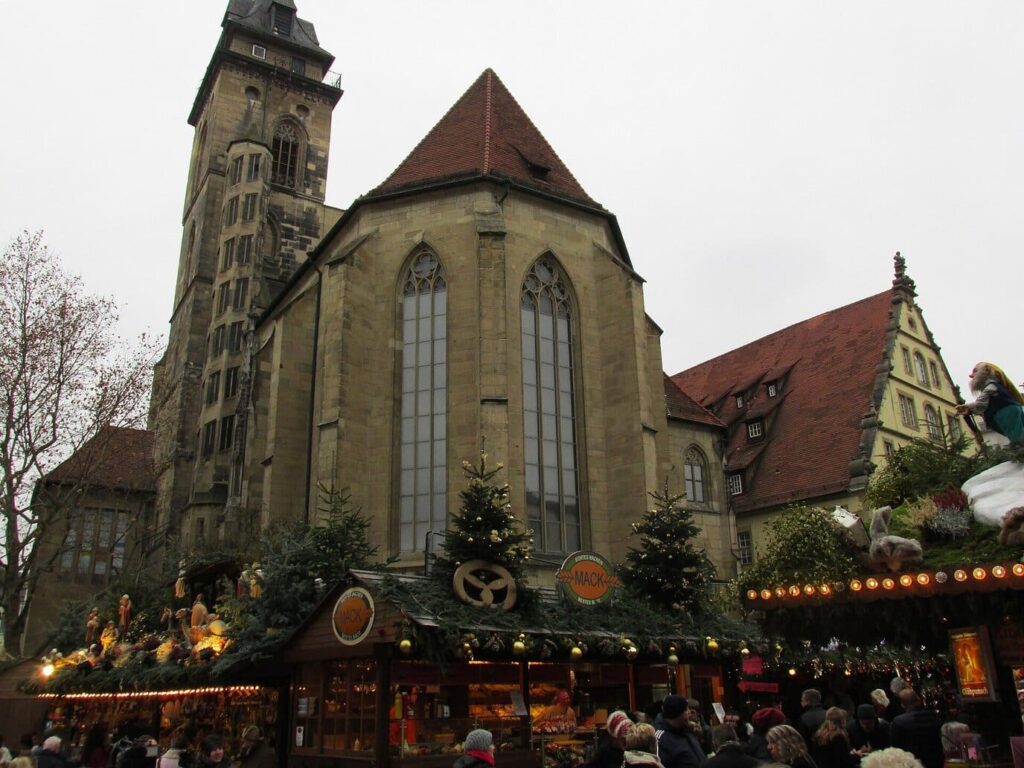
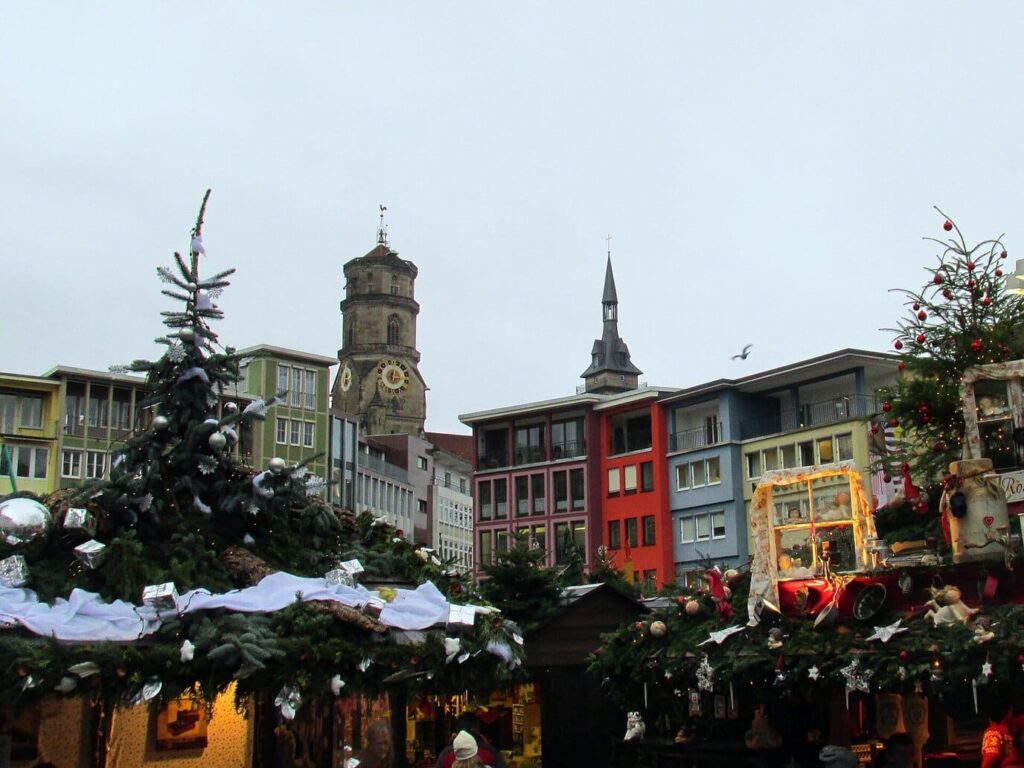
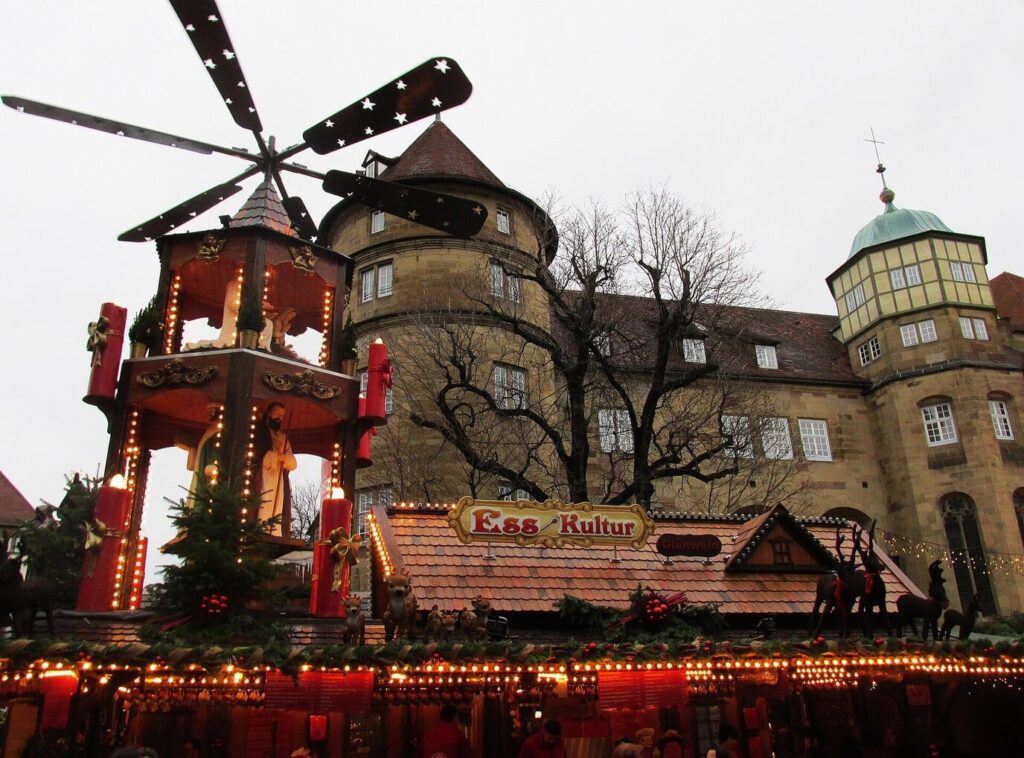
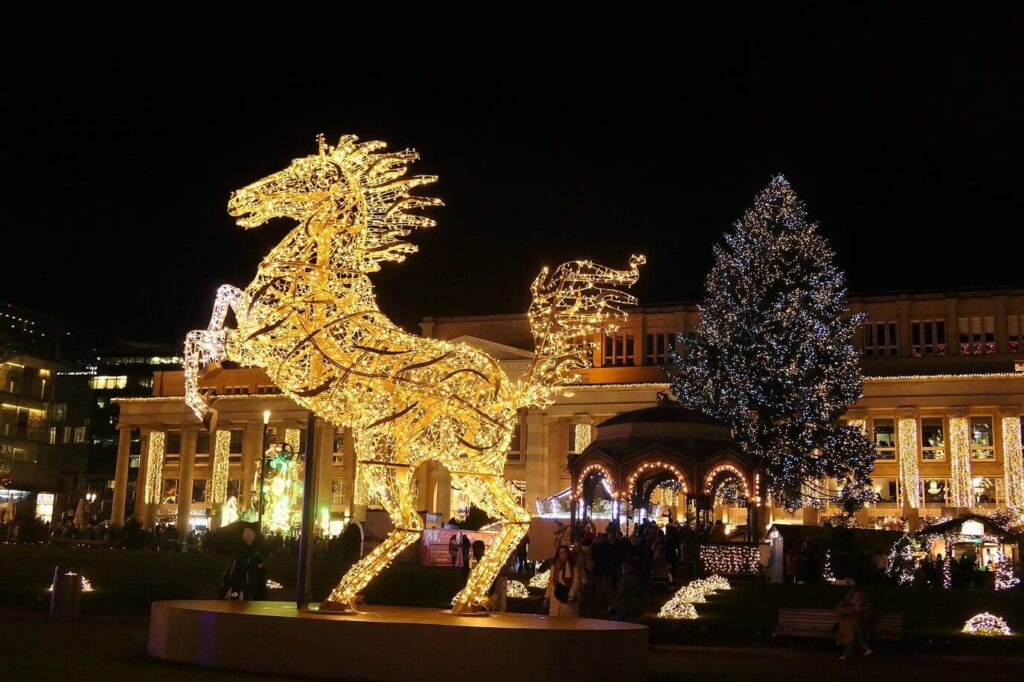
Today, these 300 chalets cover Schlossplatz, Schillerplatz and Marktplatz, linked by pedestrian streets lined with glowing shop windows. What makes the market special is its wooden roofs painted by local craftspeople or city associations: each stall has a different design, which gives the route the look of an open-air gallery. The Neues Schloss, a Baroque palace from the 18th century, is a visual landmark from almost everywhere on the square, while the Stiftskirche, a few streets away, closes the route on the Marktplatz side.
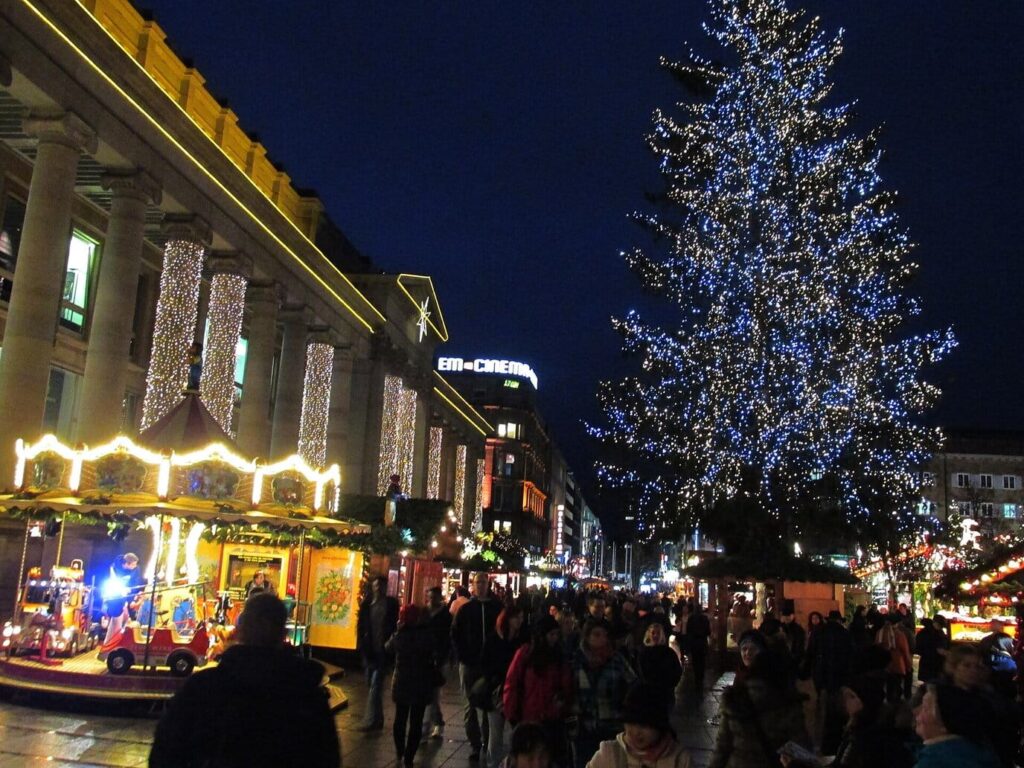
In the evening, the garlands and painted roofs take on another dimension: the warm light of the chalets is reflected on the façades of the Neues Schloss, a view many visitors photograph before carrying on.
Marktplatz, home to the town hall, closes the route to the east, with its own stalls of decorations and wooden toys. It’s also where you’ll find several textile and ceramics stalls, carrying on the crafts that have built the market’s reputation since the 19th century. The contrast between the Baroque architecture of the Neues Schloss and the colourful chalet roofs defines the market’s look in winter.
Children’s market, ice rink and Finnish village
On Schlossplatz, the Kinder-Märchenland gathers the attractions designed for younger visitors: a little steam train running through a miniature landscape, a mini Ferris wheel and an old-fashioned carousel. Children can also decorate their own gingerbread hearts in dedicated workshops, a simple activity that keeps the family busy for a good half hour.
Right next door, an open-air ice rink of around 525 m² welcomes beginner and experienced skaters for the whole duration of the market; skates can be hired on site. The Finnish village, set up near Schillerplatz, rounds things off with Nordic crafts and products from Finland, a Scandinavian note in the market’s programme.
For a break between two workshops, Königstraße, one of the longest pedestrian streets in Germany, extends the stroll with its shops and cafés, a few minutes’ walk from the market’s three squares.
Beyond the Kinder-Märchenland, several stalls sell traditional wooden toys and hand-painted decorations, carrying on the craftsmanship that has made the market’s name for generations. Families with young children will also find benches and rest areas around Schlossplatz, handy after an hour spent between the workshops and the ice rink.
Swabian specialities and mulled wine on the stalls
You can’t cross the market without passing a Maultaschen stall, the large Swabian ravioli served in broth or pan-fried with onions. Spätzle, fresh egg noodles tossed in butter, often go with the seasonal dishes, while stalls of Lebkuchen (gingerbread) and chocolate-covered candied fruit catch the eye along the way.
Those with a sweet tooth will also be happy with Christstollen, the candied fruit loaf typical of the season, sold by the slice or as a whole loaf to take away. Hot chestnuts, roasted on the spot, complete the list of classics you’ll find from one end of the market to the other.
To warm up, mulled wine is still the most popular drink at the market: served in commemorative mugs that many keep as a souvenir of their visit, it also comes in an alcohol-free version for children and drivers. Some stalls offer red-berry or spicier versions, plenty of choice for finding your favourite across the three squares before the evening is over.
Some stalls also serve local beer, heated and spiced, a lesser-known alternative to classic mulled wine, as well as hot apple juice for drivers and children. Swabian cheeses and cold meats, sold by weight at some stalls, round out a food offer that goes well beyond sweet treats.
How to get to Stuttgart from France
From Paris, the ICE runs direct to Stuttgart station in about 3 hrs 10, with no change, a comfortable connection for a full weekend there. From Strasbourg, the direct train takes about 1 hr 20, which puts the market within reach of a day trip for anyone living in Alsace or eastern France.
By car from Strasbourg, allow about 1 hr 45 via the A8, with several covered car parks close to the city centre on the Schlossplatz side. The route passes through Karlsruhe, home to Karlsruhe Christmas market, a possible stop to combine two cities in the same weekend.
If you’d rather avoid the road, regional rail services complement the ICE: several TER and German regional trains link Strasbourg, Karlsruhe and Stuttgart throughout the day, with simple connections at Karlsruhe station. A day return from Alsace is doable, as long as you plan your return around the last evening train.
The Deutschland-Ticket, valid on German regional trains, can also cover part of the journey for travellers from a border town visiting several markets in the same week, alongside an ICE ticket for the high-speed section. Park-and-ride car parks on the outskirts of Stuttgart are another option to avoid driving into the historic centre at the height of the festive season.
Practical information for Stuttgart Christmas market 2026
The 2026 edition of Stuttgart Christmas market runs from 25 November to 23 December, on the three squares in the city centre. Exact opening hours are still to be confirmed for 2026; as at most German markets, access to the squares is free, and only food, drinks and paid attractions (ice rink, Kinder-Märchenland rides) are charged separately.
Allow two to four hours to explore the three squares without rushing, longer if you stop at every speciality stall. The main aisles are wide and accessible with pushchairs and wheelchairs, with cobbles in places that call for a little care. Stuttgart’s main station is about fifteen minutes’ walk from Schlossplatz, which makes arriving by direct train from France simple.
Stuttgart Christmas market also works well as part of a regional weekend, with the nearby markets of Karlsruhe and Baden-Baden, each with a different atmosphere. For a car-free weekend, the three cities are linked by train, which makes planning easy from Stuttgart station.
Weekdays offer a calmer visit than weekends, especially for families with young children. The last weekend before Christmas draws the biggest crowds to the three squares, something to bear in mind when planning your visit.
- An hour and twenty minutes away by train, Strasbourg Christmas market lets you compare two neighbouring but different Advent traditions.
- At Baden-Baden Christmas market, the more intimate atmosphere contrasts with the scale of Stuttgart’s three squares.
- The little train and mini Ferris wheel of the Kinder-Märchenland keep the youngest busy while parents enjoy the food stalls.
- The Finnish village adds Nordic crafts among the traditional chalets of Schlossplatz.
- The Neues Schloss and the Stiftskirche frame the market, two handy landmarks for finding your way between the three squares.
Our tip
Wait until late afternoon to arrive: that’s when the chalet lights come on across the three squares.
Reviewed and approved by the editorial team
Checked on against 5 official sources. Detailed sources available on request.
A question, a mistake or a problem on this page? Write to us
Markets nearby
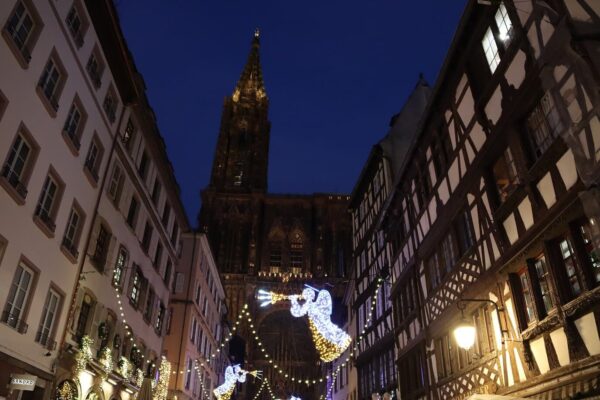 Dates to be confirmed
Strasbourg Christmas Market
Strasbourg
Worth the trip
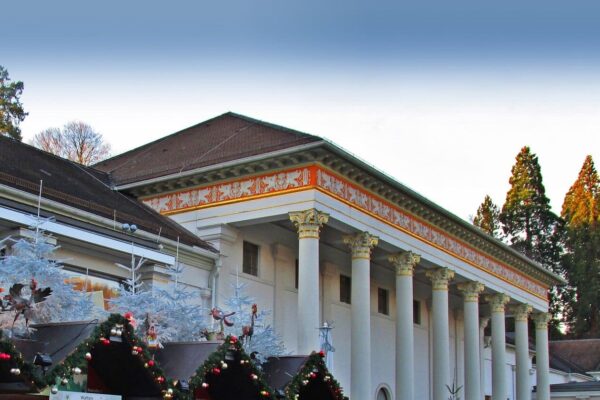 Opens in 48 days
Baden-Baden Christmas Market
Baden-Baden
From 26 November to 6 January 2027
Worth the weekend
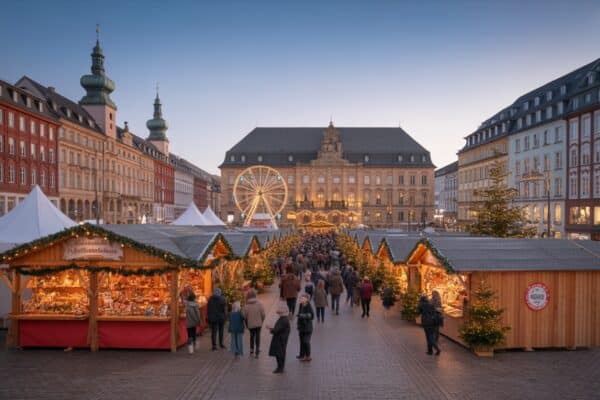 Opens in 45 days
Karlsruhe Christmas Market
Karlsruhe
From 23 November to 23 December 2026
Day out
Activities nearby
Parks and sites running a Christmas programme less than an hour's drive away. They aren't Christmas markets, and admission is charged.
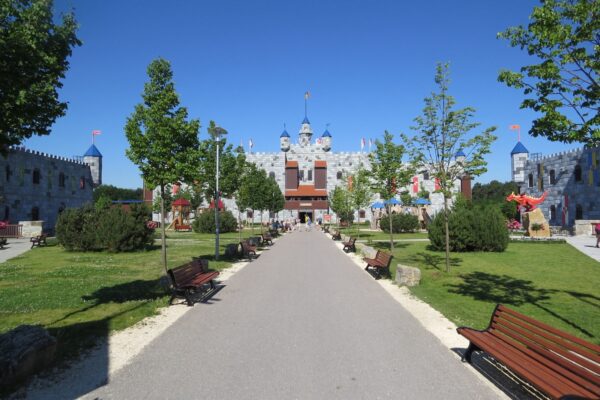 Opens in 50 days
Park
Opens in 50 days
Park
LEGOLAND Deutschland at Christmas
Günzburg
From 28 November to 10 January 2027
Day out · Park
 Opens in 50 days
Park
Opens in 50 days
Park
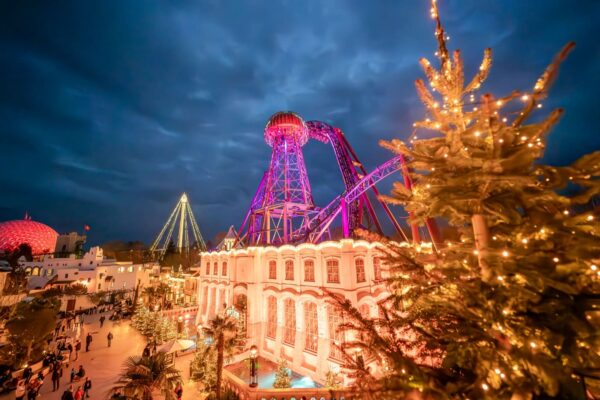
Europa-Park at Christmas: Winterzauber
Rust
From 28 November to 9 January 2027
Worth the trip · Park
 Dates to be confirmed
Park
Dates to be confirmed
Park
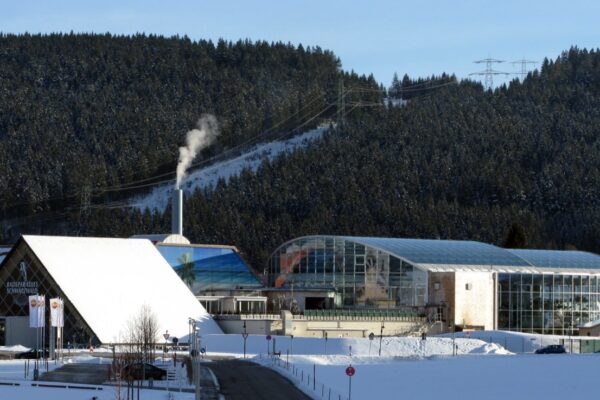
Badeparadies Schwarzwald at Christmas: relaxing in the Black Forest
Titisee-Neustadt
Day out · Park