
Where to find Dresden Christmas Market
Highlights of Dresden Christmas Market
- The oldest Christmas market in Germany confirmed by a written document, with a privilege dated 19 October 1434.
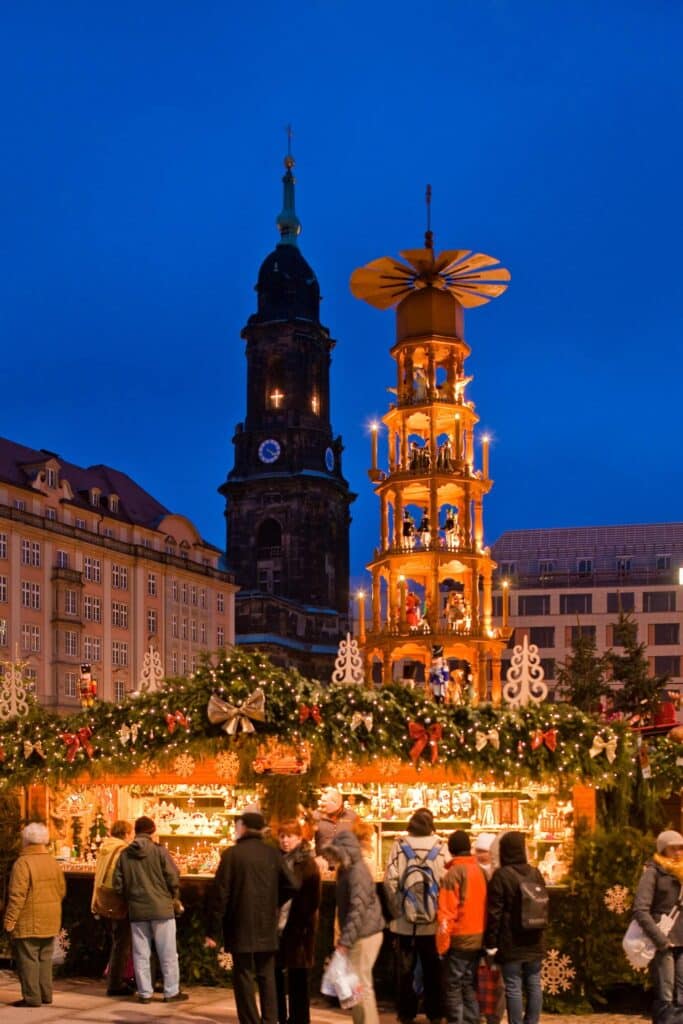
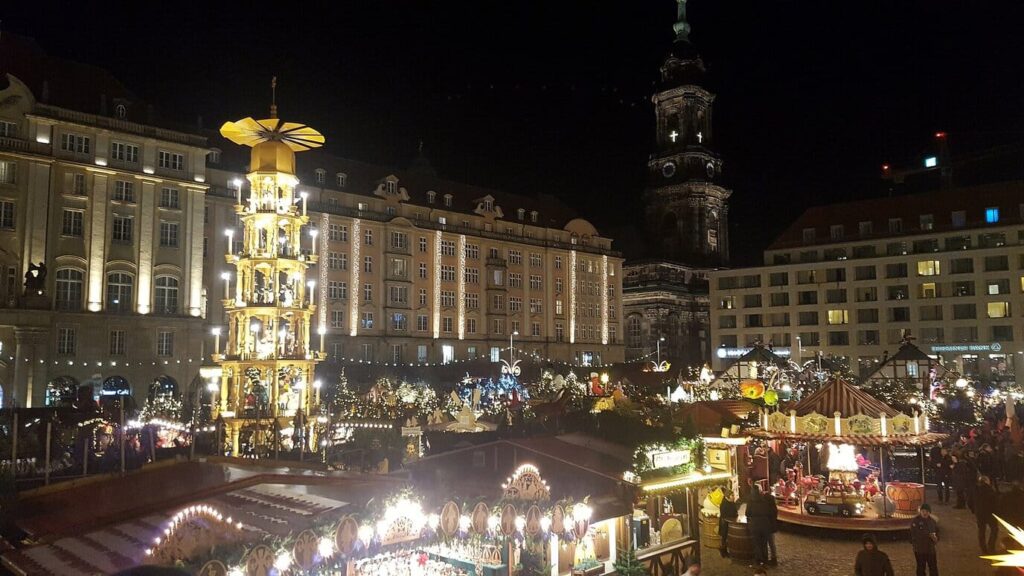
- A giant Christmas pyramid, a traditional Erzgebirge structure, standing in the middle of the Altmarkt.
- The Stollenfest, a costumed parade and public cutting of Dresden’s emblematic Christmas cake.
- A craft market well stocked with carved and turned pieces from the Ore Mountains.
- A rebuilt old town (Frauenkirche, Zwinger) a few minutes’ walk from the market.
Where to stay near Dresden Christmas Market
Hotels, flats and rooms around the market, for the dates of your stay.
Check availability with our partners
Dresden Christmas Market in pictures


Specialities to try
The flavours that make this market what it is
Dresden Stollen
a sweet bread with candied fruit and marzipan under icing sugar
remains the star of the food on offer
alongside Saxon gingerbread and spiced mulled wine
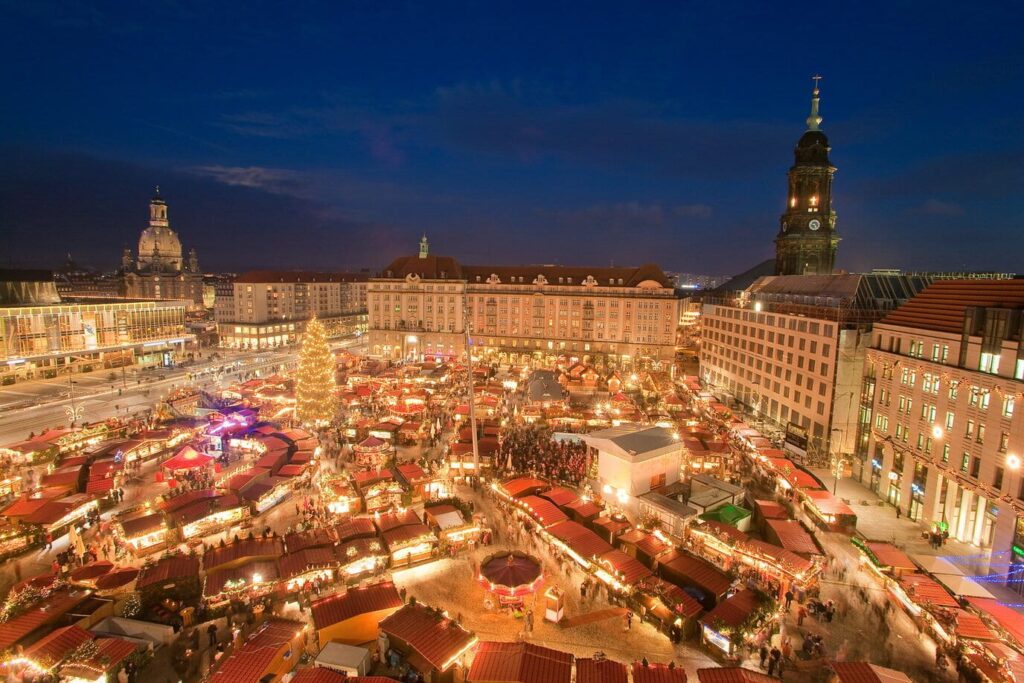
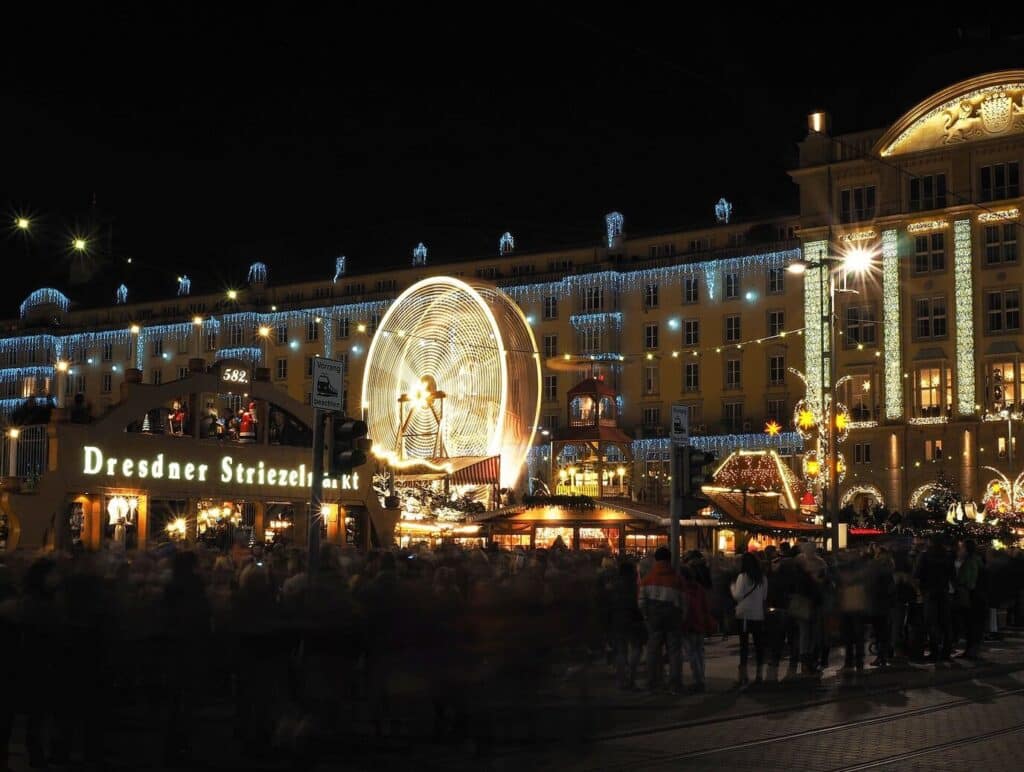
Dresden Christmas market fills the Altmarkt, the large square at the heart of an old town rebuilt after the Second World War around the Frauenkirche. Wooden chalets lined up around a giant pyramid, the smell of gingerbread and freshly baked Stollen, the muffled bustle of passers-by wrapped up against the Saxon cold: the setting matches the image you have of a great German Christmas market. The city calls it the Striezelmarkt, after the old name for the local Christmas bread, and traces it back to a princely privilege far older than most of the country’s markets. Dresden lies on the Elbe, whose banks open up a view of the Zwinger and the Semperoper, a few streets from the market.
The Striezelmarkt, the grand old man of German Christmas markets
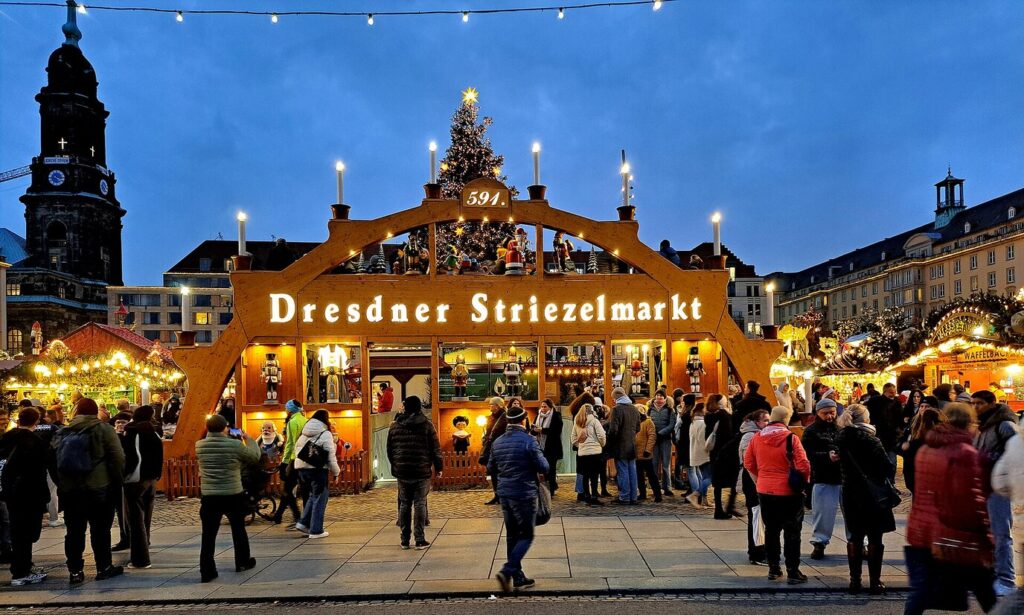
The first documented mention dates back to 19 October 1434: Elector Frederick II of Saxony and his brother Duke Sigismund granted the people of Dresden the right to hold a market, one day a year before Christmas, to buy the meat needed for the festive meal. This permission makes it the oldest German Christmas market confirmed by a written document, five centuries before the idea became widespread across the country. The name Striezelmarkt comes from Striezel, the old Dresden name for Christmas bread, which over the centuries became the Stollen we know today.
The city has changed a great deal since the fifteenth century, especially after the bombing of February 1945 that destroyed much of the historic centre. The Frauenkirche, which collapsed in the fire that followed the raid, only regained its silhouette after a reconstruction completed in 2005, funded largely by private donations from around the world. The market itself came through these successive rebuilds and is now held on a redesigned Altmarkt, surrounded by post-war buildings and a few façades restored to their original appearance. This continuity, across the centuries and despite the destruction of the city, underpins much of the place’s reputation well beyond the borders of Saxony.
Dresden Christmas market on the Altmarkt
Dresden Christmas market spreads across the Altmarkt and spills over into the neighbouring shopping streets, close to the Frauenkirche and the Zwinger. In the middle of the square stands a Christmas pyramid, a traditional structure from the Ore Mountains with rotating tiers driven by the heat of candles: Dresden’s is one of the largest of its kind to be seen in Germany. Around it, a craft market gathers carved and turned pieces from the Erzgebirge: articulated Christmas trees, incense smokers, painted nutcrackers, straw stars and illuminated wooden garlands.
The exact number of chalets varies from one edition to the next, but recent editions have counted more than two hundred, placing the market among the largest in the country by area. Attendance runs into the millions over the full length of the event, which explains why it is organised in several zones around the main square rather than as one continuous row of stalls. A small stage regularly hosts brass ensembles and choirs, in the Saxon musical tradition, between announcements about the day’s opening hours.
Stollen and Saxon treats
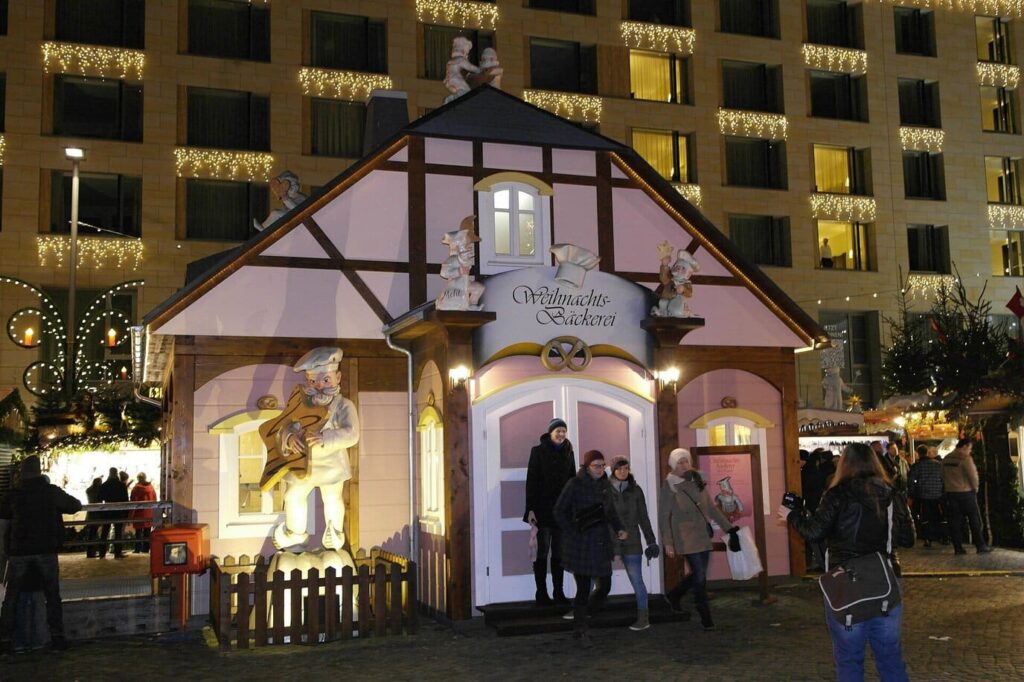
Stollen, a dense sweet bread with candied fruit, rum-soaked raisins and a marzipan centre, dusted generously with icing sugar, remains the speciality that gave the market its historic name. Every year the Stollenfest celebrates this cake with a giant loaf paraded through the streets and then cut in public, a ritual that has become one of the highlights of Dresden’s end-of-year calendar. Saxon gingerbread, sugar-roasted almonds and marzipan figures complete what the chalets offer, alongside more local specialities such as Bautzen mustard, which some traders sell in jars to take away.
Saxon mulled wine, spiced with cinnamon, cloves and citrus zest, is served in decorated ceramic mugs unique to each edition, which many visitors keep as souvenirs on a shelf. It also gives ideas to anyone who wants to keep the atmosphere going once home: mulled wine recipes let you rediscover those spicy aromas all winter long, far from the Altmarkt.
Dresden Stollen has a protected designation, reserved for pastries made to a regulated recipe in the Dresden area. Several of the city’s long-established bakers lead the Stollenfest procession, a costumed parade that crosses the centre before the cake is cut on the Altmarkt, watched by a crowd that comes as much for the tradition as for the tasting.
Practical information for the 2026 edition
The city of Dresden has published the dates of the 2026 edition: the 592nd Striezelmarkt runs from 25 November to 24 December 2026 on the Altmarkt. It opens on 25 November from 4pm to 9pm, then every day from 10am to 9pm until 23 December; on 24 December, the chalets close at 2pm. Entry to the market is free, as at almost all German Christmas markets, and a visit to the Altmarkt and its immediate surroundings takes one to two hours, longer if you carry on to the old town, the Zwinger and its Gemäldegalerie. Many visitors combine the market with a visit to the Zwinger and its picture gallery, or a stop at the Frauenkirche and the neighbouring Neumarkt, a few minutes’ walk away and also dressed in lights in December.
The Altmarkt is right in the city centre, within walking distance of the central station (Hauptbahnhof) and most hotels in the historic area. Trams serve the square directly from across the city, a handy option if you are staying on the outskirts rather than in the centre. Hotels in the historic quarter fill up fast in December: booking your nights early in your planning leaves a wider choice of neighbourhoods and budgets.
Temperatures often drop below freezing in Dresden in December, a more continental climate than on the French coast: several layers, a woolly hat and closed shoes will help you last a whole evening on the Altmarkt. The market lights up early, from the start of the afternoon at this time of year, and grows brighter as the chalet windows light up one after another.
From Paris and eastern France: getting to Dresden by train or car
There is no direct train from Paris to Dresden. The simplest route combines a TGV or ICE to Frankfurt, then an ICE to Saxony, for a total journey of around eight hours with one change. From Strasbourg or Mulhouse, the train route via Frankfurt and Leipzig is shorter, but it remains a journey of several hours better suited to a long weekend than a simple day between two trains. For travellers setting off from northern France, a route via Brussels, then Cologne and Berlin, reaches Dresden by train without going through Frankfurt, at the cost of an extra change; the ICE from Berlin to Dresden takes just over two hours. Train tickets to Germany are best booked several weeks ahead: the lowest fares go first on weekend services, especially around Christmas.
By road, allow about seven hours from Strasbourg, via Frankfurt and Leipzig, for a journey of just over seven hundred kilometres. There are car parks on the edge of the historic centre, a few minutes’ walk from the Altmarkt; the old town itself is largely reserved for pedestrians and cyclists, which makes the visit simpler once the car is parked. For those coming from eastern France, a stop in Alsace before crossing Germany splits the journey into two more comfortable days.
- The giant Christmas pyramid on the Altmarkt, one of the most imposing rotating Erzgebirge structures to be seen in Germany.
- The Stollenfest and the public cutting of the giant cake, to be checked in the 2026 programme.
- A possible detour to Berlin Christmas market or Nuremberg Christmas market, a few hours by train from Dresden.
- A stop at Strasbourg Christmas market if you are driving from eastern France.
- Saxon mulled wine from the chalets, served in mugs worth collecting from one edition to the next.
Our tip
Book your train tickets several weeks ahead: the lowest fares on services to Germany sell out fast over the festive season.
Reviewed and approved by the editorial team
Checked on against 3 official sources. Detailed sources available on request.
A question, a mistake or a problem on this page? Write to us
Markets nearby
 Opens in 45 days
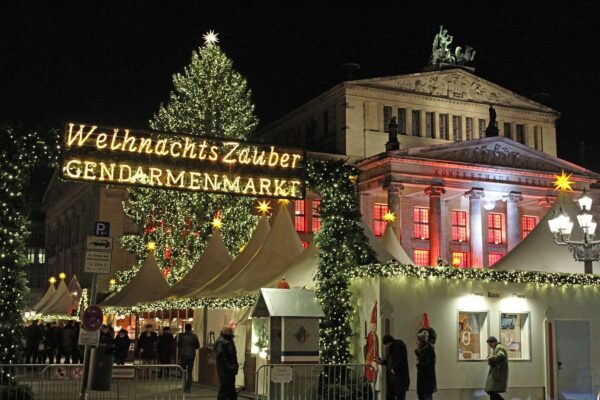
Berlin Christmas Market
Berlin
From 23 November to 31 December 2026
Worth the weekend
 Opens in 49 days
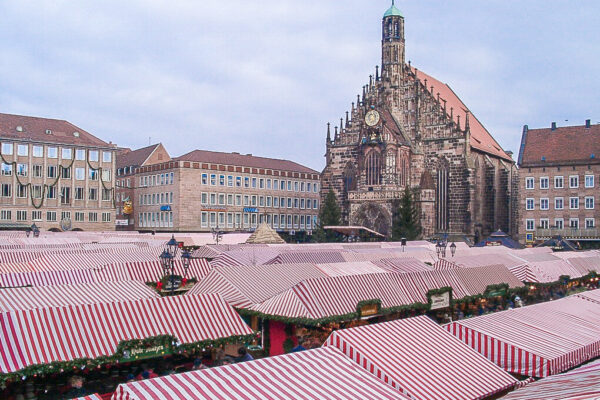
Nuremberg Christmas Market
Nuremberg
From 27 November to 24 December 2026
Worth the trip
 Dates to be confirmed
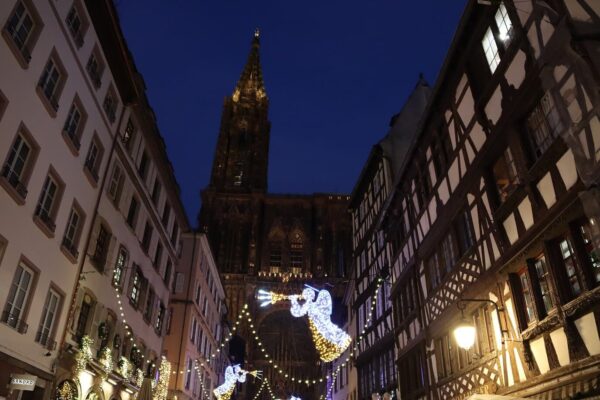
Strasbourg Christmas Market
Strasbourg
Worth the trip
Activities nearby
Parks and sites running a Christmas programme less than an hour's drive away. They aren't Christmas markets, and admission is charged.
 Opens in 50 days
Park
Opens in 50 days
Park
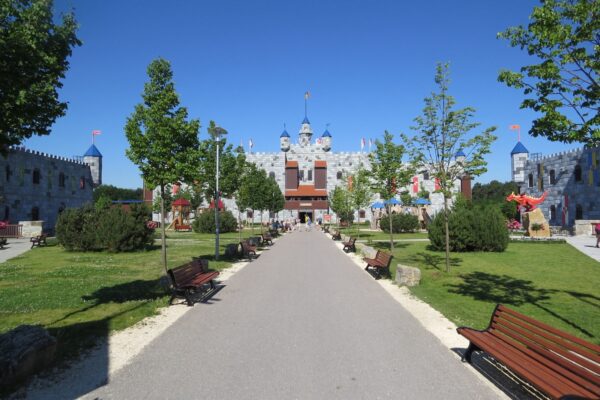
LEGOLAND Deutschland at Christmas
Günzburg
From 28 November to 10 January 2027
Day out · Park
 Opens in 49 days
Park
Opens in 49 days
Park
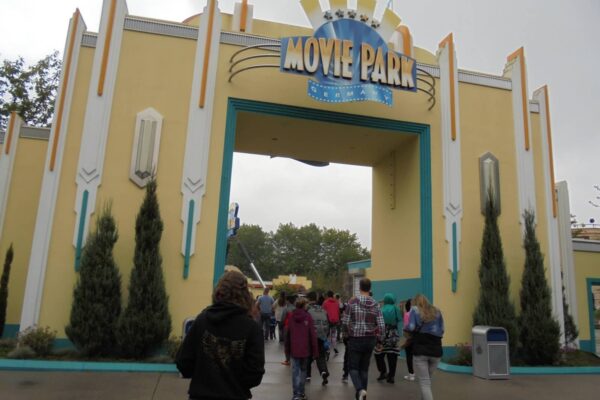
Movie Park Germany at Christmas: Hollywood Christmas
Bottrop
From 27 November to 5 January 2027
Day out · Park
 Opens in 36 days
Park
Opens in 36 days
Park
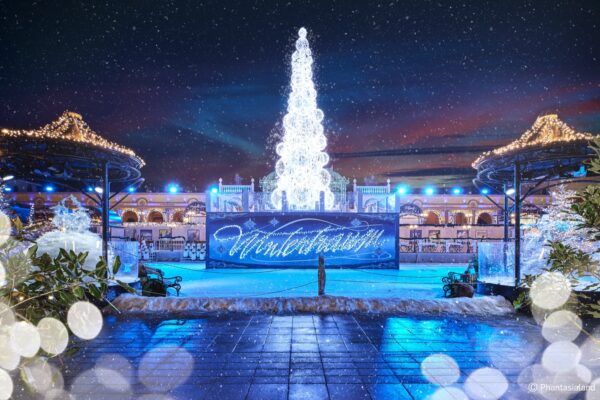
Phantasialand at Christmas: Wintertraum
Brühl
From 14 November to 24 January 2027
Worth the trip · Park